
Key Highlights
- Peter Schiff claims Strategy is selling Bitcoin to build dollar reserves because don’t have confidence in Bitcoin as collateral.
- Schiff argues the shift undermines Strategy’s earlier Bitcoin-backed financing strategy and questions the value of MSTR’s common stock.
- Strategy previously sold 3,588 BTC for $216 million to fund dividends and other financial obligations.
Gold advocate and longtime Bitcoin critic Peter Schiff said Strategy Inc., the world’s largest corporate Bitcoin treasury company, appears to have moved away from the concept of digital credit.
In a post on X on Monday, Schiff said Strategy is consistently selling Bitcoin to acquire dollars. He attributed this to lenders lacking confidence in Bitcoin as collateral and preferring traditional fiat currency as superior protection. Schiff concluded the post by advising readers to sell MSTR and Bitcoin.
The comments reference Strategy’s recent activity of converting Bitcoin holdings into dollar reserves. Schiff framed the pattern as evidence that market participants view fiat money as more reliable collateral than Bitcoin.
Reason behind Schiff’s comment
Schiff’s comments came hours after Strategy disclosed that it has continued selling Bitcoin while raising cash through equity issuance. Its latest Form 8-K covering August 3–9, 2026, shows the company sold 1,690 Bitcoin for $108.6 million at an average price of $64,262 per coin. The proceeds were used to repurchase shares of its Variable Rate Series A Perpetual Stretch Preferred Stock (STRC).
Year-to-date sales now total 6,948 Bitcoin. Earlier disposals included 32 BTC in late May, 3,588 BTC in late June and early July, and 1,638 BTC between July 27 and August 2.
According to BitcoinTreasuries data, as of August 10, 2026, Strategy held 840,447 Bitcoin with an aggregate purchase price of $63.36 billion, or an average cost basis of $75,385 per coin.
Prior comments on Strategy financing and ownership
This latest statement follows earlier criticisms from Schiff regarding Strategy’s capital structure and investor base.
On July 24, Schiff responded to Strategy CEO Phong Le’s update on the company’s STRC preferred stock. Schiff argued that the decline in retail ownership likely reflected investors selling at a loss rather than a transition toward institutional ownership. He rejected the interpretation that rising institutional participation indicated growing confidence in Strategy or Bitcoin. Instead, Schiff suggested institutions could be drawn by the high dividend yield on STRC or by using the security in hedged trading strategies.
On July 16, Schiff questioned the rationale for owning MSTR common stock. He stated that Strategy’s continued issuance of new shares was reducing the amount of Bitcoin backing each common share.
At the time, Schiff described the company as having become a funding source for creditors and preferred shareholders, arguing that the common stock no longer delivered the leveraged Bitcoin exposure many investors had expected.
Earlier remarks on Bitcoin sales
Schiff’s July 6 comments addressed Strategy’s sale of 3,588 Bitcoin. He said the transaction marked a shift from the prior approach of selling stock and issuing debt to purchase Bitcoin. According to Schiff, the updated model involved selling Bitcoin to pay interest, fund dividends, repay debt, and support share buybacks.
The remarks followed Strategy’s disclosure that the 3,588 BTC had been sold for $216 million to fund dividends on its Digital Credit securities. At that time, Strategy reported holding 843,795 BTC and $2.55 billion in dollar reserves as of July 5.
MSTR price movement
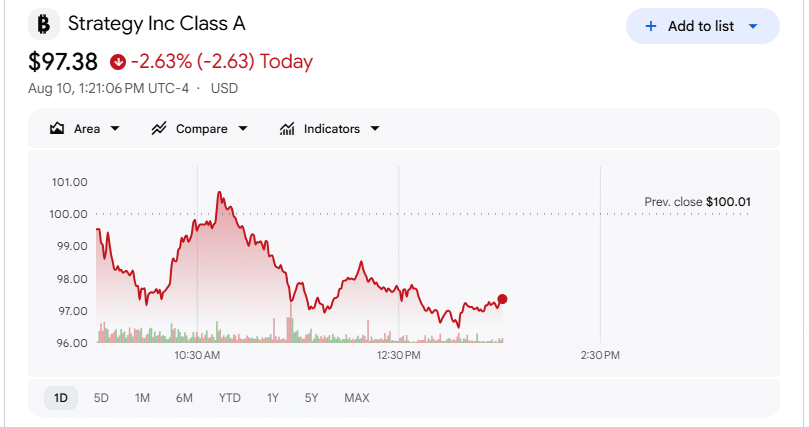
At the time of this writing, Strategy Inc. Class A stock (MSTR) traded at $97.38, down 2.63 percent, or $2.63, from the previous close of $100.01, according to data from Google Finance (as of 17:21 UTC). Intraday trading showed the stock opening near $99.50, rising briefly above $100.50, then declining through the morning session.
By early afternoon, the price had moved lower into the $96.50–$97.50 range, with the session low near $96.40 before a modest recovery. Volume patterns reflected selling pressure during the decline phase of the session.
The chart showed a series of lower highs after the early peak, consistent with the overall downward movement during the session.
Also Read: Grayscale Pulls ADA, DOT, and HBAR ETF Registrations From SEC