Key Highlights
- Jito generated $1.28 million in protocol revenue in Q2, down 45% from Q1.
- Transaction-ordering tips fell about 50% to $9.9 million, despite transaction volume remaining largely unchanged.
- BAM grew to 378 validators and reached 33% of Solana’s total network stake.
Solana-based infrastructure protocol Jito expanded its network footprint in the second quarter even as revenue from transaction-ordering activity declined.
According to the Q2 2026 Jito tokenholder report published by Blockworks Advisory on Monday, Jito generated approximately $1.28 million in protocol revenue, down 45% from Q1. Revenue has now declined for five consecutive quarters, falling from approximately $26.1 million in Q1 2025.
At the same time, Jito’s Block Assembly Marketplace (BAM) increased its share of Solana’s network stake, while the launch of its JTX trading platform introduced a potential new source of revenue for the protocol and JTO token.
Jito revenue falls as transaction-ordering activity weakens
The main pressure on Jito’s Q2 revenue came from lower transaction-ordering value (TOV), previously more commonly referred to as maximal extractable value (MEV).
Jito processed approximately $9.9 million in tips during Q2, down around 50% from $19.85 million in Q1. Transaction volume, however, remained largely stable. Jito processed approximately 1.045 billion transactions, up just 0.13% from the previous quarter.
The decline therefore came primarily from lower value generated through transaction ordering rather than a significant reduction in transaction activity.
Staking-related fees became a larger part of Jito’s revenue mix. Epoch and withdrawal fees generated approximately $733,000, or 57% of total revenue, while TOV-related fees contributed roughly $539,000, or 42%. The epoch fee, which is charged on JitoSOL staking rewards, accounted for approximately 36.5% of Q2 revenue.
BAM reaches 33% of Solana’s network stake
While revenue declined, Jito continued to expand its infrastructure footprint.
BAM grew from 340 validators at the end of Q1 to 378 at the end of Q2 and crossed more than half of Solana’s validators by count during the quarter. Its stake-weighted share increased from 27.7% to 33% of Solana’s network stake. SOL delegated to BAM validators was worth approximately $10.6 billion at the end of June.
The broader Jito client family, consisting of Jito-BAM and Jito-Labs, accounted for approximately 54% of Solana’s active stake. However, competing validator clients continued to gain share. Harmonic accounted for roughly 21% of active stake, followed by Rakurai at 9% and Frankendancer at 8%.
Jito also introduced FireBAM, a Frankendancer-compatible BAM client, expanding the number of validators that can participate in the BAM network.
JitoSOL supply falls 20%
JitoSOL also recorded a decline during the quarter. Its supply fell from approximately 12.35 million SOL at the end of Q1 to 9.86 million SOL at the end of Q2, representing a decline of roughly 20%. JitoSOL remained the largest standalone liquid-staking token on Solana, with approximately 9.85 million SOL in TVL at quarter-end.
However, its share of Solana’s liquid-staking market declined from 20.3% to 17.3% as competition increased. JitoSOL recorded a median implied APY of approximately 5.7% during Q2.
JTX opens a potential revenue channel for JTO
Jito’s main new product initiative during Q2 was JTX, a self-custody trading platform that expands Jito beyond validator infrastructure, block construction, and liquid staking.
Jito announced JTX on May 5, while its phased early-access rollout began on July 14, after the quarter ended. Spot trading is the initial offering, with perpetual futures and prediction markets planned for later stages.
Jito has committed to directing 80% of JTX revenue to JTO. Under JIP-38, approved in July, the DAO’s share of JTX revenue will be used for programmatic JTO buybacks and burns for at least one year following the platform’s launch.
The mechanism provides a more direct link between JTX activity and JTO than Jito’s existing treasury-based fee structure. However, JTX did not contribute to Q2 revenue, and its financial impact will depend on user activity and trading volume following its rollout.
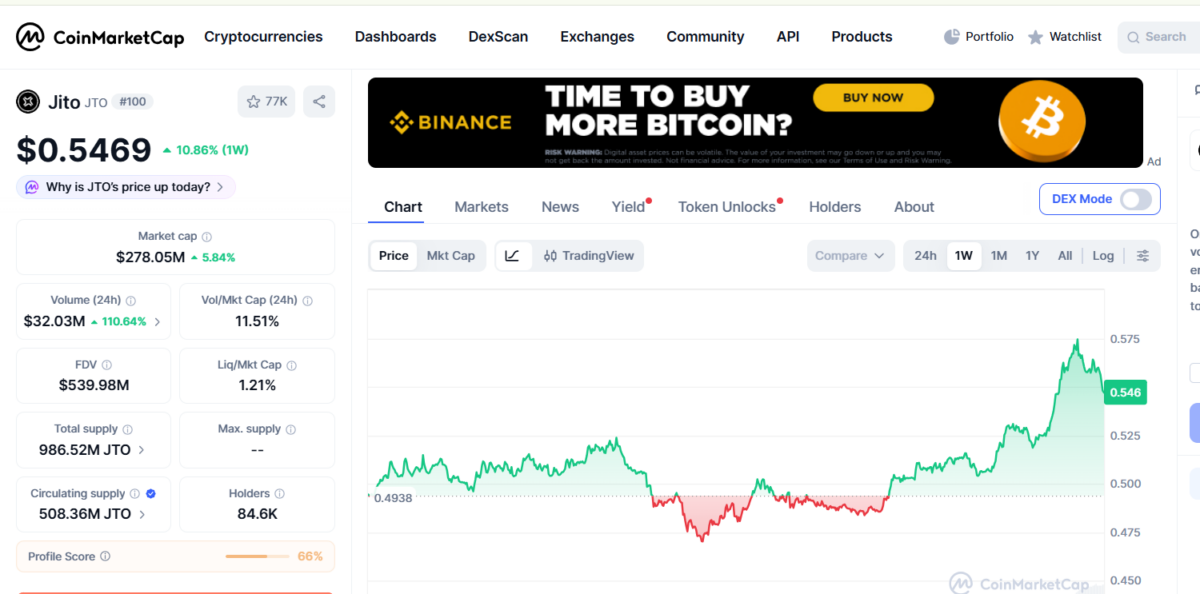
JTO trades around $0.55
At the time of this writing, JTO was trading at approximately $0.55, with a market capitalization of around $278 million and 24-hour trading volume of more than $30 million, according to CoinMarketCap data (as of 16:59 UTC). The token had approximately 508.4 million JTO in circulation.
JTO’s spot DEX trading volume increased from approximately $30.1 million in Q1 to $75.3 million in Q2, representing a 150% quarter-over-quarter increase.
The rise in trading activity, however, does not directly represent protocol revenue or distributions to JTO holders.
JTX introduces a separate potential source of token-related value through its planned revenue allocation and buyback mechanism, although the effect will depend on the platform’s eventual usage and revenue generation.
Jito treasury rises on higher JTO value
Jito’s DAO treasury increased to approximately $164.7 million at the end of Q2, compared with $68.2 million at the end of Q1. Most of the increase came from the higher market value of the DAO’s JTO holdings rather than equivalent new cash inflows.
JTO holdings were worth approximately $154.6 million at quarter-end, compared with $57.3 million at the end of Q1. The DAO also recorded negative operating cash flow of approximately $566,000 during Q2. Around $1.2 million was spent on BAM subsidies and approximately $680,000 on liquidity incentives.
Under JIP-31, protocol revenue was directed toward BAM validator incentives during Q2 rather than an active JTO buyback program. JIP-37 subsequently proposed maintaining the full BAM subsidy through September while using Cryptoeconomics SubDAO reserves for JTO buybacks matching protocol revenue during Q3. The proposal was not part of Q2 results.
Jito enters second half with mixed results
Jito ended Q2 with a larger infrastructure footprint but continued pressure on its existing revenue base. Protocol revenue fell to $1.28 million, while transaction-ordering tips declined by about 50%. JitoSOL supply and market share also fell during the quarter.
At the same time, BAM expanded to 33% of Solana’s network stake, and the broader Jito client family remained the largest validator-client group by stake. JTX now gives Jito a new potential revenue source, with 80% of platform revenue committed to JTO and a buyback-and-burn mechanism approved through JIP-38.
Also Read: Standard Chartered Sees LINK at $200 by 2030 on Tokenization