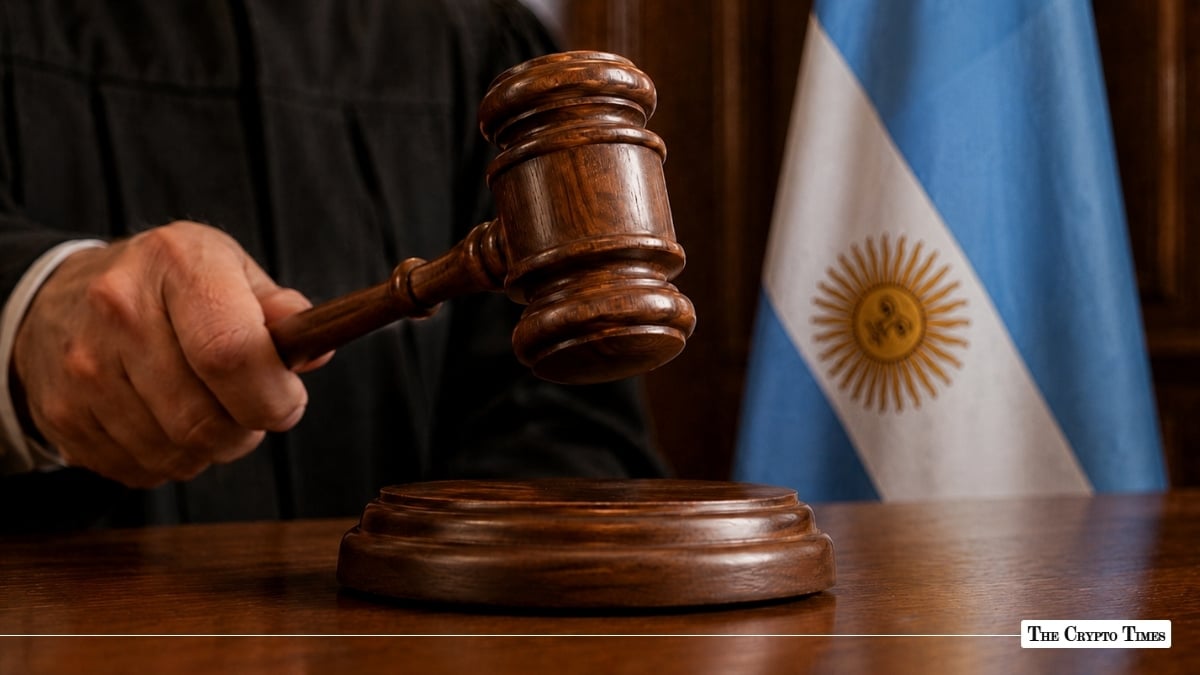
An Argentine federal judge has ordered the identification and freezing of 25 cryptocurrency wallets tied to the $LIBRA case, demanding that six international exchanges reveal who controls them.
The Order
Judge Marcelo Martínez de Giorgi ordered the measure as part of the investigation into $LIBRA, the memecoin that collapsed in early 2025 minutes after Argentine President Javier Milei promoted it. According to a court document obtained by Clarín, the wallets had been moving digital dollars in recent months; funds that investigators say were left to the token’s creators after the failed launch.
The ruling is the first significant asset measure taken within the Argentine $LIBRA docket. It directs that funds held in the wallets be frozen and that a group of exchanges hand over the identities of the account holders.
It stems from a request by federal prosecutor Eduardo Taiano, based on a report by the Cybercrime Technical Department of the Argentine Federal Police, which traced the movement of crypto assets across networks beginning in May 2026.
Six Exchanges, 25 Wallets
The order targets accounts across six platforms: Binance, Bybit, OKX, Bitfinex, and, according to earlier reporting, CoinEx and FixedFloat. The police reconstruction found at least ten of the flagged transactions passed through Binance, with eight wallets on Bybit, two on OKX and two on Bitfinex.
That concentration on centralized exchanges is the point. Such platforms require customers to complete identity verification, Know Your Customer, or KYC, to open an account, which means the exchanges hold the documents capable of revealing who is behind the wallets.
The judge accordingly demanded that each exchange provide account-holder identities, complete KYC files, associated IP addresses, linked bank accounts and full transaction histories — anything that “allows the identification of those responsible for the observed operations.” Investigators cautioned that some of the 25 wallets may prove untraceable, as they sit on platforms that do not require KYC verification.
The Money Trail
The Federal Police report reconstructed how funds moved from eight wallets identified as the “Libra Team,” associated with the token’s development and the withdrawal of investor funds on the night of the launch. Four of those eight funneled money into a single wallet identified as “61yk.”
That wallet carries its own history: it had already been frozen for nearly six months at the request of a Southern District of New York court, as part of the US investigation into $LIBRA creator Hayden Davis.
From there, according to the judge’s reconstruction, “61yk” moved the money through what the ruling calls a “digital smurfing” strategy — splitting amounts across different wallets to liquidate them into fiat or make them harder to trace. On May 10, a large outflow used a cross-chain protocol to transfer 498,539 USDT to a wallet on the Tron network, which then divided the funds into 17 separate transactions to obscure their movement.
Crypto analyst Fernando Molina, among the first to publicly track the $LIBRA money trail, had reconstructed that roughly $8.2 million sat stagnant before beginning to move in May 2026 through the wallets now in the court’s sights. Davis has said the operation left him approximately $110 million.
Milei’s Role and the Limits of the Case
Milei promoted $LIBRA in a post on X on February 14, 2025, which he later deleted. The token’s price spiked on the exposure and then collapsed within minutes, leaving numerous investors with heavy losses. Argentina’s Anti-Corruption Office subsequently cleared Milei, finding his promotion was personal rather than official misconduct; he has not been charged.
The wallet identifications now sought do not, on their own, establish who controls the accounts — that is precisely what the KYC data is meant to reveal. Davis and two alleged operators, Orlando Mellino and Favio Camilo Rodríguez Blanco, remain under a separate asset freeze; all are accused, not convicted, and Davis’s lawyer has said she will present evidence to identify the “true responsible parties.”
The freeze order also landed at a fraught moment for the case. Almost simultaneously, Martínez de Giorgi moved to exclude the plaintiff victims from the proceedings, a decision that drew heavy criticism. The investors’ lawyers have appealed, and the Federal Court of Appeals will now rule on the matter.
An Order Is Not a Seizure
For all its detail, the ruling has not yet moved any money. Analyst Molina noted that no funds have actually been frozen, and it remains unclear whether the wallets still hold balances or whether the money has continued to move.
That gap is the structural tension at the center of crypto enforcement. Argentine investigators can trace the USDT, map the wallets and file the orders, but freezing funds requires the cooperation of private companies operating across multiple jurisdictions. Until Binance, Bybit, OKX, Bitfinex, and the others act, the money remains in limbo.
The order is the most concrete judicial step yet in a case that has drawn both Argentine and US law enforcement attention since the token’s collapse. Whether it recovers anything for investors depends on what the exchanges hold, how quickly they respond, and whether the funds are still there to freeze.