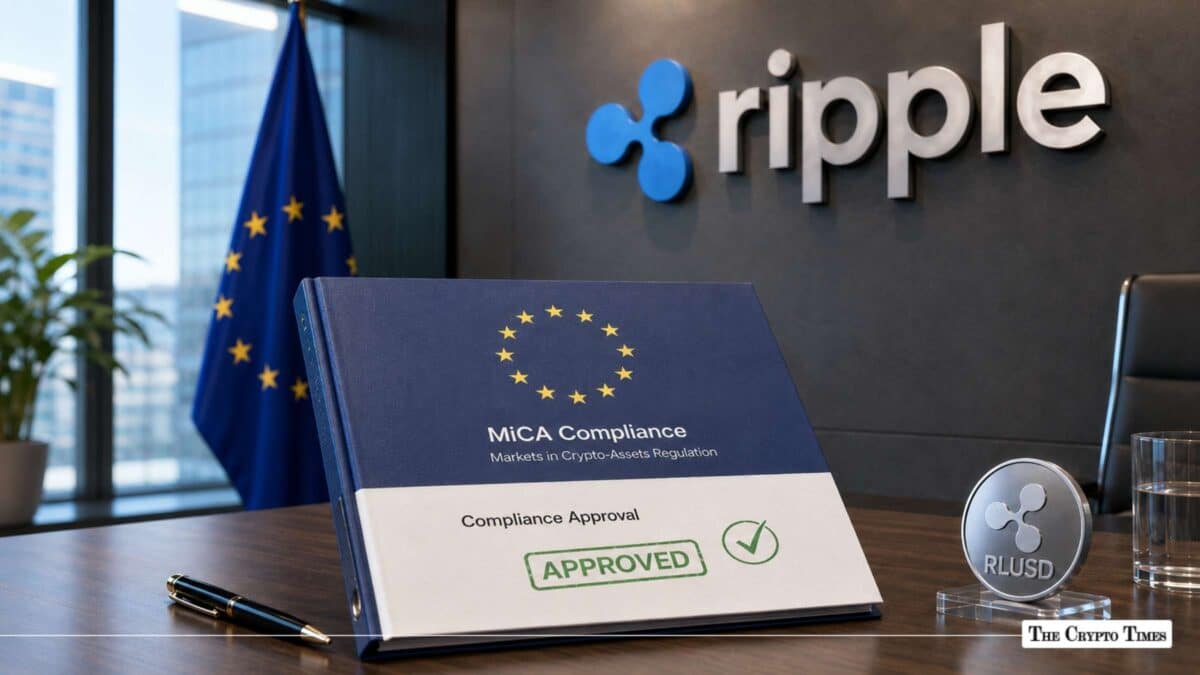
Ripple has received preliminary approval for its Crypto Asset Service Provider (CASP) license from Luxembourg’s CSSF under the EU’s MiCA regulation, the company said Tuesday, a significant step for its enterprise payments ambitions in Europe, and one in which XRP is barely mentioned.
A win routed through RLUSD and payments, not the token
The announcement centers on Ripple Payments and RLUSD, Ripple’s dollar-backed stablecoin, not on XRP. Ripple framed the approval as enabling banks, fintechs, and corporates to access its full crypto-asset and stablecoin payments infrastructure—collect, exchange, and pay out—across all 30 European Economic Area countries. In the company’s own description, XRP appears only as part of what “underpins” those solutions, alongside RLUSD.
That distinction matters for token holders, and it is a familiar one. Ripple’s enterprise momentum increasingly flows through RLUSD and its infrastructure stack rather than XRP itself, a gap that boiled over last week when parts of the XRP community publicly turned on Ripple’s Swell 2026 agenda for prioritizing the stablecoin while the token underperformed.
A regulated EU lane for RLUSD distribution and cross-border payments fits that pattern: clear corporate upside, no direct mechanism creating XRP demand.
“Preliminary” is doing real work in the headline
The approval is not the finished license. It arrived as a “Green Light Letter” from the CSSF and remains subject to final conditions, meaning Ripple’s ability to offer regulated services at scale depends on clearing those remaining steps. The company said only that upon full approval, the CASP license, combined with its existing EU Electronic Money Institution (EMI) license, also from Luxembourg, would make it fully MiCA-compliant.
In other words, full MiCA compliance is a future state contingent on final sign-off, not a status conferred today. It is a distinction worth holding onto as the news circulates, since the preliminary nature of the approval is easy to lose in summary.
Late to MiCA, betting on the full-stack combo
Ripple also arrives at this milestone behind several peers. MiCA became fully applicable to crypto-asset service providers in December 2024, and rivals have spent the months since collecting authorizations: Circle secured MiCA approval to expand services in April, B2C2 obtained a CASP license through the same Luxembourg CSSF in May, and exchanges including OKX, Coinbase, and Kraken were cleared across 2025.
Ripple’s pitch is less about being first than about being comprehensive. By pairing the CASP license with its EMI license, Ripple says European institutions can run collection, exchange, and payout through a single integration for the first time, a one-stop regulated rail rather than a single service.
With Ripple Payments having processed more than $100 billion in volume across 60-plus markets, and the company holding over 75 licenses globally, the combined-stack argument is the differentiator it is leaning on against peers that arrived earlier.
The RLUSD question the release leaves open
There is also a nuance the announcement does not resolve. A CASP license authorizes the provision of crypto-asset services — custody, exchange, transfer, and the like — but it is distinct from the separate authorization a stablecoin needs to be issued as a MiCA e-money token.
The release touts a “stablecoins payments infrastructure” without detailing RLUSD’s own status under MiCA’s strict regime for non-euro tokens, which caps the scale at which dollar-pegged stablecoins can be used as a means of exchange in the bloc.
That regime has already reshaped the European stablecoin map: Tether’s USDT was effectively pushed out ahead of MiCA, while Circle brought USDC and EURC into compliance through its EMI. Where RLUSD sits on that spectrum, distributed through a licensed Ripple entity versus authorized as a compliant e-money token in its own right, is the detail institutions will scrutinize, and one this announcement does not spell out.
What to watch next
For now, the green light is a directional signal with conditions attached. The concrete tests ahead are whether Ripple clears the CSSF’s final requirements to convert the preliminary approval into a full license, how quickly the combined EMI-CASP stack translates into named institutional integrations, and whether RLUSD’s MiCA standing is clarified as the rollout proceeds.
For XRP holders watching the company rack up regulatory wins, the more pointed question remains the one Swell surfaced: when, if ever, the corporate momentum starts routing through the token. Meanwhile, at the time of writing, XRP was trading at around $1.10, down 3.05% over the last 24 hours.