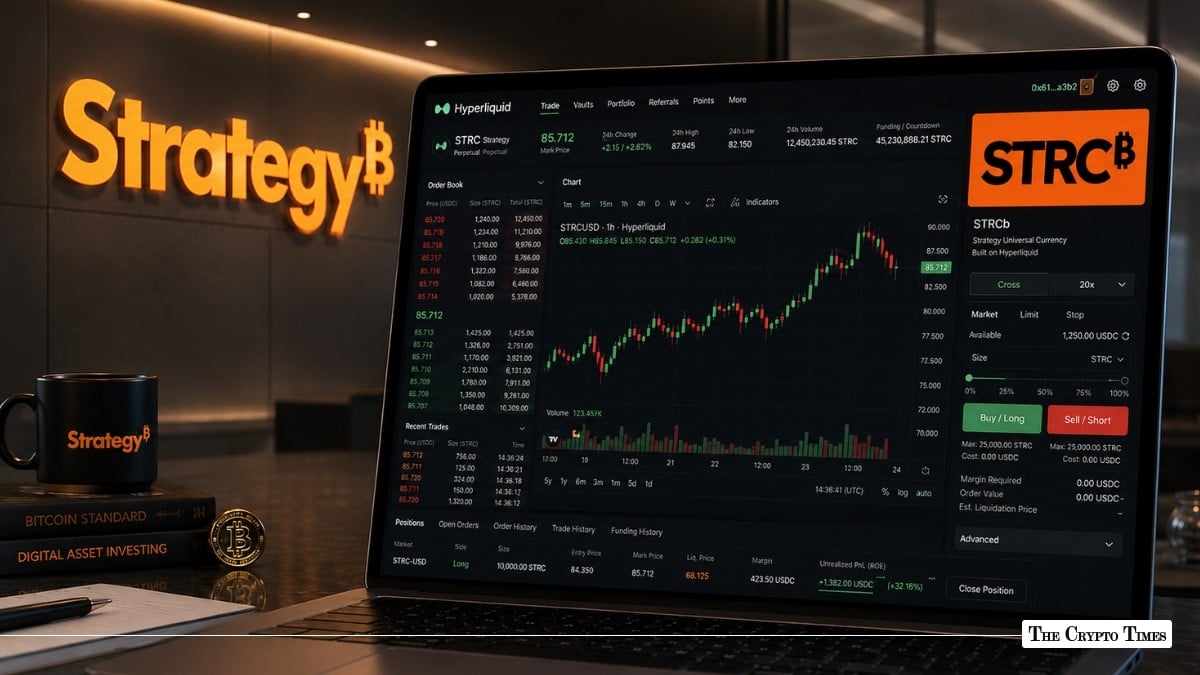
On June 23, 2026, the decentralized perpetuals exchange Hyperliquid enabled the perpetual futures for Strategy Inc.’s STRC preferred stock, offering traders up to 10x leverage in a fully on-chain, 24/7 environment. The market was deployed by tradexyz (trade.xyz), a leading HIP-3 builder on the Hyperliquid platform.
This development comes at a pivotal moment for STRC, Strategy’s Variable Rate Series A Perpetual Stretch Preferred Stock, often called “Stretch,” which has been the subject of intense market scrutiny and debate over the past several weeks.
The launch enables leveraged speculation and hedging on one of the most closely watched “digital credit” instruments tied to Bitcoin treasury strategies, without the constraints of traditional equity market hours or brokerage requirements.
The timing underscores the rapid convergence of traditional finance instruments and decentralized infrastructure. Hyperliquid, operating on its own high-performance Layer 1 blockchain, has positioned itself as a go-to venue for tokenized and real-world asset (RWA) perpetuals, allowing continuous price discovery and leveraged exposure to equities, indices, commodities, and now prominent preferred stock products like STRC.
STRC: Talk of the Town Amid Volatility & Strategic Shifts
STRC was launched by Strategy (the company formerly known as MicroStrategy and led by Executive Chairman Michael Saylor) in July 2025 as a perpetual preferred stock offering with a $100 par value. It was engineered as a “digital credit” instrument designed to trade near par through a variable dividend rate, currently around 11.5% and adjustable monthly.
The product was positioned as a way for investors to gain yield exposure linked to Strategy’s massive Bitcoin holdings while providing the company with flexible capital to fund further Bitcoin (BTC) acquisitions when the stock traded above par.
In its early months, STRC gained significant traction, growing into what Saylor described as one of the world’s largest and most liquid preferred stock offerings. It formed a key part of Strategy’s capital structure evolution, shifting emphasis toward preferred equity to support Bitcoin accumulation.
However, in the weeks leading up to the Hyperliquid launch, STRC became a focal point of market discussion and concern. The instrument experienced a notable depeg from its $100 target. On June 18, 2026, it hit an intraday low of approximately $82.50 before closing at $88.59 on elevated trading volume, reportedly one of its highest-volume sessions on record, with around 10.7 million shares traded compared to a typical 3.4 million.
Contributing factors included broader Bitcoin price weakness (with BTC trading near $63,000 amid the selloff), shifts in Strategy’s capital management (including bond repurchases that temporarily reduced cash reserves), and rotation by some yield-seeking investors toward competing products offering higher or more frequent payouts.
The company had also executed its first Bitcoin sale in years, 32 BTC for about $2.5 million, to help cover a dividend payment, drawing attention to the mechanics of sustaining distributions.
Strategy responded by highlighting substantial Bitcoin reserves (reportedly sufficient for decades of dividend coverage in some statements, such as 32 years in one update) and rebuilding cash holdings to over $1 billion.
The episode sparked broader debate within crypto and finance communities about the resilience of engineered yield products, leverage dynamics in “digital credit” markets, and the sustainability of Strategy’s Bitcoin flywheel strategy during periods of price pressure.
Read: Will Strategy Sell More Bitcoin to Plug the STRC Dividend Gap?
While some viewed the depeg as a temporary liquidity-driven event rather than a fundamental credit issue, others highlighted risks of dilution or stalled capital raising when trading below par. The ATM (at-the-market) issuance program for new STRC shares was effectively paused, as issuing below par would undermine the economics of funding additional Bitcoin purchases.
Despite the volatility, STRC’s prominence has only grown, making the introduction of dedicated perpetual futures particularly relevant for traders seeking leveraged exposure or hedging tools around its price movements.
STRC’s Deepening Roots in DeFi
This Hyperliquid perpetuals listing marks another milestone for STRC but is far from its first foray into the decentralized finance (DeFi) ecosystem.
Since early 2026, Strategy’s Bitcoin-backed preferred stock has rapidly become a cornerstone asset in the DeFi, with protocols layering sophisticated yield, leverage, and tokenization mechanics on top of its ~11.5% variable dividends.
Protocols such as Apyx (wrapping STRC into apxUSD synthetic stables with over $481 million exposure), Saturn Credit (packaging dividends into USDat and sUSDat products with ~$188 million in STRC collateral), and xStocks (tokenizing ~$172 million) have brought hundreds of millions in STRC on-chain.
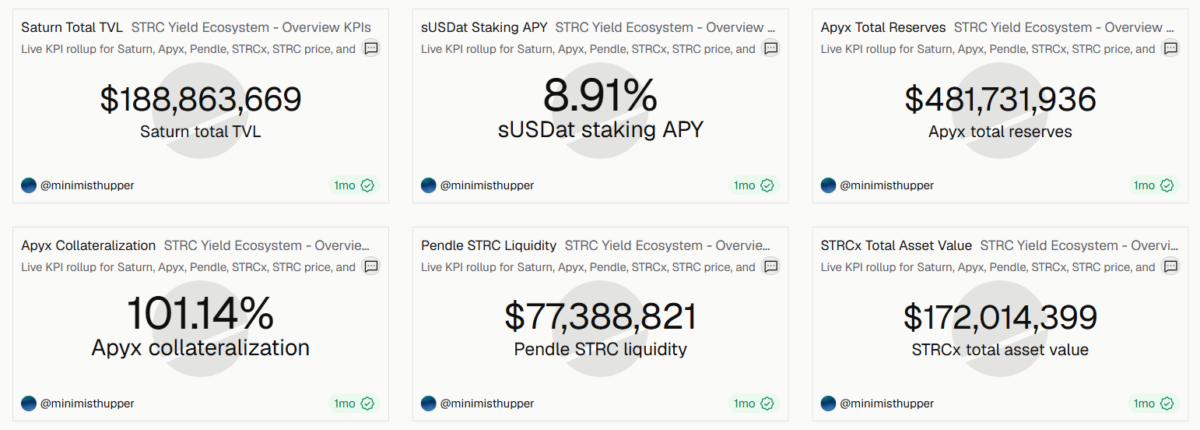
Pendle Finance enables traders to split and trade the principal versus the floating yield components, creating fixed-rate and leveraged yield markets, while Morpho powers looping strategies that amplify effective yields through leveraged borrowing.
Cumulative on-chain STRC exposure has exceeded $270 million in recent months, transforming the Nasdaq-listed instrument into programmable collateral for yield-bearing stables, lending pools, and structured products.
These integrations have allowed DeFi users to earn STRC dividends by depositing stablecoins, loop exposure for higher returns, and trade future yield streams, often manufacturing effective APYs well above the base 11.5% through leverage.
Hyperliquid’s Ascent as a Leading Venue for Tokenized Stocks and RWA Perpetuals
Hyperliquid has rapidly evolved beyond its origins as a crypto-focused perpetual exchange into a major platform for tokenized and real-world asset trading. Its permissionless HIP-3 framework allows independent builders, such as tradexyz, to stake HYPE tokens and deploy custom perpetual markets against oracle price feeds for virtually any asset class.
This architecture has fueled explosive growth in non-crypto perpetuals. Markets for equities (including major names and pre-IPO names like SpaceX), indices (such as a licensed S&P 500 contract), commodities (oil, gold, and others), and now instruments like STRC have become significant volume contributors.
Reports indicate that RWA-related perps have accounted for a substantial and growing share of overall platform activity, in some analyses approaching or exceeding 40-50% in recent periods.
Key advantages driving adoption include true 24/7 trading with no traditional market closures, deep on-chain liquidity and order books, cash settlement in USDC, and flexible leverage (up to 10x or more depending on the market and risk parameters). These features appeal to both retail traders and institutional participants looking for continuous price discovery, particularly useful for assets like pre-IPO valuations, commodities influenced by global events outside U.S. hours, or instruments tied to crypto treasury strategies.
HIP-3 deployer trade[.]xyz has been one of the most active builders in this space, previously launching high-profile markets such as the S&P 500 perpetual and SpaceX pre-IPO perps, which saw rapid uptake and notable price action upon debut. Now, the addition of STRC further expands the catalog of accessible leveraged products tied to prominent Bitcoin-related equities and credit instruments.
The platform’s overall momentum is evident in rising interest from Wall Street observers, ETF filings, and launches around its native HYPE token, and its role as an always-on venue that can capture trading flow when traditional markets are closed.
As tokenized and synthetic representations of traditional assets proliferate, Hyperliquid’s infrastructure, combined with builders like tradexyz, positions it as a bridge between decentralized finance efficiency and conventional asset exposure.
Also read: CFTC Weighs Crypto-Style Perpetuals and 24/7 Trading for Oil