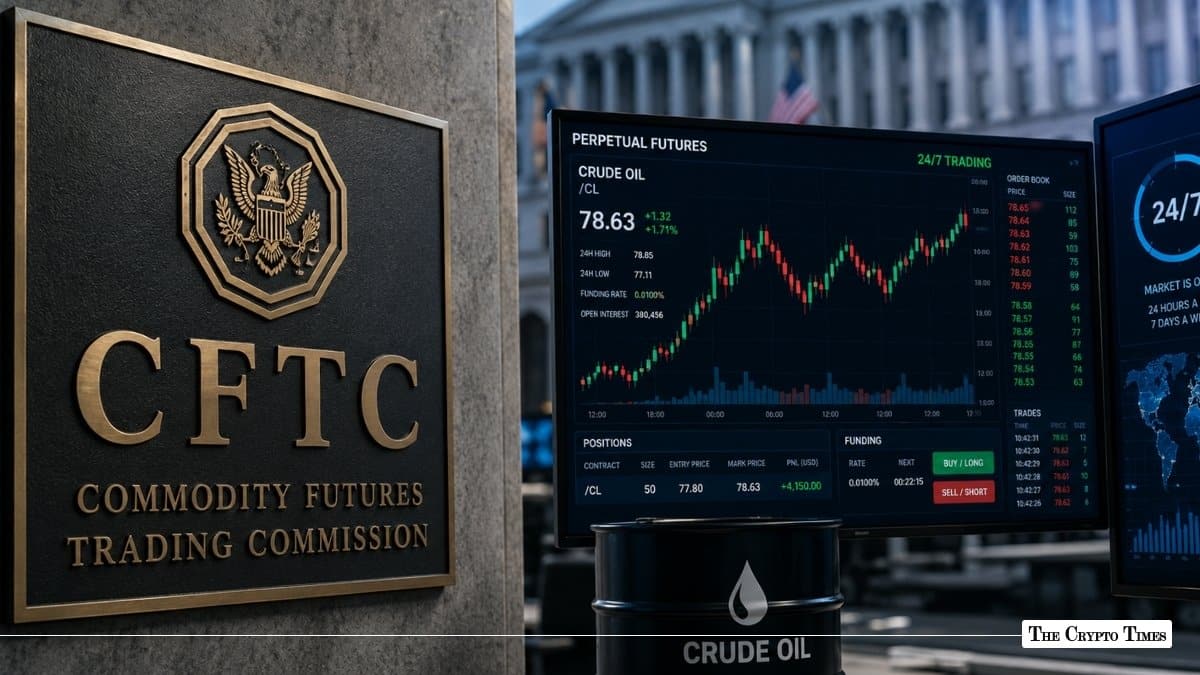
The Commodity Futures Trading Commission (CFTC) has asked for public input on bringing perpetual contracts and 24/7 trading to physical energy markets, the clearest sign yet that a market structure pioneered in crypto is moving into traditional commodities.
From crypto perps to crude oil
In a request for comment issued June 22, the CFTC posed two sets of questions. The first concerns extending standard futures contracts, including energy futures, to a 24/7 trading schedule while leaving their fixed expiration intact. The second concerns the potential listing of perpetual contracts that reference physically delivered or storable energy commodities, such as crude oil.
Both features are hallmarks of crypto trading. Perpetual contracts, or “perps,” are derivatives with no expiration date kept aligned to spot through a periodic funding rate payment, and they have long dominated offshore crypto venues. Around-the-clock trading is similarly native to crypto, where markets never close. The CFTC is now asking whether that model belongs in the markets that price the world’s oil.
Chairman Michael S. Selig framed the request as fact-finding rather than a decision. He said a clear, data-driven record would help the Commission understand the implications of longer trading hours and new contract designs, while preserving protections against manipulation and market disruption. Comments are due within 30 days of the request’s publication in the Federal Register.
The next step in a year-long onshoring push
The request does not arrive in isolation. It is the latest move in the most aggressive crypto-derivatives onshoring campaign in the agency’s history, run largely by Selig, who is currently the CFTC’s sole active commissioner.
On a single day in late May, the Commission approved Kalshi’s bitcoin perpetual contract, the first true perp on a U.S.-regulated exchange, cleared a path for Coinbase to route U.S. customers to offshore perpetuals as foreign futures, and issued a staff advisory on 24/7 trading, clearing, and settlement. It also published a policy statement establishing case-by-case review for perpetuals beyond bitcoin, one that explicitly flagged energy and other physical commodities as asset classes requiring formal scrutiny. This week’s request operationalizes that flag.
The commercial pull is already visible. Kraken went live with CFTC-regulated perps in mid-June through its Bitnomial subsidiary; Coinbase has a U.S. perpetual-style product slated for July; and ICE and OKX launched Brent and WTI oil perpetuals in May for OKX’s non-U.S. users, a product that, until now, had no clear path into the regulated U.S. market. Selig has repeatedly argued that the absence of a domestic framework pushed more than $60 trillion in annual perpetual volume offshore, beyond the reach of U.S. oversight.
A frontier under legal fire
The expansion is contested, and the dispute is already in court. CME Group has moved to sue the CFTC over the Kalshi approval, with CEO Terry Duffy arguing perpetual contracts are swaps under the Dodd-Frank Act rather than futures and calling them a “disaster waiting to happen.”
The classification matters: swaps and futures carry sharply different margin and compliance requirements, and a ruling against the CFTC could unwind the framework these energy products would rely on. The CFTC has called the suit frivolous, and critics note CME’s own perpetual volume was under $6 million the day it filed, less than 1% of Kalshi’s.
The risk concerns are not only competitive. Consumer advocates warn that perpetuals, with their leverage and liquidation mechanics, can be hazardous for retail traders in always-on markets that never let positions cool. Those dangers are not hypothetical: a perpetual contract tracking SpaceX’s valuation on Hyperliquid flash-crashed earlier this year, wiping out roughly $1.5 million in notional value within 30 minutes when one outsized position met thin liquidity. The CFTC’s own May policy statement struck a cautionary note too, observing that perpetuals may be “particularly ill-suited” for some physical commodities—a tension the agency will have to resolve as it considers oil.
How perpetuals would work in energy
The mechanics are what make energy perps genuinely novel. A traditional oil future relies on a fixed expiration to converge with the physical spot price, at which point delivery or cash settlement occurs. A perpetual has no such date; instead, the funding rate does the work, when the contract trades above spot, longs pay shorts, and when it trades below, the reverse, nudging arbitrageurs to close the gap continuously.
Applying that to a physically delivered or storable commodity raises questions a crypto perp never had to answer: how a no-expiry contract interacts with storage costs, delivery logistics, and the seasonal dynamics of oil. That is precisely the terrain the CFTC is asking the market to map and why it has paired the perpetuals question with the separate one on extending conventional, expiring futures to a 24/7 clock.
A 30-day window, and an unsettled fight
For now, the request is exploratory — a solicitation of views, not a rule or an approval. It signals direction without committing the Commission to a destination, and any energy perpetual would still face formal review under the agency’s product-approval process. The comment period runs 30 days from Federal Register publication, after which the CFTC says it will use the input to inform its understanding.
What hangs over the entire exercise is the CME litigation. If a court accepts the swaps argument, the legal foundation beneath crypto perps — and any energy perpetual built on the same logic — would be thrown into doubt. The CFTC is asking how far crypto’s trading model should reach into the oil market; the answer may ultimately be decided not at the comment desk, but in a courtroom.