Key Highlights
- Stocks are outperforming by about 9% because of strong AI-related spending and tech demand.
- Bitcoin and gold are lagging, with Bitcoin slightly down and gold down sharply due to expectations of higher US interest rates.
- Fed rate expectations are the main driver, as a rising interest rate outlook is pushing investors away from non-yield assets like Bitcoin and gold toward stocks.
The global markets have been moving in different directions ever since the start of the Iran war in late February 2026, according to asset manager Graysale.
In a report published on Monday, Zach Pandl, the firm’s Head of Research, said investors are now reacting less to events in isolation and more to one major signal coming from the US economy, like the interest rates and what the Federal Reserve is likely to do next.
Stocks take the early lead
According to Pandl, the numbers have split since the war began. He said that the U.S stock pulled ahead, climbing about 9% over the period due to support from heavy spending in artificial intelligence and strong demand for tech-related companies.
At the same time, Bitcoin has slipped about 1%, while gold has fallen sharply by around 20%. This gap shows a clear rotation in the market, where money has moved toward stocks and away from traditional “store of value” assets.
Pandl said that the main force behind this is the increase in expectations that the US Federal Reserve may keep rates higher for longer or even consider additional hikes in 2026. “While heavy AI spending has bolstered stocks, Bitcoin and gold have lagged partly due to expectations that the Fed might raise rates to head off inflation,“ he said.
One-year rate expectations have increased by around 60 basis points since the conflict began. Nearly half of Fed policymakers are now open to the idea that further tightening could still be needed. At the same time, the European Central Bank has already moved ahead with increasing its rate.
Why higher rates matter for Bitcoin and gold
Bitcoin and gold do not pay interest or yield. They are simply held as assets, not as income-generating instruments. So when there’s an increase in interest rates, investors can earn returns from safer options like government bonds or bank deposits. That makes holding Bitcoin and gold less attractive, since they do not offer that same steady return. This is one of the key reasons the report links their weakness to the current rate outlook.
Pandl also noted that Bitcoin is not just a single-purpose asset. He described it as having two roles in portfolios:
- First, it acts like a scarce digital asset, similar in some ways to gold, used for long-term value storage.
- Second, it gives exposure to the growth of the crypto industry, which continues to expand over time.
Because of this mix, Bitcoin sits between traditional safe assets and high-growth stocks, giving it a unique position in modern portfolios. He added that Bitcoin and gold have both lagged stocks mainly because markets are pricing in tighter monetary policy. But he also pointed out that this could change if expectations shift. If the Federal Reserve decides not to continue raising rates, Bitcoin could regain momentum and start catching up with equities again.
Bitcoin and gold remain under pressure
Bitcoin’s recent price action reflects the uncertainty. The asset has been volatile, briefly dropping below $60,000 before recovering to the mid-$65,000 range. Currently, the asset is trading for $64,344, up a modest 0.31% as it tries to recover.
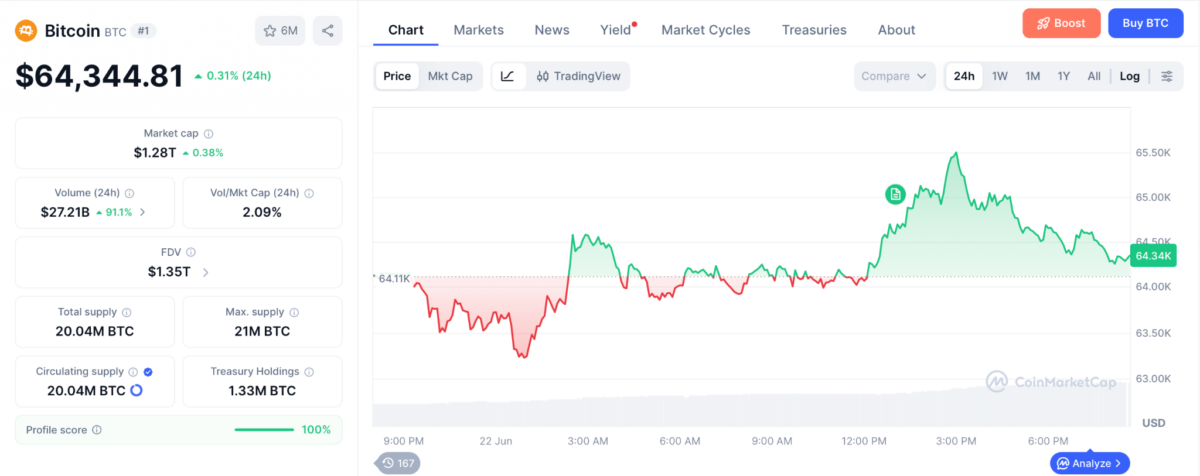
Despite the daily gain, Bitcoin remains down 3.46% over the past week and 15% over the past month. Trading activity has increased significantly, with volume rising more than 90% to $27.39 billion. Gold, on the other hand, is down 22% since February. This was shortly after it reached $5,600 per ounce in January.
For now, Bitcoin and gold remain tied to shifting expectations around U.S. monetary policy rather than geopolitical developments alone. As investors assess whether inflation pressures will keep the Federal Reserve on a hawkish path, future rate decisions could play a key role in determining whether capital continues flowing into equities or returns to alternative assets such as Bitcoin and gold.
Also Read: Bitcoin Breaks Below “Fire Sale” Zone Amid Extreme Fear