
Key Highlights
- U.S. annual inflation cooled to 3.4% in July from 3.5% in June, while core CPI eased to 2.5%, but the reading was largely in line with expectations.
- Bitcoin remained below $64,000 after the CPI release as declining inflation failed to generate enough new demand for a breakout.
- U.S. spot Bitcoin ETFs recorded $61.16 million in net outflows on August 12, while analysts pointed to unusually weak spot trading activity and crowded positioning.
Bitcoin failed to break out after softer U.S. inflation data, suggesting that easing price pressures alone are no longer enough to bring fresh buyers into the cryptocurrency market.
Bitcoin was trading around $64,000 on Thursday after briefly slipping toward $63,500, despite two inflation readings that reduced concerns over another near-term Federal Reserve rate hike.
The U.S. Bureau of Labor Statistics reported Wednesday that the Consumer Price Index rose 3.4% year-over-year in July, down from 3.5% in June. Core CPI, which excludes food and energy, increased 2.5% over the same period.
The softer annual inflation figures would typically be supportive for risk assets such as Bitcoin because declining inflation can reduce pressure on the Federal Reserve to maintain tighter monetary policy.
This time, however, Bitcoin barely reacted, and the overall crypto market remained flat.
CPI cooled, but Bitcoin had already priced it in
The first problem for Bitcoin was that July’s inflation report did not deliver a meaningful surprise.
While headline inflation slowed, the CPI reading broadly matched market expectations. That meant the report removed the risk of an unexpectedly hot inflation print without forcing traders to substantially change their expectations for monetary policy.
Bitcoin showed a similarly muted reaction immediately after the release. According to CoinGecko, at 2:00 p.m. ET on August 13, BTC traded at about $64,029, down 0.15% over the previous hour and 0.38% over 24 hours.
The lack of movement continued Thursday even after producer-price data provided another relatively favorable inflation signal. Bitcoin remained below $64,000 as traders looked beyond the inflation reports toward upcoming labor-market data and Federal Reserve signals.
In other words, cooling inflation prevented the macro backdrop from becoming worse for Bitcoin, but it did not provide a sufficiently strong new catalyst to push BTC higher.
Bitcoin buyers are still missing
More importantly, Bitcoin’s inability to rally appears to extend beyond CPI. Market activity has become increasingly compressed as BTC remains trapped in a narrow trading range.
Bitcoin’s spot trading volume has fallen to levels not seen since 2019, while buyer participation remains weak despite easing selling pressure. The combination has left BTC in a market where neither buyers nor sellers currently have enough conviction to establish a sustained direction.
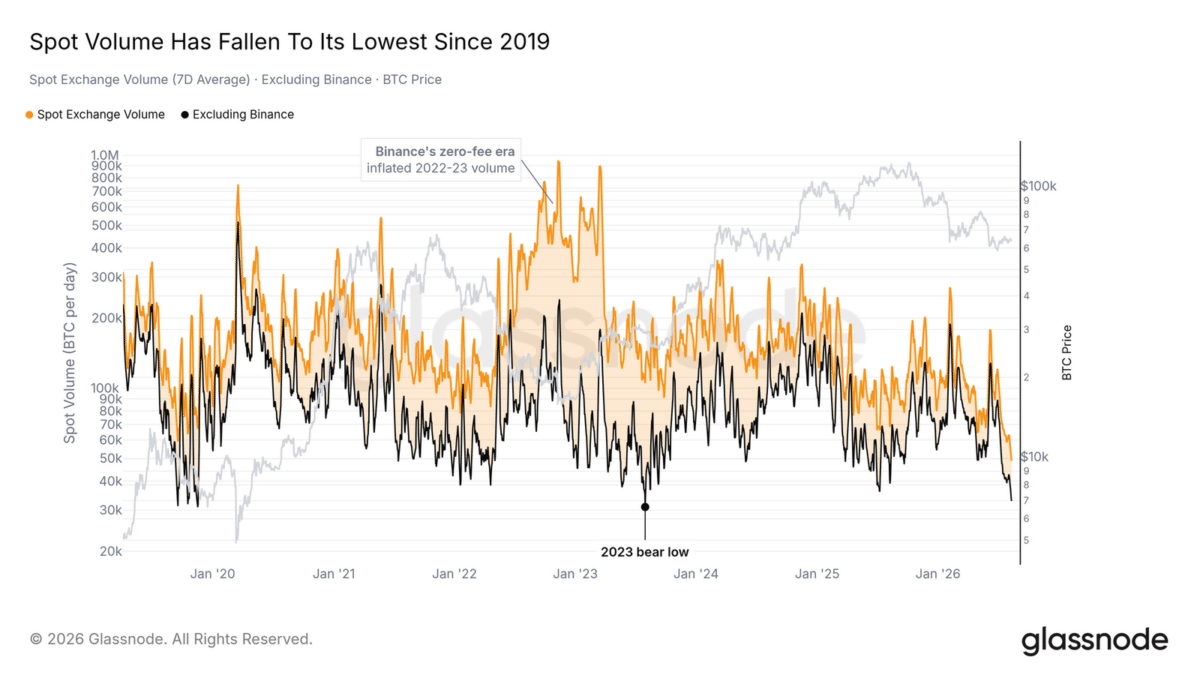
Lower selling pressure can help establish a floor underneath Bitcoin, but a breakout requires the opposite side of the equation: new demand capable of absorbing available supply and pushing prices through resistance.
That demand has yet to appear consistently.
Ahead of CPI, market participants were already observing the same imbalance. ETF inflows had provided support, but selling from other market participants was offsetting institutional demand while weeks of sideways trading compressed Bitcoin volatility.
The CPI report therefore arrived in a market that was stable, but not necessarily positioned for aggressive upside.
Bitcoin is trapped between $63K and $68.7K
The more important explanation may now be coming from Bitcoin’s own market structure.
Glassnode said Bitcoin is caught between two major investor cost-basis levels: the Median Realized Price near $63,000 and the Short-Term Holder Cost Basis around $68,700.
The lower level has helped provide support, while the short-term holder cost basis above BTC has repeatedly limited recovery attempts.
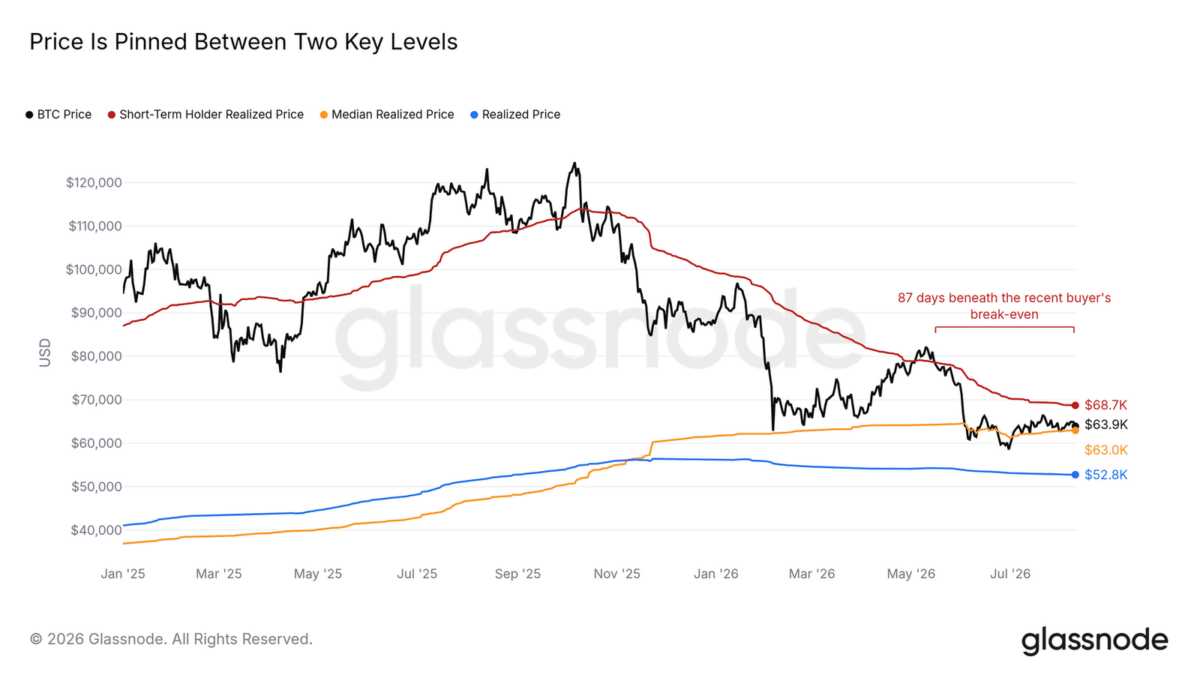
That has effectively boxed Bitcoin into a roughly $63,000-$68,700 range.
The significance of $68,700 goes beyond conventional technical resistance. It represents approximately the average acquisition price of recent Bitcoin buyers. As BTC approaches that level, investors who bought at higher prices get another opportunity to exit around breakeven.
Glassnode said break-even levels have already rejected multiple recovery attempts, leaving Bitcoin squeezed between exhausted sellers below and hesitant buyers above.
Bitcoin ETF outflows add to the problem
Institutional flows also failed to provide the follow-through Bitcoin needed after CPI.
U.S. spot Bitcoin ETFs recorded approximately $61.16 million in net outflows on August 12, according to flow data reported Thursday by Farside. Fidelity’s FBTC accounted for about $46.82 million of those withdrawals.
The reversal came after Bitcoin investment products had attracted roughly $850 million during the previous week, highlighting how institutional demand has remained inconsistent rather than accelerating into the inflation report.
ETF demand has become an important source of incremental Bitcoin buying since spot products entered the U.S. market. When those flows weaken while spot-market activity is already subdued, Bitcoin has fewer immediate sources of demand capable of producing a breakout.
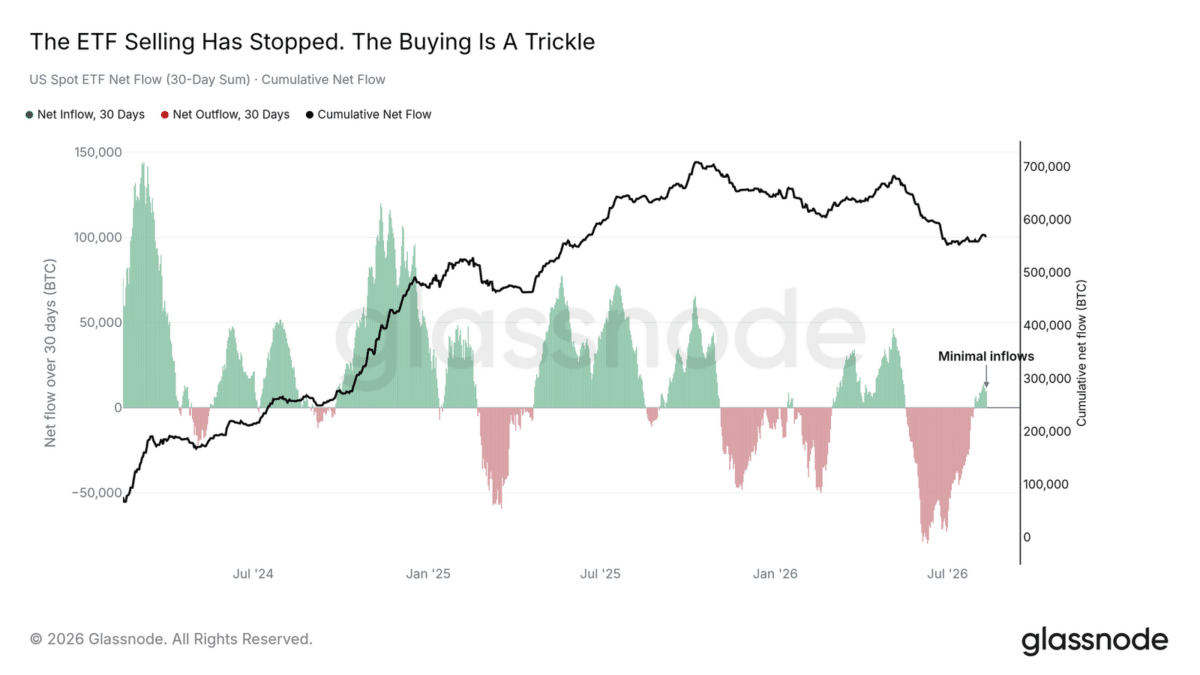
That helps explain why favorable macroeconomic data has so far produced stability rather than momentum.
Crowded Bitcoin longs could complicate the next move
The derivatives market adds another layer to Bitcoin’s consolidation.
Traders have accumulated leveraged long positions while spot liquidity remains thin. Heavy long positioning does not necessarily produce upward pressure because perpetual and futures exposure can increase without the corresponding spot purchases required to push the underlying market through resistance.
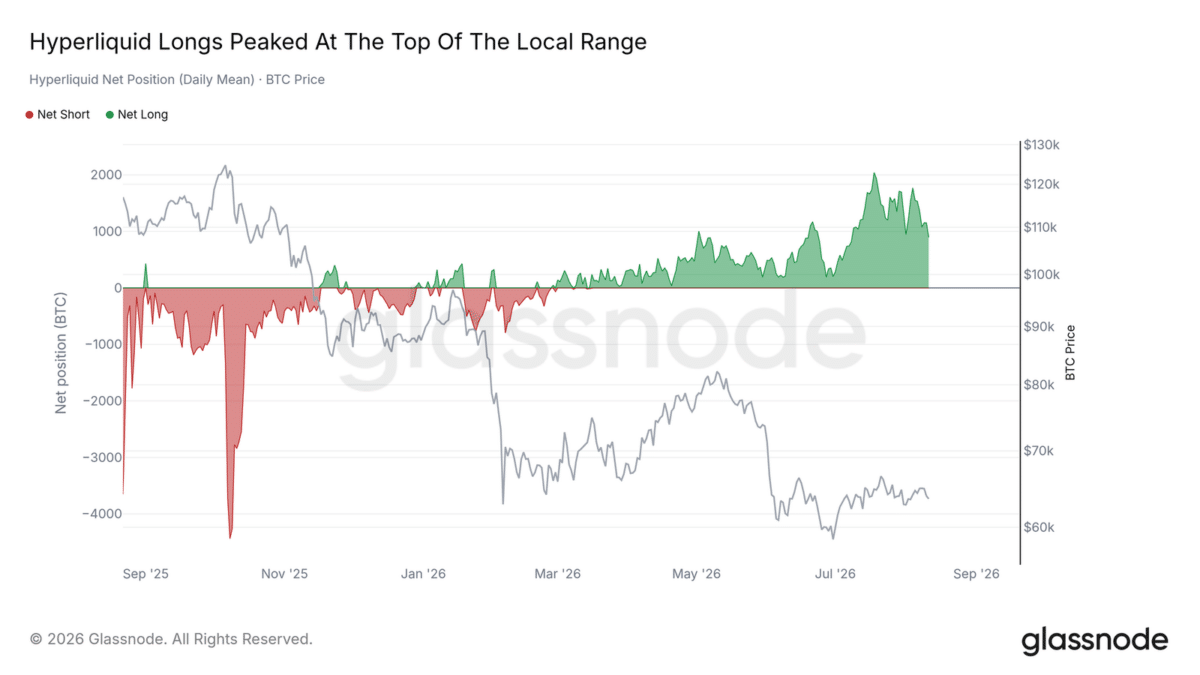
Thin liquidity also increases Bitcoin’s sensitivity to liquidations.
A negative macroeconomic or geopolitical catalyst could force leveraged longs to close, adding market sell orders at a time when spot depth is already limited. The resulting liquidation pressure could temporarily accelerate a decline even without a major deterioration in Bitcoin’s longer-term demand picture.
Conversely, a clean move through resistance backed by rising spot volume would provide stronger evidence of a genuine demand-driven breakout than an increase in leveraged positioning alone.
Fed uncertainty has not disappeared
Cooling CPI also does not automatically translate into easier Federal Reserve policy.
The Fed kept its benchmark interest rate unchanged at 3.50%–3.75% on July 29, but the decision passed by a divided 9–3 vote, with three officials favoring a rate hike.
That division leaves investors with a considerably different policy setup than one in which cooling CPI immediately raises expectations for rate cuts.
Instead, traders are now looking toward additional employment and inflation data as well as Fed Chair Kevin Warsh’s appearance at the Jackson Hole symposium later this month for clearer signals on the direction of monetary policy.
For Bitcoin, that means July CPI settled only one part of the macroeconomic debate.
What does bitcoin need to finally break out?
Bitcoin’s reaction to CPI suggests the market currently needs more than declining inflation.
The immediate macro risk has improved, but BTC still faces weak spot participation, inconsistent ETF demand and uncertainty over whether the Federal Reserve’s next move will ultimately be a hold, hike or shift toward easier policy.
The current consolidation therefore represents a demand problem as much as a macroeconomic one.
If ETF inflows return while spot buying activity improves, softer inflation could provide a supportive backdrop for another attempt higher. Without that demand, however, favorable economic data may continue to produce muted reactions rather than sustained Bitcoin rallies.
For now, July CPI appears to have removed one obstacle for Bitcoin but it has not provided the buyers needed to force a breakout.
Also Read: Bitcoin Price Navigates Key Support While BVIV Hits Multi-Month Low