Bitcoin, Ethereum, and XRP hold steady after the Fed as crypto sentiment remains cautious
Crypto markets remained relatively stable after the Federal Reserve’s decision to leave interest rates unchanged, with Bitcoin, Ethereum, and XRP holding their ground despite a hawkish policy tone.
Bitcoin traded around $63,947, up 0.42% over the past 24 hours, while Ethereum was near $1,900, down 0.69%, and XRP traded around $1.07, up 1.92% on the day according to the CoinMarketCap.
The broader crypto market remained subdued. Total market capitalisation stood near $2.18 trillion, while the Crypto Fear & Greed Index remained at 35, signalling that investor sentiment is still firmly in fear territory. The Altcoin Season Index was at 51, suggesting neither Bitcoin nor altcoins have established a decisive leadership trend.
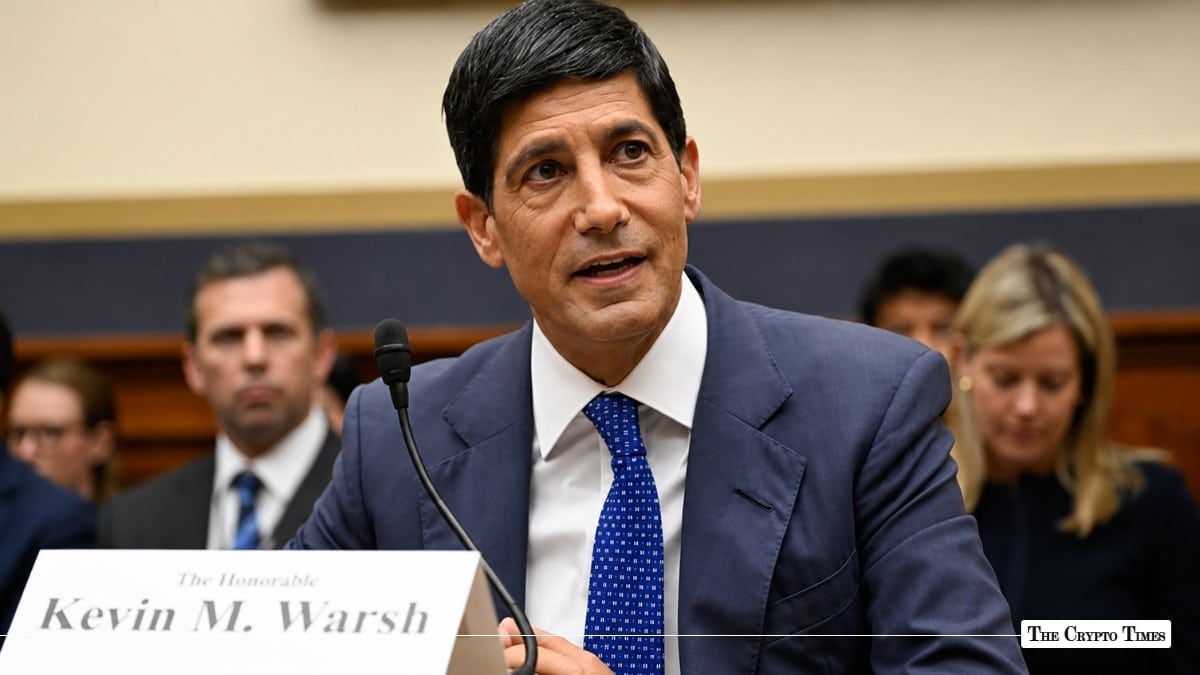
The relatively muted reaction suggests traders had largely expected the Fed to hold rates, with the main focus shifting to Kevin Warsh’s hawkish messaging and what it could mean for Treasury yields, liquidity, and risk assets over the coming months.
For Bitcoin, Ethereum, and XRP, the next major catalyst is likely to be incoming inflation data, ETF flows, and the Jackson Hole symposium in late August, where Warsh may provide a clearer signal on the Fed’s policy direction ahead of the September meeting.
Warsh says Jackson Hole speech is still a ‘blank piece of paper’
Fed Chair Kevin Warsh said his keynote speech for the Federal Reserve’s Jackson Hole symposium next month is still a “blank piece of paper,” suggesting that the annual gathering could become a key source of new policy signals.
With no FOMC meeting scheduled in August, investors are already looking ahead to the Jackson Hole conference, which runs from Aug. 27-29 and has historically been used by Fed chairs to outline broader monetary policy priorities.
Warsh said he plans to meet with the leaders of the five policy task forces he has created and may use those discussions as a starting point for his Jackson Hole remarks.
“In the next couple weeks, I’m going to be doing a check back in, giving them time to think hard about their agenda, their debate, their schedule, and when they might be ready for prime time,” Warsh said. “That may or may not inform anything I have to say in Jackson.”
For Bitcoin, Ethereum, and XRP, the comments suggest that Jackson Hole could become the next major macro catalyst after today’s Fed decision. Any shift in Warsh’s thinking on inflation, interest rates, or the Fed’s broader policy framework could influence Treasury yields, the U.S. dollar, and crypto market sentiment heading into the September FOMC meeting.
Theo CIO Iggy Ioppe says institutional Bitcoin flows remain a key support
Iggy Ioppe, Chief Investment Officer at Theo and former head of a $1 billion-plus long-short proprietary trading group at Credit Suisse, said the Fed’s decision reinforces a market environment where inflation remains complicated but liquidity conditions are still supportive over the medium term.
Ioppe said the June inflation data improved, but rising oil prices linked to U.S.-Iran tensions and shipping risks around the Strait of Hormuz and the Red Sea have made the inflation outlook less clear.
“Warsh has made it clear he will not be bounced by one print, and that approach makes sense in this environment,” Ioppe said.
He argued that the broader policy backdrop remains easier than inflation and labour-market conditions might justify, which should remain supportive for risk assets over time.
Ioppe added that the immediate focus remains on generating yield while liquidity conditions stay broadly constructive, with energy prices and macro policy continuing to drive short-term crypto sentiment.
Sygnum’s Can-Luca Köymen says the Fed is staying restrictive, not becoming more aggressive
The Federal Reserve’s decision to hold interest rates steady, while maintaining a hawkish tone, was largely in line with expectations, according to Can-Luca Köymen, Investment Strategist at Sygnum Bank, in comments shared with CryptoTimes.
Köymen said the Fed is trying to preserve flexibility while energy markets remain uncertain, rather than signalling an immediate shift toward more aggressive tightening.
“This was broadly the outcome we expected,” Köymen said. “Our base case was a hold, and hawkish language accompanying it is consistent with a committee that wants to preserve optionality while the energy picture remains unsettled.”
DWF Labs’ Andrei Grachev says the Fed’s message is the worst-case outcome for crypto
The Federal Reserve’s hawkish message could be the least favourable policy outcome for digital assets this cycle, according to Andrei Grachev, Managing Partner at DWF Labs.
Grachev said the Fed’s decision signals that policymakers are willing to keep financial conditions tight if inflation remains above target, even if that increases the risk of slower economic growth.
“This is the Fed telling markets it will not tolerate inflation above target even at the cost of a growth scare,” Grachev said. “For digital assets, that’s the least favorable outcome on the table this cycle.”
He argued that a prolonged hawkish stance would mean tighter policy, reduced liquidity, and more expensive carry, a combination that has historically created a more challenging environment for risk assets.
Grachev said institutional investors are likely to become more defensive if the market begins to price a higher probability of future rate hikes, with Bitcoin, Ethereum, and XRP potentially facing additional pressure from rising Treasury yields and a stronger U.S. dollar.
“Bitcoin has held up through a hawkish stretch already, but a fresh hawkish surprise would negatively impact prices,” he said.
His comments add to growing concern that the Fed’s policy outlook, rather than today’s hold decision, could become the dominant driver of crypto markets in the weeks ahead.
Bitget’s Ryan Lee says the Fed’s Fed has shifted the market from rate-cut expectations to rate-hike risk
The Federal Reserve’s decision to hold interest rates steady was expected, but the real story was the hawkish shift in the Fed’s language, according to Ryan Lee, Chief Analyst at Bitget Research.
Lee told The Crypto Times that the committee’s tone was more hawkish than June’s softer inflation data would have justified, arguing that policymakers are increasingly focused on inflation risks that could become more visible in upcoming data.
“The Fed held, as expected, but the language was the story, and it came in more hawkish than June’s soft inflation print would have justified,” Lee said. “Markets had essentially priced out cuts for the year already, and today confirmed the debate has shifted to whether the next move is a hike.”
He said institutional investors appeared to absorb much of the initial volatility after the Fed announcement, suggesting larger market participants were willing to buy into weakness rather than aggressively reduce exposure.
Warsh says markets should focus on economic data, not the Fed
Fed Chair Kevin Warsh said rising Treasury yields since the last Federal Reserve meeting are a welcome development, arguing that markets are increasingly responding to economic data rather than trying to anticipate Fed intervention.
During his press conference, Warsh said real rates have moved higher even as the Fed left interest rates unchanged, reflecting stronger market participation and more data-driven pricing.
“Market attention centered on real data and real economic developments,” Warsh said. “Prices reacted in real time to incoming information.”
He added that investors are increasingly “playing the ball, not the referee,” suggesting markets are focusing more on inflation, growth, and employment data than on interpreting every signal from the central bank.
Warsh said that shift is positive because the Federal Reserve does not always need to be the center of attention.
Crypto liquidations top $328 million as Ethereum leads the selloff
Crypto derivatives markets saw a sharp wave of liquidations following the Fed decision, with more than $328 million in positions wiped out over the past 24 hours, according to CoinGlass data.
Ethereum accounted for the largest share of liquidations, with roughly $18.3 million erased in the past hour, while Bitcoin liquidations reached about $8.6 million. XRP also saw notable liquidations as volatility picked up across major crypto assets.
Long positions were hit the hardest over the past 24 hours, with nearly $229 million in bullish bets liquidated, compared with about $100 million in short liquidations. That suggests many traders were positioned for a stronger post-FOMC rally and were forced to exit as price action turned volatile.
CoinGlass said 97,784 traders were liquidated over the past 24 hours, with the largest single liquidation occurring on Binance in the ETHUSDT market.
FOMC holds rates steady in split 9–3 vote
The Federal Reserve kept interest rates unchanged at 3.50%–3.75% for the fifth straight meeting, but the decision revealed growing divisions among policymakers. The vote passed 9–3, with Beth Hammack, Neel Kashkari, and Lorie Logan dissenting in favor of a rate hike.
In its statement, the Fed said the U.S. economy continues to expand at a solid pace, though inflation remains above its 2% target. The rare three-member dissent gives the decision a more hawkish tone, shifting attention to Chair Kevin Warsh and any signals on inflation or the possibility of future rate hikes.
Traders are making record bets on the Fed’s next move
Traders are making some of the largest bets on a Federal Reserve decision in years, with positioning in the August federal funds futures contract reaching a record 967,136 contracts ahead of this afternoon’s FOMC announcement.
Open interest in the contract, which settles after this week’s Fed decision, has more than doubled since the second week of June and has now surpassed the previous record set in October 2024, another period of elevated uncertainty around Fed policy.
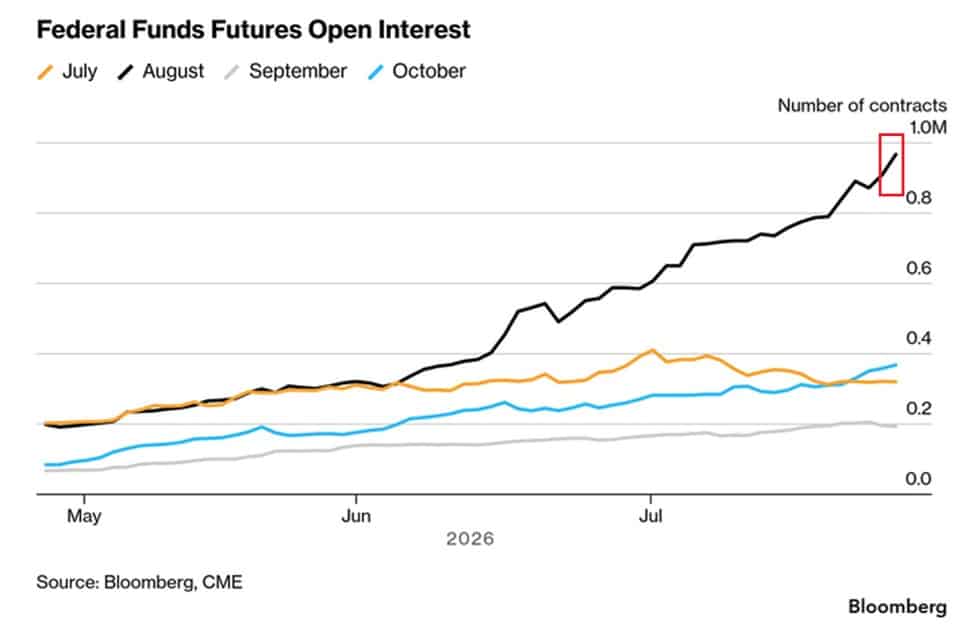
The surge in positioning reflects just how divided markets have become. Investors are still largely expecting the Fed to leave rates unchanged, but futures markets are pricing roughly a 36% chance of a rate hike, an unusually high level of uncertainty heading into a policy meeting.
According to Bianco Research, only 4 of the 135 FOMC meetings held since the end of the 2008 financial crisis saw the probability of a rate hike fall between 33% and 66% in the days leading up to the decision.
Tom Lee says the Fed is likely to hold rates, with QT a bigger surprise risk
Fundstrat’s Tom Lee said the Federal Reserve is likely to leave interest rates unchanged today, while arguing that the bigger surprise could come from the Fed’s balance-sheet policy rather than the rate decision itself.
Lee said markets broadly expect no change in rates, with Fed futures still assigning only a modest probability of a hike. After reviewing comments from the 12 voting FOMC members since the June meeting, Fundstrat concluded that only three officials have taken a clearly hawkish tone, while two have been dovish. Lee described Chair Kevin Warsh as broadly neutral, citing his repeated emphasis on evaluating economic conditions before adjusting policy.
Lee also said the Fed could announce a resumption of quantitative tightening (QT), or balance-sheet reduction. He argued that QT can effectively tighten financial conditions even without a rate hike, making it a potentially more important policy signal than today’s interest rate decision.
“This is a new Fed, so markets have little visibility ahead of the meeting,” Lee said, adding that the FOMC announcement could help restore that visibility once the decision is released.
For Bitcoin, Ethereum, and XRP, a resumption of QT could be interpreted as a hawkish development because it would reduce liquidity in the financial system. However, Lee believes the Fed is more likely to hold rates and wait for additional inflation data, making the statement and Warsh’s press conference the key events for crypto markets this afternoon.
Kevin Warsh can’t reopen the Strait of Hormuz
The public is frustrated with the high cost of living, and the Federal Reserve is once again under pressure to act.
Fed Chair Kevin Warsh has made it clear that he wants inflation back to the central bank’s 2% target. Some investors believe the Warsh-led Fed could show it is serious about that commitment by signalling a more hawkish path, potentially opening the door to a future rate hike.
The challenge is that the Fed’s inflation-fighting tools are limited when inflation is being driven by supply shocks rather than demand.
CNN reports, the central bank cannot negotiate a ceasefire in the Middle East, reopen the Strait of Hormuz, or reverse the impact of tariffs and other supply disruptions that have pushed energy and goods prices higher.
As former Fed official Benson Durham, founder of DASM LLC, put it: “Rate hikes won’t keep the bombs from dropping.”
Cleveland Fed’s Beth Hammack says some business leaders are calling for higher rates
Cleveland Fed President Beth Hammack said she is hearing an unusual message from business leaders, with some now arguing that interest rates should be higher to bring inflation under control.
In a LinkedIn post published earlier this month, Hammack said it was the first time she had heard business executives openly favour tighter monetary policy, a notable shift given that companies typically support lower borrowing costs.
She also said she is hearing increasing financial stress from households, describing conversations with consumers who “can’t make ends meet” and reporting a growing sense of economic despair.
Peter Schiff warns a surprise Fed rate hike could hit risk assets
Gold advocate and macro commentator Peter Schiff said a surprise interest rate hike by the Federal Reserve could trigger a sharp market reaction, arguing that a serious effort to bring inflation under control would pressure both financial markets and the broader economy.
In a post on X, Schiff said that if the Fed unexpectedly raises rates and gold still rallies, it would suggest that investors are becoming increasingly concerned about the long-term inflation outlook. He argued that aggressive inflation-fighting measures could ultimately force the Fed to reverse course.
Schiff’s comments come as markets overwhelmingly expect the Federal Reserve to leave interest rates unchanged at Wednesday’s meeting, with traders focused instead on Chair Kevin Warsh’s guidance for the September policy meeting.
Economist Claudia Sahm says the Fed statement may point to a future rate hike
Economist Claudia Sahm believes the Federal Reserve’s post-meeting statement could signal that policymakers are moving closer to another interest rate hike if inflation does not continue to improve.
Sahm, chief economist at New Century Advisors, expects the statement to place greater emphasis on inflation risks despite Chair Kevin Warsh’s preference for limiting explicit forward guidance. She believes the Fed could indicate that further policy tightening may be warranted if inflation remains elevated while the labour market stays strong.
Her expectation comes after Warsh’s first FOMC meeting in June, when the Fed released a notably shorter statement that dropped much of the previous boilerplate language and instead focused on the committee’s commitment to restoring price stability.
Sahm expects the July statement to acknowledge that inflation remains above the Fed’s 2% target, with pressure coming from supply disruptions linked to the Middle East conflict, tariffs, and strong AI-related demand. She also expects the Fed to describe labour market conditions as broadly consistent with its maximum employment mandate.
Stocks and Treasury yields rise ahead of the Fed decision as oil adds inflation pressure
U.S. stocks opened sharply lower on Wednesday, while Treasury yields moved higher, increasing market pressure ahead of the Federal Reserve’s interest rate decision later this afternoon.
The Dow Jones Industrial Average fell nearly 400 points in early trading, with much of the weakness linked to a fresh jump in oil prices. The move followed renewed geopolitical tensions after President Donald Trump said the United States would respond forcefully to attacks on American personnel in the Middle East.
Bond markets also reflected growing inflation concerns. The 10-year Treasury yield rose to 4.62%, close to its highest level of the year, while the 2-year Treasury yield climbed to 4.30%, a level that is particularly important because it is highly sensitive to expectations for Federal Reserve policy.
Bitcoin, Ethereum, and XRP remain muted ahead of the Fed decision
Bitcoin, Ethereum, and XRP traded in a tight range on Wednesday as crypto markets remained largely subdued ahead of the Federal Reserve’s interest rate decision.
Bitcoin was holding around $63,900, down about 0.3% over the past hour, while Ethereum traded near $1,889 and XRP hovered around $1.06, according to CoinMarketCap. The muted price action suggests traders are avoiding large directional bets before the FOMC statement and Chair Kevin Warsh’s press conference.
Broader crypto sentiment also remained cautious. The Crypto Fear & Greed Index stood at 35, indicating fear, while the overall crypto market capitalisation was little changed near $2.18 trillion.
The lack of movement across Bitcoin, Ethereum, and XRP reflects a market that is waiting for a macro catalyst. A hawkish message from the Fed could strengthen the U.S. dollar and pressure risk assets, while any sign that policymakers are becoming more open to easing later this year could support a broader crypto rebound.
For now, the key takeaway is that the three largest traded crypto assets are holding steady, with volatility expectations remaining elevated ahead of the Fed announcement.
Fed expected to keep rates unchanged as inflation remains the key concern
Federal Reserve policymakers are showing growing frustration with persistent inflation, but they are not expected to turn that frustration into action at this week’s meeting. The central bank is widely expected to keep its benchmark interest rate unchanged when the Federal Open Market Committee concludes its two-day meeting in Washington on Wednesday.
The more important question for markets is whether Chair Kevin Warsh signals that the Fed is moving closer to a policy shift at its next meeting on September 15-16.
Inflation has remained above the Fed’s 2% target for more than five years, and Warsh has adopted a notably firm tone since taking over as Fed chair. Earlier this month, he told Congress that he has “no tolerance” for elevated inflation, reinforcing expectations that future meetings could become more consequential if price pressures remain stubborn.
This is Warsh’s second FOMC meeting as chair, making his post-decision press conference a major event for financial markets. Investors will be watching closely for any change in the Fed’s inflation assessment, the outlook for future rate cuts, and comments that could move Treasury yields, the U.S. dollar, and crypto assets.
Warsh is scheduled to hold a news conference at 2:30 p.m. EDT, and his remarks could shape expectations for the September meeting even if the Fed leaves rates unchanged today.
Also Read: What to Expect From the July FOMC Meeting?