Bitcoin is consolidating near critical technical support levels while its primary measure of expected price swings has fallen to the lowest reading in nearly a year, underscoring a pronounced shift in derivatives market dynamics rather than a fundamental reassessment of the asset’s outlook.
As of early August 12 (6:30 AM UTC), Bitcoin traded near $63,580 after a period of range-bound price action that has largely confined the cryptocurrency between roughly $62,000 and $66,000 since early July.
The Volmex Bitcoin Implied Volatility Index (BVIV), which tracks 30-day annualized implied volatility derived from options pricing across major venues, declined to 35.59% over the recent weekend, its lowest level since September 2025, before edging modestly higher toward the high 30s.
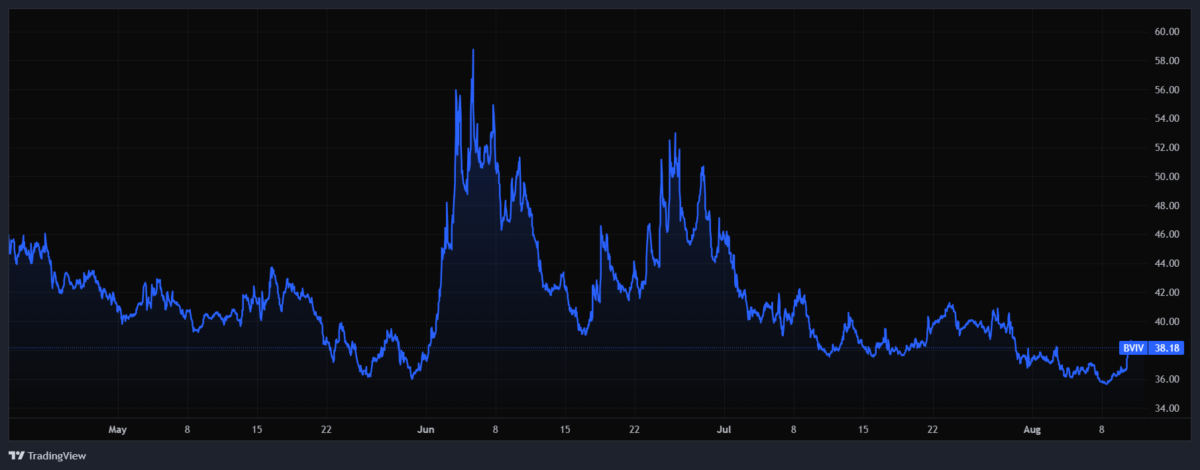
The compression in BVIV, often described as crypto’s equivalent of the equity market’s VIX, comes after readings that exceeded 90% during the sharp sell-off in February. Market participants attribute the decline less to outright complacency and more to changes in how large holders manage their positions.
Griffin Sears, FalconX Head of Derivatives said BVIV’s recent slide is the result of a broad supply-demand imbalance in the crypto options market. With Bitcoin’s price stubbornly range-bound, the appetite for directional optionality has evaporated, while a growing number of market participants are utilizing systematic overwriting programs. His view is that these strategies involve writing call options to generate yield on their spot BTC holdings, which effectively suppresses volatility by flooding the market with options supply.
Volatility Compression Reflects Structural Shift in Options Markets
The drop in implied volatility stems from a clear supply-demand imbalance in the Bitcoin options market. With spot prices locked in a relatively tight range, demand for directional optionality—bets on large upward or downward moves—has diminished.
At the same time, supply has increased as Bitcoin miners, corporate treasury teams, and other large holders have expanded systematic call-writing, or overwriting, programs to generate yield on their holdings.
In a statement shared with The Crypto Times, Diana Pires, Chief Business Officer at sFOX, framed the development in similar structural terms. “Bitcoin’s implied volatility has fallen to its lowest level in nearly a year, with BVIV dropping below 36%, but that shouldn’t be mistaken for a reduction in risk,” Pires said.
“What’s happening is a shift in market structure. As Bitcoin remains range-bound, demand for directional exposure has declined while miners, corporate treasuries, and other large holders increasingly generate yield through option-writing strategies. That additional supply is helping suppress volatility premiums and creating the appearance of a calmer market,” she further emphasized.
According to Pires, the premium investors continue to pay for downside protection remains telling. “What’s particularly interesting is that investors continue to pay a premium for downside protection, suggesting the market remains cautious even as near-term price expectations have become more subdued.”
This elevated put skew—puts trading more expensively relative to calls—indicates that while traders are not positioning aggressively for large moves in either direction, concern about potential further weakness persists.
Price Action Holds Near Critical Technical Levels
On the spot market, Bitcoin has repeatedly tested the mid-$63,000s as near-term support after failing to sustain advances above the $65,000–$65,500 resistance zone. The 5-year chart from TradingView shows that immediate support is clustered around $63,000–$63,700, with the lower boundary of the recent consolidation nearer $62,500. The psychologically significant $60,000 level remains a key longer-term reference point should selling pressure intensify.
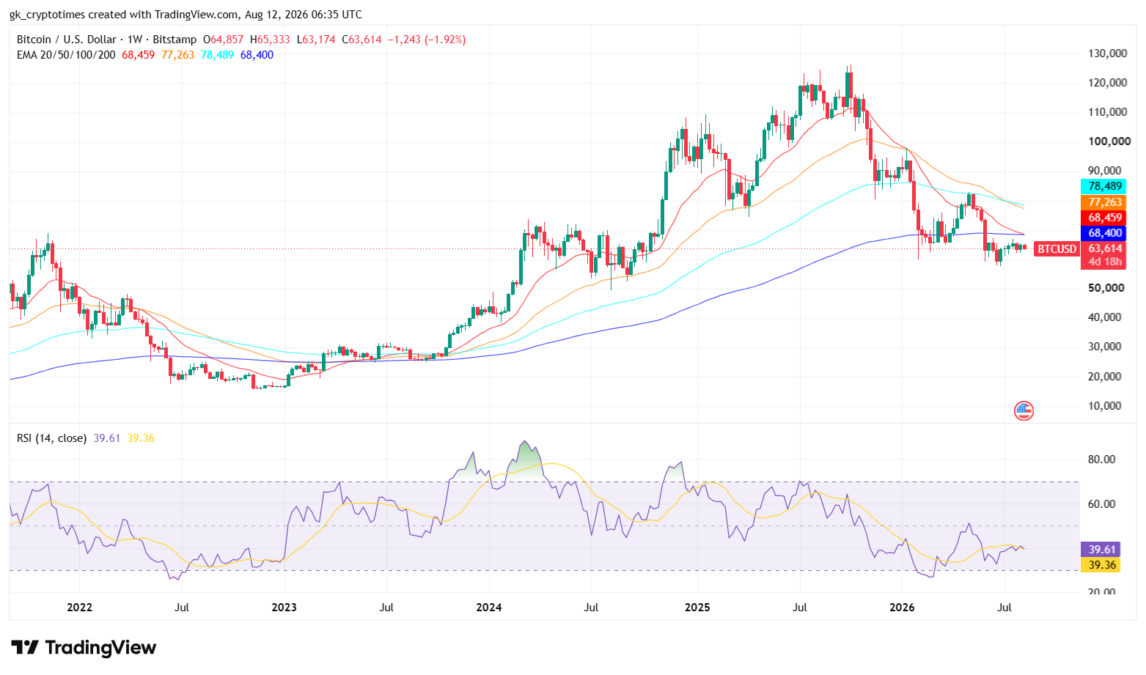
Technical analysts describe the broader structure as range-bound on weekly timeframes, with the higher-timeframe bias remaining constructive provided price holds above the mid-$63,000s.
Resistance continues to cap advances near $65,000–$65,500, and a sustained break above that area would be required to open the path toward higher levels. Volume and open interest dynamics have been consistent with a market in consolidation rather than one driven by strong directional conviction.
The subdued price action has coincided with the seasonal summer lull, further reducing the frequency of large absolute moves and reinforcing the feedback loop between lower realized volatility and softer implied volatility readings.
Low Volatility Does Not Equal Low Risk, Analysts Caution
Market observers on X emphasize that the current calm should not be equated with diminished risk. Periods of compressed volatility in Bitcoin have historically preceded larger directional moves, though the eventual direction remains uncertain and dependent on external catalysts, including macroeconomic data, liquidity conditions, and shifts in broader risk sentiment.
Pires underscored this distinction clearly. “As is often the case in Bitcoin, the story is playing out more in derivatives markets than in spot demand. What’s often misunderstood about periods like this is that low volatility and low risk are not the same thing. The macro backdrop remains uncertain, and Bitcoin continues to trade as a global asset influenced by liquidity conditions, investor positioning, and broader risk sentiment. What we’re seeing is a market with less conviction about short-term direction, not a market reassessing Bitcoin’s long-term value proposition.”
Read: Binance Bitcoin Reserves Hit 667,500 BTC as Bitcoin Slips Below $64K
The persistence of elevated put premiums supports this view of residual caution. While overall implied volatility has compressed, the relative pricing of downside protection indicates that institutional and professional participants remain willing to pay for insurance against adverse moves.
Meanwhile, the growth of systematic overwriting strategies has altered the traditional balance between option buyers and sellers, contributing to the suppression of volatility premiums even as underlying uncertainty about the macroeconomic environment persists.
For now, Bitcoin continues to navigate the lower half of its established range while derivatives markets signal reduced near-term directional conviction. The interplay between technical support levels, options market structure, and the broader liquidity and risk backdrop will likely determine whether the current period of relative calm extends or gives way to a more decisive move.
Also read: Michael Saylor’s Strategy to Resume Bitcoin Purchases Before Year-End