Key Highlights
- Aster has activated AOS-2, extending its open listing framework from spot markets to perpetual contracts.
- Eligible projects must stake 1 million ASTER for four years with no early-exit option.
- Applications proceed through an on-chain validator vote before Aster’s risk team configures the market.
Aster, a decentralized exchange (DEX) built on the BNB Chain, has activated AOS-2, extending its open listing framework to perpetual markets. The standard builds on AOS-1, which previously applied published criteria to spot listings.
According to the official announcement, under AOS-2, projects that meet defined eligibility requirements can apply for a perpetual market through a structured process that includes staking, an on-chain validator vote, and subsequent risk configuration. Also, AOS-3 is scheduled to follow the current standard.
What users need to know about the update
An eligible applicant must stake 1,000,000 $ASTER. The stake is locked for four years with no early-exit option. Once the stake is confirmed, the application advances to an on-chain validator vote. If the vote passes, Aster’s risk team completes the market configuration, and the perpetual is scheduled to go live on a T+1 basis. If the vote fails, the full stake is returned.
Here, T+1 basis means the perpetual market goes live on the next calendar day (or next business day) after the on-chain vote passes and Aster’s risk team finishes configuration. If the vote fails, the full stake is returned.
The application form becomes available only after the stake is successfully confirmed. The sequence follows a fixed order: application submission, staking of 1,000,000 $ASTER, validator vote, risk configuration, and potential go-live on the next day.
Eligibility is assessed at the time of submission and requires three conditions. The token must be listed on Binance Alpha or a Tier 2 exchange. Circulating market capitalization must stand at or above $10,000,000 USD. The applicant must supply a designated market-maker wallet address already connected to the Aster platform.
Staking terms and the voting process operate under the same published rules for every applicant. Leverage levels and other risk parameters for each market remain subject to Aster’s internal risk controls. The rules themselves are published, and the outcome of each vote is recorded on-chain.
In June 2026, Aster completed its first token buyback and burn under the tokenomics system introduced earlier that month. At the time, the protocol reported that the buyback used 99% of the daily fees collected since June 17. An equal quantity of tokens was permanently removed from the team’s allocation.
ASTER price movement
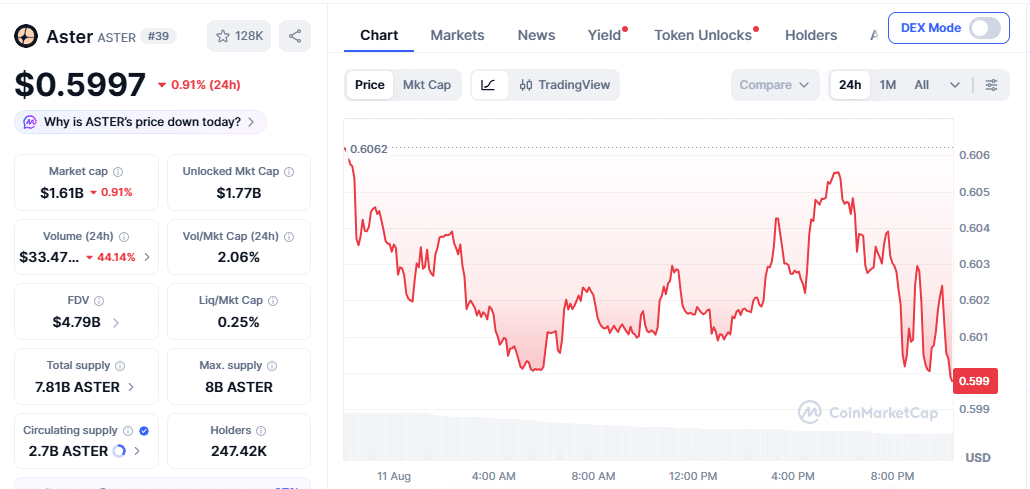
The Aster update was accompanied by a decline in the token’s price. At the time of this writing (on August 11, 2026, at 16:50 UTC), the token was trading at $0.5997, down 0.91% over 24 hours, according to data from CoinMarketCap.
Market capitalization stood at $1.61 billion, with 24-hour volume near $33.47 million, a 44.14 percent decline from the prior day. The intraday range ran from a low of $0.5997 to a high of $0.6057, and the circulating supply remained at 2.7 billion ASTER.
Formal channel for perpetual markets
AOS-2 establishes a formal channel for perpetual market applications that replaces reliance on private negotiation with a combination of staking, on-chain voting, and published criteria. The framework sets fixed requirements for applicants while retaining separate risk parameter controls.
The earlier buyback and burn activity represents one operational step under the protocol’s current tokenomics. Both developments are part of the documented processes currently in effect on the platform.
Also Read: Grayscale Says AI Could Drive New Demand for Public Blockchains