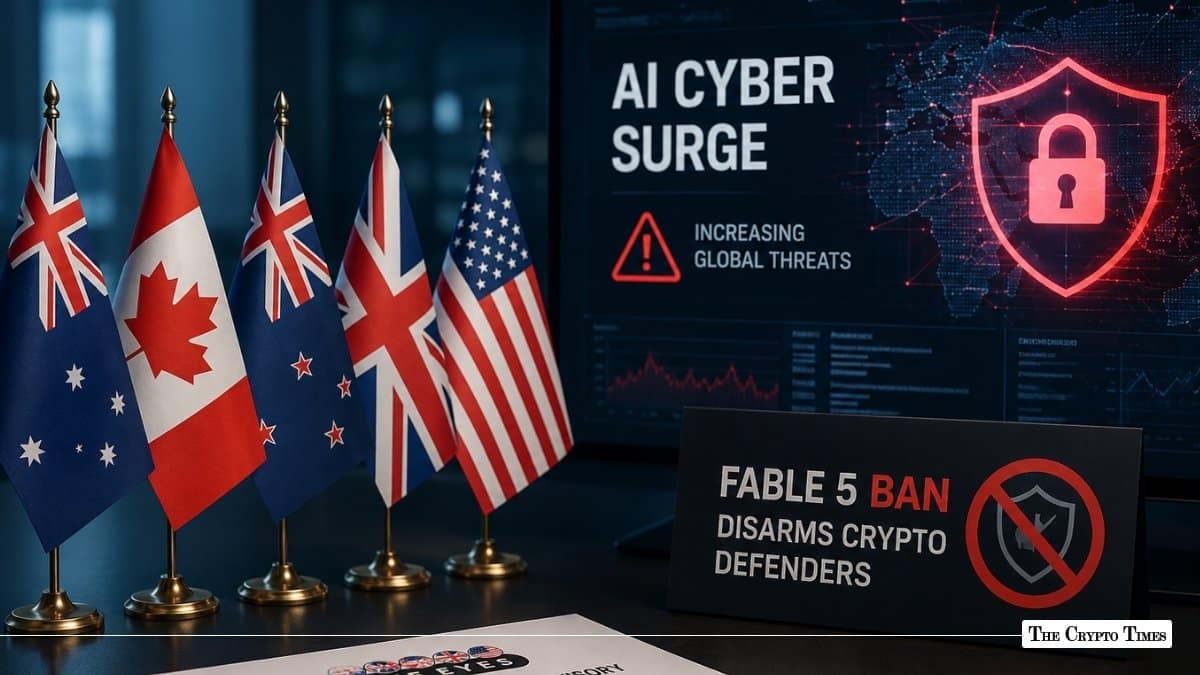
In crypto, code is the vault. There are no chargebacks and rarely any recourse. A single unpatched flaw can drain a decentralized protocol in one irreversible transaction. Now, the world’s most powerful intelligence-sharing alliance is warning that the window to find and patch those vulnerabilities is violently shrinking.
The cybersecurity heads of Australia, Canada, New Zealand, the United Kingdom, and the United States, collectively called the “Five Eyes,” issued a joint statement titled “The AI shift in cyber risk: why leaders must act now.” Published on June 22, the document is unusually blunt: frontier AI models will fundamentally transform both offensive and defensive cyber capabilities. The agencies warn the timeline for this shift is “months, not years.”
For digital-asset systems, the timing is perilous. The advisory arrives just as a US export-control directive targeting foreign nationals forced Anthropic to abruptly pull its Fable 5 model for all users globally. Security experts warn this leaves crypto’s defenders strictly outgunned by attackers who continue to wield comparable, unsafeguarded AI capabilities.
Why crypto sits in the impact zone
The agencies’ central warning is that AI lowers the barrier for malicious actors and increases the speed and complexity of attacks, continually shrinking the window between a vulnerability being discovered and being exploited. That dynamic is dangerous everywhere; in crypto it is almost uniquely so. Digital-asset systems run on public, immutable smart contracts where the code is the vault, a single unpatched flaw can drain a protocol in one irreversible transaction, with no chargebacks and often no recourse.
The sector meets this warning already bruised. 2025 was the worst year on record for crypto theft, with hacks and exploits draining an estimated $2.7 billion to $3.35 billion, headlined by the roughly $1.4 billion Bybit breach, the largest crypto heist in history. The agencies explicitly note that as AI systems evolve, new and previously unknown vulnerabilities, including zero-days, will emerge. For DeFi protocols, bridges, exchanges and custodians, that means attackers may locate and weaponize a bug faster than human teams can audit, patch and respond.
What the agencies are telling leaders
The Five Eyes statement reframes cyber risk as a core leadership responsibility, stressing that having controls on paper is no longer enough. The agencies set out five urgent actions that map directly onto crypto infrastructure:
- Reduce the attack surface by limiting unnecessary access and challenging whether certain off-chain or oracle systems need to be exposed at all.
- Accelerate patching, because AI is aggressively compressing the time between vulnerability discovery and exploitation.
- Address legacy systems, reframing outdated infrastructure and deprecated smart contracts as strategic liabilities, not just technical debt.
- Strengthen identity and access controls, mandating rigorous admin-key management and enforcing strict multisig permissions.
- Prepare for inevitable incidents, assuming breaches will occur and focusing on fast containment, circuit breakers, and rapid recovery.
Behind almost every nine-figure loss in DeFi is a sprawling, undermanaged attack surface. For crypto businesses, the Five Eyes guidance reads like a direct mandate to tighten admin keys and radically accelerate response times to disclosed contract flaws.
The arms race cuts both ways
The agencies are emphatic that AI is also a defensive weapon, and urge organizations to use it deliberately to strengthen defence rather than merely improve efficiency. Adversaries are already using AI to move faster, they note, and defenders must do the same, integrating AI to detect vulnerabilities earlier, improve software quality, monitor unusual behaviour and respond faster.
That cuts in crypto’s favour too: AI-assisted auditing, formal verification and continuous on-chain monitoring at machine speed could surface exploitable bugs before attackers do. But the same autonomy creates fresh exposure. On-chain AI agents that execute strategies and move funds without a human in the loop are a brand-new attack surface, faster than human operators yet uniquely vulnerable to manipulation when their permissions are loosely designed.
The Fable 5 irony
The timing carries a pointed subtext. While the Five Eyes statement does not name any vendor, it lands just days after US export controls forced Anthropic to withdraw Fable 5, the safeguarded, publicly available counterpart to the cyber-capable Mythos 5. Security researchers protested in an open letter that restricting Fable 5 disadvantages defenders, since adversaries already have access to models nearly as capable and are closing the gap fast.
That tension sits at the heart of the agencies’ message. They close by calling on leaders across industry, explicitly including vendors, to act now and share threat information, and they urge defenders to wield AI deliberately. Yet the most capable defensive tooling is precisely what governments are now moving to gate. For crypto security teams, who arguably have the most to gain from AI that can audit a smart contract at machine speed and the most to lose from one that can exploit it, that policy crossfire is anything but academic.
The takeaway
Signed by Stephanie Crowe (Head Australian Cyber Security Centre), Rajiv Gupta (Head Canadian Centre for Cyber Security), Catriona Robinson (Head of New Zealand’s National Cyber Security Centre), Richard Horne (CEO, National Cyber Security Centre-UK), David Imbordino (Director Cyber Security Directorate-USA), and Nick Andersen (CISA), the statement carries the weight of the world’s most powerful intelligence-sharing alliance.
Stripped of the diplomatic phrasing, its message is blunt: breaches are inevitable, the only variable is preparedness, and the clock is now measured in months. In an industry where the code is the bank, that may be the most consequential government guidance of the year, and the one most likely to be ignored until the next exploit makes it unavoidable.
Also Read: $950K Drained: ATM Token Suffers Second Major Exploitation on BNB Chain