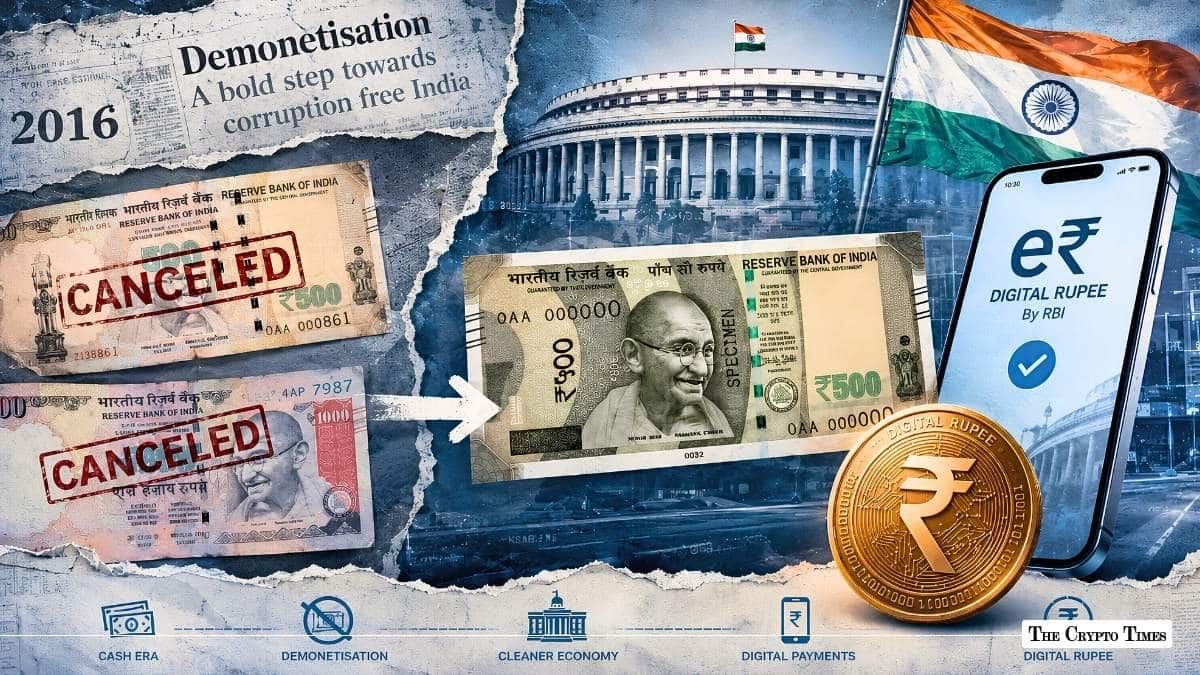
At 8 pm on November 8, 2016, every television set in India tuned into the same broadcast. Prime Minister Narendra Modi, in an unscheduled national address, told 1.3 billion people that their 500 and 1,000 rupee notes were worthless. Effective midnight. No extensions.
The country went into shock. ATMs ran dry within hours. Queues outside banks stretched for blocks. Small businesses that ran entirely on cash shuttered for days. Migrant laborers who carried their earnings in folded notes found themselves holding paper that could not buy a meal. In a single evening, 86% of all currency in circulation was declared invalid.
Demonetization, as the policy was called, was framed as a surgical strike against black money, counterfeit currency, and terror financing. Its economic legacy remains bitterly debated. But it did something that no white paper or policy committee could have: it forced a cash-dependent nation of street vendors, autorickshaw drivers, chai sellers, and farming households to confront digital money for the first time.
Paytm’s downloads surged 300% in the weeks that followed. The Unified Payments Interface (UPI), a real-time interbank payment system the National Payments Corporation of India had launched just months earlier in April 2016, went from an obscure backend protocol to the only way millions of Indians could transact. Within two years, UPI would process more transactions daily than most countries manage in a month.
Demonetization did not cause India’s blockchain journey. But it cracked the ground open. It proved that the Indian state was willing to make disruptive, even traumatic, interventions in the monetary system if it believed the outcome served its vision of a digital economy.
It created a population that, willingly or not, had been pushed off cash and onto digital rails. And it embedded a political conviction in New Delhi that would drive every policy decision that followed: the state, not markets, not miners, not foreign exchanges, would decide what money looks like in the Republic of India.
To understand how that conviction became a CBDC, a national blockchain framework, and programmable welfare delivery, you have to go back three years before demonetisation, to a press release that almost nobody read.
Phase I: Skepticism and Control (2013 to 2020)
On December 24, 2013, the Reserve Bank of India (RBI) published a short notice cautioning users and traders of “Virtual Currencies, including Bitcoins” about potential financial and security risks. While it did not explicitly ban anything, it simply, yet sharply, said the central bank had not authorized any entity to deal with these instruments.
Bitcoin had then just crossed $1,000 for the first time. Small Indian exchanges like Buysellbitco.in and INRBTC were getting started, and several were temporarily shut down after the notice.
The warnings escalate
Let’s fast forward to a few years later. In February 2017, the RBI issued a second warning, and a third in December 2017, timed to the global mania that saw Bitcoin blow up past $10,000 and Indian retail investors flooding into exchanges.
Then, on April 6, 2018, the RBI dropped the hammer with a circular under the Banking Regulation Act, directing every regulated entity to cease dealing in virtual currencies and exit existing crypto-related relationships within three months.
This was a de facto banking ban. Exchanges lost bank accounts overnight. Customers could not deposit or withdraw fiat. Some platforms pivoted to peer-to-peer models. Others shut down entirely.
The Supreme Court reversal
The Internet and Mobile Association of India challenged the circular. On March 4, 2020, the Supreme Court struck it down in IAMAI v. RBI, ruling it disproportionate under Article 19(1)(g) of the Constitution. The court did not endorse crypto or declare it legal tender. It simply said the RBI had not demonstrated actual harm to regulated entities.
The crypto industry celebrated. The government took a different lesson entirely: regulation, not prohibition, was the legally sustainable path. And the groundwork for a state alternative had already begun.
Phase II: Blockchain without crypto (2018 to 2022)
While the banking ban was being fought in court, Indian policymakers were learning to separate the technology from the token. Finance Minister Arun Jaitley drew the line in his February 2018 Budget Speech: the government did not recognize crypto as legal tender, but it encouraged blockchain technology in payment systems. India was not anti-blockchain. It was anti-private-crypto.
NITI Aayog’s national strategy
In January 2020, NITI Aayog published “Blockchain: The India Strategy, Part I”, a 59-page paper arguing that blockchain could redefine trust in governance, reduce costs, and replace paper-based legacy systems. It documented pilot projects already underway, including a fertilizer subsidy supply chain initiative with PwC and Intel for Gujarat Narmada Valley Fertilizers, targeting a drastic reduction in processing times of three to four months through a shared, tamper-proof ledger.
The paper called for a national blockchain infrastructure and government procurement processes for the technology. The state intended to claim blockchain for itself.
States as pioneers
Several states moved faster than New Delhi.
Andhra Pradesh and Telangana
Andhra Pradesh became the first Indian state to pilot blockchain for land records in October 2017, partnering with ChromaWay and Zebi Data to build blockchain-secured records in the Amaravati capital region.
By 2025, the project had authenticated approximately 340 million government documents on the Polygon blockchain. In January 2026, Chief Minister Chandrababu Naidu announced blockchain-secured surveys would cover the entire state by 2027. Telangana ran a parallel pilot in Hyderabad with C-DAC and Tech Mahindra for revenue department records.
Tamil Nadu, Maharashtra, and beyond
Tamil Nadu published a dedicated Blockchain Policy in 2020. Maharashtra explored blockchain for its Mahabhulekh land portal. Karnataka integrated its Aushada medicine supply system with blockchain for drug traceability.
Nearly half of India’s states were running blockchain pilots before the central government had even launched its own framework. None involved cryptocurrency.
The UPI precedent
By 2022, UPI was processing over 300 million transactions per day, the most successful real-time payments system in the world. UPI proved India could build world-class digital payment infrastructure that was public, sovereign, interoperable, and free.
The lesson for policymakers was decisive: India did not need private crypto to digitize money.
Phase III: The state-led ledger era (2022 to 2026)
By 2022, India had rejected private crypto, embraced blockchain for governance, and built the world’s leading real-time payments system. Now it was ready to build its own digital money.
Budget 2022: The dual announcement
On February 1, 2022, Finance Minister Nirmala Sitharaman settled two questions at once. She announced a flat 30% tax on income from virtual digital assets with no deductions except acquisition cost, no loss set-offs, and a 1% TDS on all crypto transactions above ₹50,000 annually. The 30% rate matched the tax on lottery winnings. The signal was blunt.
In the same speech, she announced the RBI would issue a Digital Rupee based on blockchain technology. The Finance Act 2022 amended the Reserve Bank of India Act of 1934 to give the central bank legal authority to issue CBDC.
Tax crypto punitively. Build state digital money. That was the playbook.
RBI’s concept note and pilot launches
On October 7, 2022, the RBI published its Concept Note on CBDC, classifying the Digital Rupee into wholesale (for interbank settlements) and retail (for consumer transactions).
The wholesale pilot (e₹-W) launched on November 1, 2022, focused on the settlement of secondary market government securities transactions. Nine banks participated, including SBI, HDFC Bank, ICICI Bank, and HSBC.
The retail pilot (e₹-R) followed on December 1, 2022, launching in Mumbai, New Delhi, Bengaluru, and Bhubaneswar. The retail e₹ was token-based: the holder was presumed to be the owner, transactions settled instantly between digital wallets, and payments to merchants worked via QR codes.
Early numbers and scale-up
Initial figures were modest. The wholesale pilot averaged ₹325 crore per day. The retail pilot created ₹3 crore in its first 48 hours. By September 2023, daily retail transactions sat at just 18,000. But as the RBI confirmed to Parliament, the pilot was built for learning, not mass adoption.
By December 2023, the RBI hit one million daily retail transactions. By March 2025, the pilot had expanded to 17 banks and six million users. Digital rupees in circulation grew from ₹100 crore in late 2023 to ₹1,016 crore (~$120 million) by March 2025, with cumulative retail value crossing $3 billion by year-end.
The numbers were never the point. The features were.
Programmable CBDC: money that carries rules
On August 29, 2024, HDFC Bank introduced user-level programmability on the Digital Rupee, letting users set conditions on how and where e₹ could be spent, including validity periods and geographic restrictions.
The government deployed programmability for welfare at speed. In April 2024, IndusInd Bank used programmable e₹ to compensate 50 Maharashtra farmers for carbon credits. Andhra Pradesh delivered its Deepam 2.0 LNG subsidy through programmable CBDC. Gujarat’s G-SAFAL scheme restricted livelihood assistance to approved agricultural inputs.
On February 26, 2026, Puducherry launched a food subsidy pilot under the Pradhan Mantri Garib Kalyan Anna Yojana, where CBDC tokens could only be redeemed at authorised merchants for entitled foodgrains. In Kerala, over 100 Kudumbashree women in waste management received income via programmable e₹, with the scheme expected to scale to nearly 10 million beneficiaries.
India was no longer digitizing money. It was programming it.
Offline e₹: solving the last-mile problem
At the Global Fintech Fest 2025 in Mumbai, the RBI unveiled offline Digital Rupee functionality, using NFC-based tap payments to enable wallet-to-wallet transactions with zero internet connectivity. Users tap devices together, value transfers instantly, and change is generated automatically in the wallet. No fees, no minimum balance, and wallets are recoverable if the device is lost.
Fifteen banks rolled out offline e₹ in late 2025. India became one of the first countries to operationalize a CBDC with offline capability, a critical milestone for a nation where hundreds of millions live beyond reliable connectivity.
The National Blockchain Framework
On September 4, 2024, MeitY launched the National Blockchain Framework with a ₹64.76 crore budget. Built on the Vishvasya Blockchain Technology Stack, an indigenous Blockchain-as-a-Service platform running Hyperledger Fabric and Hyperledger Sawtooth across NIC data centres in Bhubaneswar, Pune, and Hyderabad, the NBF is the governance backbone of India’s blockchain ambitions.
Four core components
Vishvasya is the core permissioned blockchain stack. NBFLite is a sandbox for startups and researchers. Praamaanik verifies mobile app authenticity via blockchain. The National Blockchain Portal is the centralized repository for policies and use cases.
The numbers by late 2025
Over 340 million documents verified, spanning CBSE certificates, land records, income certificates, and driving licences. TRAI integrated DLT for telecom spam prevention across 113,000+ entities.
NSDL deployed blockchain for debenture covenant monitoring. Over 21,000 government officials trained through 214+ MeitY programmes.
Cross-border ambitions
On June 30, 2024, the RBI joined Project Nexus, the BIS-led initiative linking fast payment systems across India, Malaysia, Thailand, the Philippines, and Singapore, expected to go live in 2026. The RBI had already linked UPI bilaterally with payment systems in Bhutan, the UAE, France, Sri Lanka, and Mauritius.
The RBI signed a digital assets pact with Singapore’s Monetary Authority and is reportedly exploring CBDC corridor pilots with Singapore and the UAE. In 2026, reports emerged that the RBI proposed placing BRICS CBDC interlinking on the agenda of the 2026 summit hosted by India, building on the Project mBridge wholesale CBDC platform that reached MVP stage in mid-2024.
What comes next
India has built something no other major democracy has attempted at this scale: a state CBDC with programmable welfare and offline capability, a national blockchain framework verifying hundreds of millions of documents, and cross-border payment corridors spanning two continents. All while keeping a 30% tax wall around private crypto.
The infrastructure is live. The question now is political. Will the 30% tax stay, or will India create space for regulated private innovation alongside state digital money? Will programmable CBDC, built for targeted subsidies, also enable targeted restrictions on how citizens spend their money? Will offline e₹ deliver genuine financial inclusion, or extend state visibility into the last corners of the cash economy?
The arc from that November 2016 evening, when a prime minister invalidated the wallets of a billion people, to this moment, when six million Indians carry programmable state-issued tokens in their phones, is not a story of technology adoption. It is the story of a state that watched private digital money rise, decided it was a threat, and built its own version on its own terms.
India did not adopt blockchain. It captured it.
Also Read: The 7% Premium Trap Exposed: How India Makes Crypto More Expensive Than Dollars