
Key Highlights
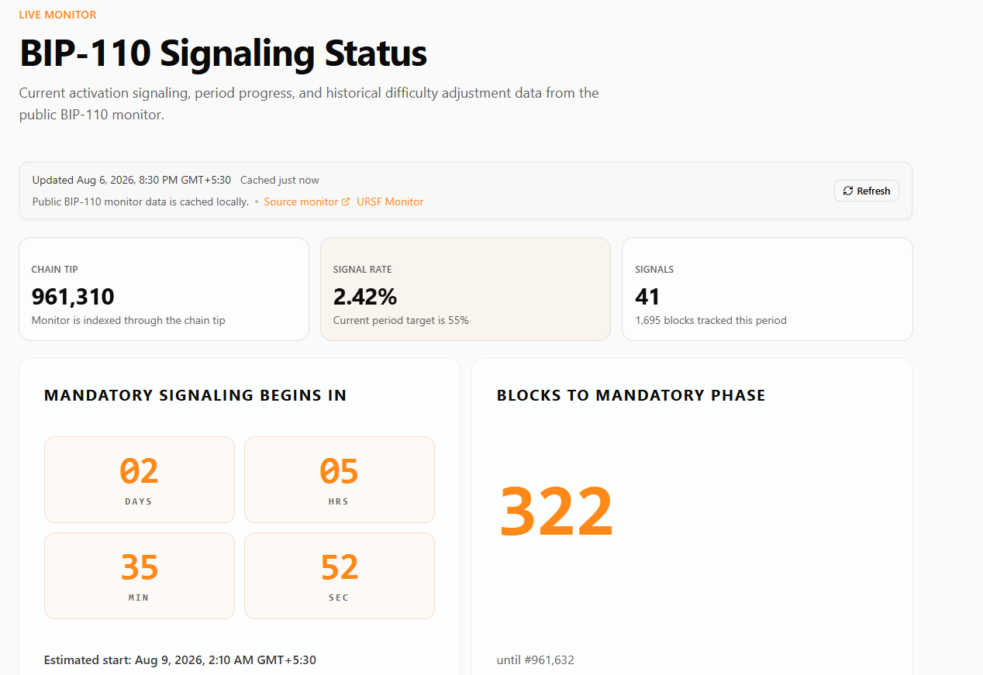
- BIP-110 has entered its final voluntary signaling period, with mandatory signaling expected to begin in about two days.
- Current miner signaling stands at 2.42%, far below the 55% threshold required for early lock-in.
- Bitcoin Suisse CEO Andrej Majcen questioned whether the proposal addresses blockchain spam at its source.
Bitcoin’s proposed BIP-110 soft fork is set to enter its mandatory signaling phase around August 9, according to the public BIP-110 monitoring dashboard, even as miner support remains well below the threshold required for early activation.
The dashboard showed the proposal had secured 2.42% signaling support during the current difficulty adjustment period, compared with the 55% required for early activation.
The proposal has sparked debate among developers, miners, and other Bitcoin ecosystem participants over whether consensus rules should be used to limit non-monetary data stored on the blockchain.
Proposal targets blockchain data usage
BIP-110 aims to reduce the use of Bitcoin block space for data unrelated to monetary transactions, including certain inscriptions, tokens, and other forms of embedded content.
Supporters argue that limiting these uses would preserve block space for payments and reduce blockchain bloat. However, critics contend that Bitcoin’s permissionless design should not discriminate between transaction types as long as users pay the required transaction fees.
The proposal has become a focal point in the long-running debate over whether Bitcoin should remain primarily a monetary network or continue accommodating broader on-chain applications.
Andrej Majcen questions rule changes
Among those questioning the proposal is Bitcoin Suisse Co-Founder and CEO Andrej Majcen, who argued that restricting one method of storing data is unlikely to eliminate unwanted blockchain activity. He stated, “Bitcoin’s block space has been used for image files, tokens, and inscriptions that have nothing to do with sending or storing money, and I understand why part of the community wants that contained.”
However, he suggested that determined users would simply adopt alternative methods. “Anyone determined to put unwanted content on the chain will find another encoding path once this one closes,” he added.
Majcen also warned against changing Bitcoin’s consensus rules to address what he views as a market issue. He added that while future protocol upgrades may become necessary for threats such as quantum computing, spam does not currently justify such a change.
Saylor focuses on economic consensus
The governance debate has also drawn comments from Strategy Executive Chairman Michael Saylor, who earlier this week argued that Bitcoin protocol changes require broad economic support rather than technical backing alone.
Commenting on BIP-110, Saylor said Bitcoin’s direction is ultimately determined by what exchanges, miners, custodians, investors, and businesses collectively adopt—not simply by the number of signaling nodes.
His remarks added another dimension to the discussion, highlighting the distinction between technical signaling and economic consensus, a principle that has historically shaped major Bitcoin upgrades.
Ordinals community warns of a minority fork
Meanwhile, opposition from the Ordinals ecosystem has become increasingly vocal.
In a thread on X, Leonidas, a prominent Ordinals advocate, described BIP-110 as an attempt to restrict Ordinals and Runes activity on Bitcoin. He argued that the proposal would fail to gain sufficient support and instead lead to a minority chain.
Leonidas also called for the Ordinals ecosystem to reduce its reliance on Bitcoin Core development and instead build an independent Bitcoin client capable of pursuing its own roadmap.
Governance debate extends beyond BIP-110
While BIP-110 focuses on limiting certain categories of blockchain data, the discussion has evolved into a broader debate over Bitcoin governance itself.
Some participants argue protocol changes should prioritize preserving Bitcoin’s monetary function, while others believe market incentives, not consensus rule changes, should determine how block space is used.
With mandatory signaling approaching and support still limited, BIP-110 has become another test of how Bitcoin balances technical proposals, economic incentives, and community consensus without altering the network’s long-standing governance model.
Also Read: ARK Invest Says Ethereum Revenue Debate Goes Beyond EIP-8361