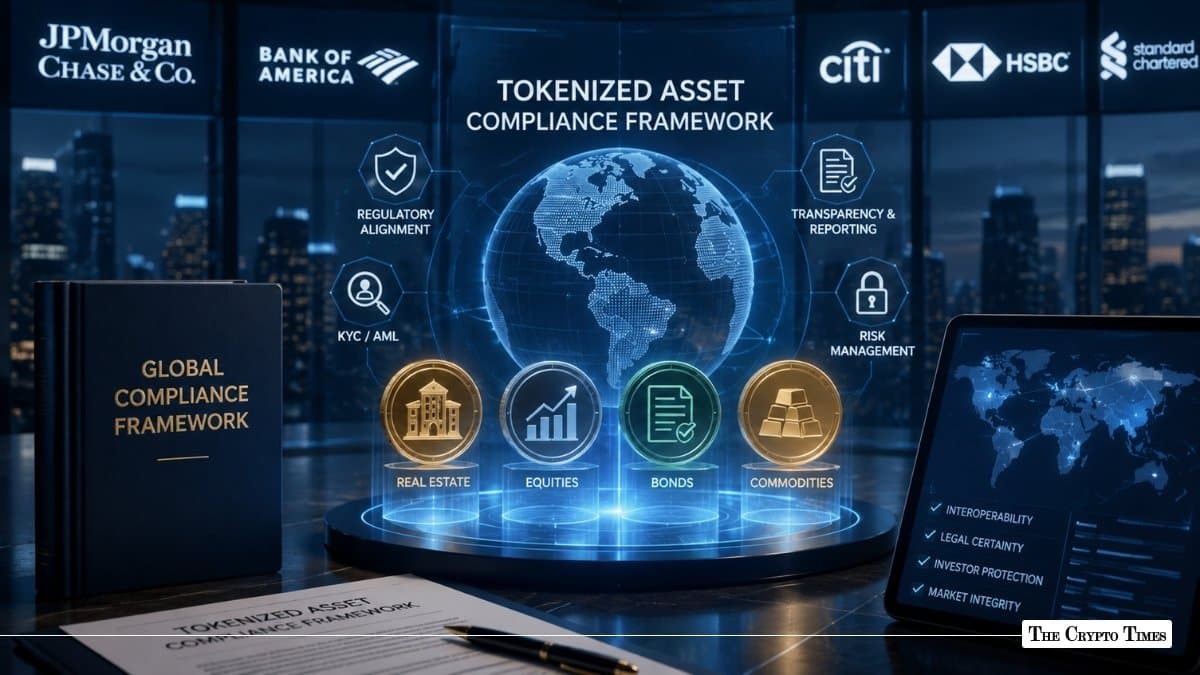
Major financial institutions and regulators have introduced a new framework aimed at helping digital assets comply with financial rules while protecting user privacy, as interest in tokenized finance continues to grow.
The framework was outlined in a white paper published by Global Layer One, with contributions from the International Monetary Fund (IMF), Banque de France, JPMorgan’s Kinexys unit, and the Monetary Authority of Singapore. The paper explores how compliance checks can be built directly into digital assets, allowing regulators to maintain oversight without exposing sensitive information.
The effort also brought together Standard Chartered, Chainlink Labs, the BIS Innovation Hub, and GLEIF, while Bermuda contributed expertise on privacy-focused technologies. The group said clearer standards will be needed as more financial assets move onto blockchain-based systems and tokenized markets continue to expand.
Privacy and compliance move to center stage
Bermuda said one of the main challenges facing tokenized finance is finding the right balance between transparency and privacy. While public blockchains make transactions easy to track, they can also expose sensitive information that financial institutions are required to keep confidential.
The firm said the opposite approach can create problems as well. If privacy measures are too restrictive, regulators may struggle to identify and isolate bad actors. In some cases, authorities may be left with no option but to freeze an entire pool of assets, affecting legitimate users along with those under investigation.
To address that issue, the white paper outlines tools that could give regulators more targeted ways to enforce rules without exposing private data. One of the technologies highlighted is zero-knowledge proofs, which allow information to be verified without revealing the details behind a transaction.
Jan Philipp Fritsche, Bermuda’s Co-Founder and a former European Central Bank official, said effective oversight requires precision. He said recent incidents have shown the drawbacks of broad enforcement measures that can end up impacting compliant users as well as wrongdoers.
Banks and tokenization efforts accelerate
Traditional banks are stepping up their work on blockchain systems as competition in digital payments grows. JPMorgan Chase, Citigroup, Bank of America and Wells Fargo have supported plans for a tokenized deposit network that will run through The Clearing House, with a launch expected in 2027. The move reflects how major banks are trying to modernize payments as stablecoins gain wider use.
Interest in tokenized assets is also expanding beyond banking. Apex Group has joined Goldman Sachs, Archax, LRC Group and Ownera in a blockchain-based real estate fund that will use Goldman Sachs’ GS DAP platform to issue tokenized fund shares. In simple terms, investors would hold digital versions of fund ownership recorded on a blockchain.
Regulators are also tightening their approach. CryptoUK said a proposal involving U.S. agencies, including the Federal Reserve, OCC, FDIC, FinCEN, and the National Credit Union Administration, would require stablecoin issuers to carry out risk-based identity checks.
However, people holding tokens on secondary markets would not be treated as direct customers. The aim is to improve anti–money laundering controls without disrupting how blockchain systems operate.
Also Read: Five Eyes Warns of AI Cyber Surge as Anthropic’s Fable 5 Ban Hits Crypto