
In late May, Michael Saylor led Strategy Inc. (formerly MicroStrategy) did something it had not done since 2022: it sold Bitcoin (BTC). Just 32 coins, worth roughly $2.5 million. The proceeds went toward distributions on its Variable Rate Series A Perpetual Stretch Preferred Stock, known as STRC.
For a company that built its identity around “never selling Bitcoin,” the move was small in absolute terms but seismic in symbolism. It has since fueled intense discussion across crypto markets and investor forums about whether Strategy will need to sell substantially more of its 846,842,000 BTC holdings to service the dividends on its preferred shares, or whether smarter capital allocation moves, such as buying back discounted preferred stock, could resolve the pressure.
A Surprising Bitcoin Sale Shakes Investor Confidence
The sale, disclosed in an 8-K filing on June 1, marked the first time Strategy had parted with any Bitcoin since it began its aggressive accumulation strategy years earlier. Chairman Michael Saylor had long framed the company’s approach as a pure Bitcoin treasury play, with the explicit goal of increasing Bitcoin per share over time.
Company filings and statements indicate the sale was tactical, a minimal amount to meet preferred dividend obligations while the firm continued building cash reserves. Shortly afterward, Strategy purchased additional Bitcoin through other means, maintaining its net accumulator status.
Still, the precedent rattled parts of the market. Critics argued that any Bitcoin sale, no matter how small, exposed a structural vulnerability in relying on perpetual preferred equity with real cash dividend requirements during periods of Bitcoin price weakness.
STRC Trades at Record Discount Amid Volatility
In added scrutiny, the STRC preferred stock, designed as a high-yield vehicle to attract capital for Bitcoin purchases, has traded well below its $100 par value in recent weeks. On June 18, the preferred stock dipped as low as $83 before closing at $88.59, representing an approximate 11% discount and pushing the effective yield above 13%.
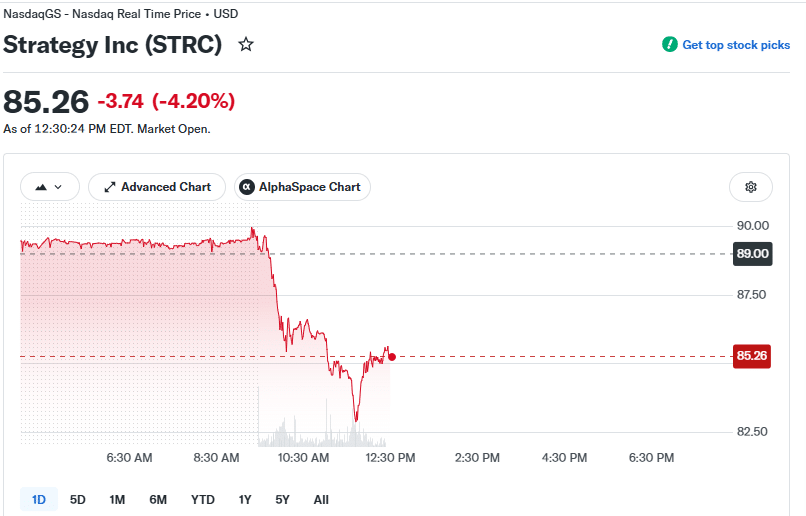
The drop coincided with broader Bitcoin volatility and followed Strategy’s decision to pause at-the-market issuance of new STRC shares above par: a key mechanism the company had used to raise relatively inexpensive capital for further Bitcoin acquisitions.
Strategy has emphasized that its Bitcoin holdings provide coverage for approximately 32 years of preferred dividends at current levels, supported by a roughly $1.1 billion cash reserve built in part through common stock sales. The company also secured shareholder approval in early June to shift STRC dividend payments from monthly to semi-monthly, a change intended to improve liquidity and reduce reinvestment lag for holders.
Company Reassures with Coverage Claims and Policy Tweaks
Saylor has publicly backed STRC, describing the goal of making it “the best credit instrument in the world.” The company’s messaging frames the recent Bitcoin sale not as a retreat from its Bitcoin-first philosophy but as a demonstration of commitment to preferred holders.
By honoring dividend obligations even through a small liquidation, Strategy aims to build long-term credibility that could support future preferred issuance when market conditions improve. The semi-monthly payment cadence and cash buffer are presented as prudent steps to de-risk the structure.
The company’s management continues to evaluate all capital allocation decisions through the lens of Bitcoin per share accretion rather than absolute Bitcoin holdings or short-term common stock price movements.
Crypto Community Divided on the Path Forward
Reactions across X and crypto investment circles have been sharply split.
Many long-term Strategy supporters view the May sale as a calculated, low-impact signal. They argue that selling an insignificant fraction of holdings to uphold obligations strengthens the preferred product, potentially drawing more capital inflows that ultimately fund larger Bitcoin purchases.
Alternately, some have described the move as strategic positioning or even a market “troll” to reset expectations.
Critics, however, see it as evidence of a deeper flaw. They contend that perpetual high-yield preferred obligations create ongoing cash needs that Bitcoin’s volatility cannot reliably cover without periodic sales or dilution. The depeg of STRC below par and the pause in new issuance above par are cited as early warning signs of stress in the model.
Skeptics have drawn parallels to classic leveraged structures that can face margin-like pressures during drawdowns, while defenders emphasize Strategy’s massive Bitcoin stack and long-term horizon.
Buybacks Emerge as a Potential Solution
One of the more constructive ideas gaining traction in recent discussions involves Strategy using capital to repurchase its own preferred shares trading at a discount.
Because STRC is currently available well below par, buying back and retiring portions of the outstanding preferred stock could eliminate or reduce the associated high dividend obligations. This approach is explicitly permitted under the terms of the preferred stock prospectus and is viewed by some analysts and investors as accretive to common shareholders.
Proponents argue that such a move would simplify Strategy’s capital structure, lower ongoing cash requirements, and return the company closer to a cleaner Bitcoin treasury model without perpetual yield drag. It could be funded through a combination of common stock sales, modest Bitcoin liquidations, or other financing, potentially executed opportunistically while shares trade cheaply.
Other suggested paths include continued common equity issuance to simultaneously acquire Bitcoin and bolster reserves, further adjustments to dividend policy, or a greater emphasis on any remaining software revenue streams. However, the buyback concept stands out for its potential to directly address the “hole” created by preferred obligations.
Risks and Broader Implications for Corporate Bitcoin Plays
The current episode highlights both the power and the perils of using preferred equity to scale a Bitcoin treasury. On one hand, the structure has allowed Strategy to raise substantial capital on terms attractive to income-seeking investors while maintaining aggressive Bitcoin accumulation. On the other, it introduces fixed-ish cash obligations in an asset class known for sharp price swings.
For the wider corporate Bitcoin adoption narrative, Strategy remains the most visible and influential example. How the company navigates the STRC situation could influence whether other public companies pursue similar hybrid capital structures or opt for simpler equity or debt raises.
Short-term risks include further pressure on MSTR common stock if STRC weakness persists or if larger Bitcoin sales are required. Longer-term, Bitcoin’s price trajectory will likely remain the dominant variable. A sustained recovery could restore the ability to issue preferred shares above par and ease dividend pressures organically.
What Comes Next
Investors and observers will be watching several indicators closely in the coming weeks and months: any additional disclosures around Bitcoin transactions or preferred activity in upcoming filings, the performance of STRC as it transitions to semi-monthly payments, and whether Strategy announces any formal share repurchase program for its preferred stock.
Bitcoin price action will also play a decisive role. A meaningful rebound could validate the company’s patient, long-horizon approach, while prolonged weakness would intensify scrutiny of the preferred stock strategy’s sustainability.
For now, Strategy appears committed to honoring its obligations while continuing to accumulate Bitcoin on net. Whether that requires additional sales to “fill the STRC hole” or whether capital markets maneuvers like discounted buybacks can provide a cleaner exit remains one of the most closely watched questions in the Bitcoin corporate treasury space.
Also read: What Happened to Strategy’s STRC and Strive’s SATA?