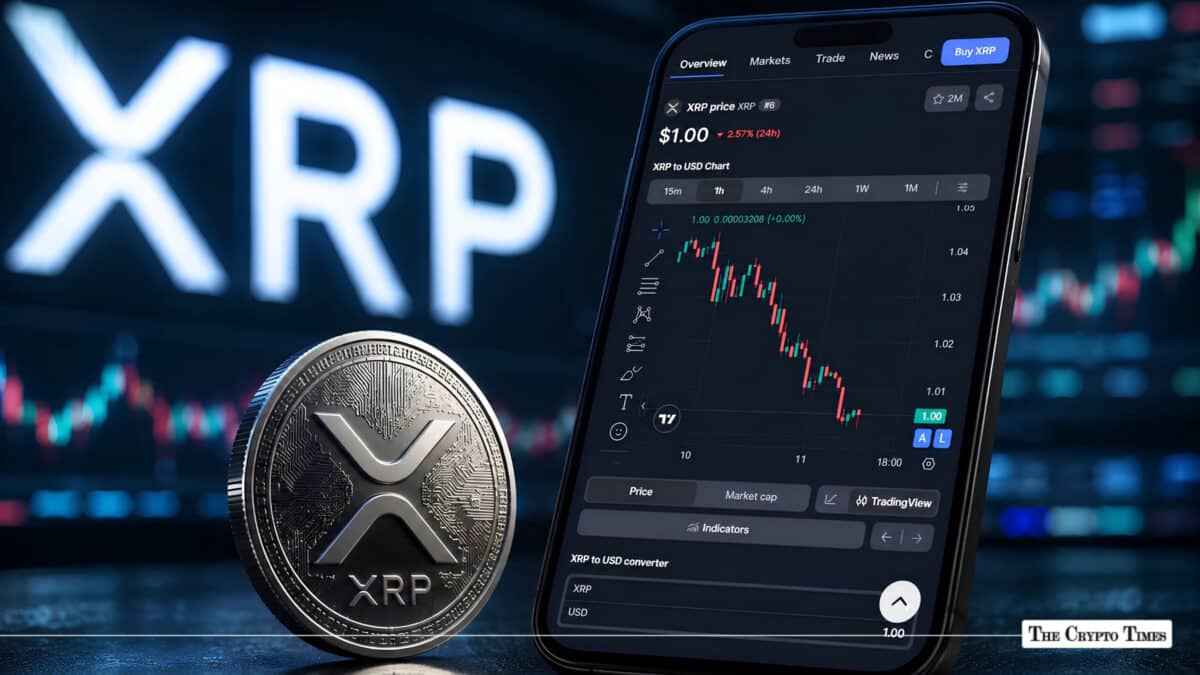
XRP, the native cryptocurrency of the XRP Ledger, hovered near the critical $1 psychological level on Tuesday, August 11, 2026, as large holders continued to build positions despite broader crypto market pressure and muted institutional flows.
As of 10:30 UTC on August 11, 2026, XRP traded around $1.01, digesting a decline of roughly 2.7% over the prior 24 hours, according to data from CoinMarketCap. Its market capitalization stood near $62.75 billion, with 24-hour trading volume in the $1.0 billion to $1.17 billion range.
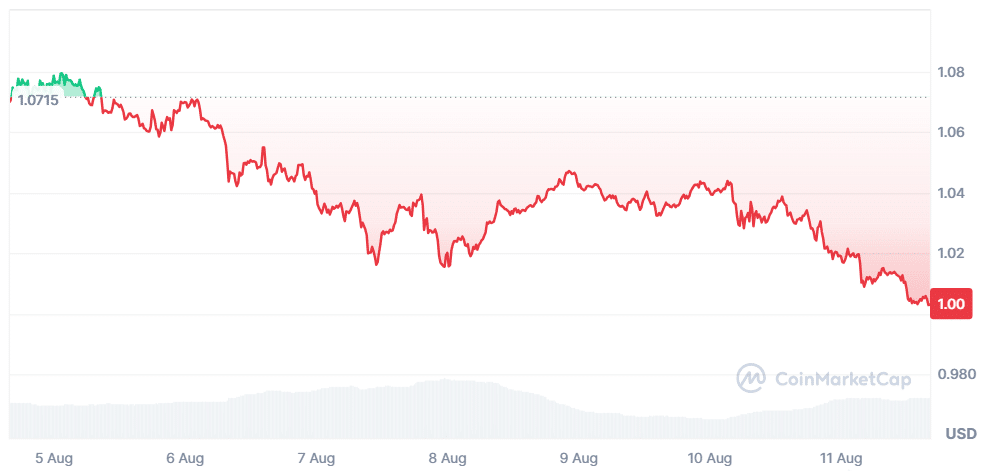
XRP price has ground lower in recent sessions after peaking near $1.16 in late July. Daily closes tracked a gradual retreat from the low- to mid-$1.10s through early August, with recent trading confined largely between $1.00 and $1.04.
Over the past week the cryptocurrency was down about 5% to 6%, while the 30-day decline measured roughly 7% to 8%. On a one-year basis, XRP remained approximately 69% below levels seen near its mid-2025 highs of around $3.35 to $3.66.
Various analysts on X highlighted $1.00 as the pivotal support, stating that a sustained break lower could expose the $0.97 Fibonacci zone, a technical analysis tool to find potential support, resistance, and reversal points on a price chart.
The U.S. Consumer Price Index (CPI) report scheduled for August 12 was widely flagged as a potential near-term catalyst that could drive volatility in either direction in XRP price and the broader crypto market.
Whales Accumulate Hundreds of Millions Near Key Level
On-chain data painted a contrasting picture beneath the flat price action. Large holders, commonly referred to as whales, accumulated more than 380 million XRP over the preceding week, according to latest data from Santiment. Buying appeared concentrated around the $1 mark. Certain large-holder cohorts saw their combined balances rise to approximately 8.1 billion to 8.13 billion XRP following the purchases.
Year-to-date through early August, wallets holding between 10 million and 100 million XRP added roughly 1.23 billion tokens, lifting their aggregate holdings from about 10.97 billion to 12.2 billion. The number of such addresses increased from around 301 to 313.
On the other hand, exchange flow metrics reinforced the accumulation narrative. CryptoQuant data shows that XRP Whale addresses accounted for a high share of outflows from platforms such as Binance, with reports indicating roughly 81% of recent Binance XRP outflows originated from large holders shifting tokens into self-custody.
Whale inflows to exchanges had previously fallen to multi-month lows.
Earlier in the year, wallets in the 100,000-to-100-million range had already increased their XRP balances by about 2.8% over multi-week periods while smaller retail wallets reduced positions.
Divergent Signals Shape Near-Term Outlook
The divergence between quiet whale accumulation and subdued price performance has drawn attention from market observers. Some analysts interpret the buying, coupled with reduced exchange deposits, as consistent with late-stage accumulation in a broader downtrend.
As highlighted by Ali Charts, a popular crypto analyst on X, technical signals including a Tom DeMark Sequential buy indication on the monthly chart noted by some commentators, have been referenced alongside the on-chain activity.
At the same time, recent weekly net inflows into the U.S. XRP spot exchange-traded (ETF) products were reported to have slowed sharply in some data sets. SoSoValue data shows XRP ETFs amassed $1.01 million in inflows whereas Bitcoin and Ether ETFs saw over hundreds of millions inflows during the last week (August 3 to 7, 2026).
As of now, XRP has maintained closes above $1 for an extended stretch measured in hundreds of days, adding a historical dimension to the current test of the level. Whether the combination of whale positioning, technical support, and the forthcoming inflation data produces a decisive move higher or further downside remains the central question for trade