
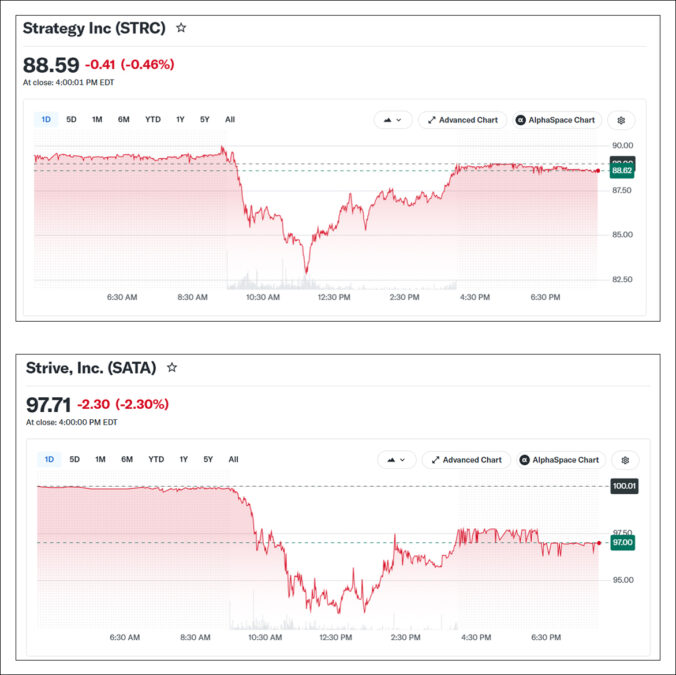
On June 18, 2026, investors in two prominent Bitcoin treasury-linked preferred securities watched sharp, rapid price declines unfold.
Strategy’s variable-rate perpetual preferred stock STRC traded as low as around $82.50. Strive’s equivalent offering, SATA, slipped from near its $100 par target into the low 90s before both instruments saw meaningful buying interest and partial recoveries by the close.
The moves came amid broader Bitcoin market pressure and triggered intense debate across trading desks, social platforms, and analyst circles. Was this a credit event signaling trouble for the issuers? Or a classic leverage-driven liquidation flush in a still-maturing asset class?
Strive CEO Matt Cole framed it as the latter. In a widely circulated statement, he described the session as “the most difficult day in the history of Digital Credit” but stressed that the selloff stemmed from over-leveraged positions unwinding, not any deterioration in the underlying credit quality of the issuers.
“What happened today was a leverage liquidation event, not a deterioration in underlying credit quality,” Cole noted.
He pointed to an old market adage: the road to hell is paved with carry. Attractive yields on assets perceived as relatively stable and low-volatility can lure investors into borrowing against them to amplify returns, until the market turns and forces selling cascades.
“When investors discover an asset that offers attractive yields, relatively low volatility, and strong underlying credit characteristics, many eventually decide that owning it is not enough. They borrow against it. They lever it. They attempt to enhance the carry,” Cole said. “That works until it doesn’t.”
How the Selloff Developed
STRC had spent much of the prior period trading in a tight range near or above $99–$100, which analysts say encouraged leverage. When attention shifted amid competing products (including SATA’s own momentum) and Bitcoin price action softened, opportunistic shorting reportedly accelerated the decline. Margin calls on highly leveraged long positions then fed on themselves, pushing prices lower independent of the issuers’ fundamentals.
SATA experienced a similar, though somewhat less severe, move before rebounding. Both securities saw “substantial demand at those prices,” according to Cole, with buying interest emerging off the intraday lows. This price action, he argued, reflected meaningful capital stepping in at discounted levels rather than a fundamental breakdown.
The broader “Digital Credit” category—perpetual preferred equity instruments issued by Bitcoin-holding companies that pay variable dividends and aim for relatively stable trading near par—had grown rapidly. Strategy and Strive were the most prominent names, with billions in notional outstanding. The sector positioned itself as a way to deliver Bitcoin-linked income with less direct volatility than holding BTC or common equity in the treasury companies.
Matt Cole’s Assessment from Strive
Cole was clear that the episode did not reflect stress at Strive itself. The company’s dividend reserves remained intact, its Bitcoin holdings and overall credit profile unchanged, and it remained well-positioned to meet obligations.
He likened the dynamic to historical episodes in traditional fixed-income markets, where highly leveraged positions in seemingly safe assets (such as U.S. Treasuries) unraveled due to balance-sheet constraints rather than credit impairment.
Importantly, Cole viewed the volatility as instructive for a young asset class. “Digital Credit is still in its infancy,” he wrote. Experiencing these mechanics now, while the market remains relatively small, allows participants to learn about leverage and liquidity risks before the category scales significantly larger. He emphasized that a liquidation event is distinct from a credit event—the price action did not alter his long-term conviction in the opportunity.
Jesse Myers’ Detailed Breakdown of the Cascade
Analyst Jesse Myers offered one of the most granular public dissections. He noted that STRC’s prior stability near par invited leverage, with investors comfortable with a narrow trading range could borrow aggressively to boost portfolio yields. When conditions shifted—attention to SATA, softer Bitcoin prices, and possible short interest—the price began to slip, triggering margin calls that snowballed.
Myers argued Strategy’s balance sheet remained sound. With current holdings and assumptions around modest Bitcoin appreciation, the company could sustain STRC dividends for decades. The selloff did not impair the issuer’s ability to pay; it reflected positioning in the secondary market.
Looking forward, he outlined plausible paths: Strategy could raise the dividend rate (potentially to 11.75% or 12% around the June 30 reset), making the instrument more attractive at current prices. The company might also consider buying back STRC shares in the open market, potentially funded by issuing common equity or other capital raises, and later re-issuing at higher levels to capture the spread for Bitcoin accretion.
Myers stressed that opportunistic hedge funds and long-term buyers would likely step in at discounted levels, helping the market “heal itself.”
He drew a clear distinction from past failures like Terra/Luna: here the issuer’s core collateral and cash-generation capacity were not in question. The lesson, in his view, is that even low-volatility-designed instruments will experience de-pegs when leverage builds up during stable periods. Markets learn, and repeats become less likely.
Skeptical and Supportive Voices
Not everyone shared the optimistic framing. Gold advocate Peter Schiff highlighted the math: at lows near $85, the effective yield on STRC rose substantially. To pull the price back toward $100 and facilitate new issuance, Strategy would likely need to increase the dividend rate further—benefiting newer buyers at the expense of earlier ones who bought nearer par.
Others focused on structural questions. One detailed analysis framed STRC as functionally similar to a coin-margined Bitcoin long position with more predictable funding costs than typical perpetual futures. In this view, Strategy operates in part like a leveraged Bitcoin trading vehicle.
When the underlying Bitcoin price declines, the economics of maintaining the preferred at par become more challenging, and buybacks or reduced issuance could become rational responses—even if that means realizing losses on the Bitcoin side to capture gains on discounted preferred repurchases. Reputational considerations around prior dividend-rate management and product characterization were also raised as potential headwinds for future capital raising.
On the more constructive side, Bitcoin entrepreneur Samson Mow described STRC (and similar instruments like SATA) as a “brilliant” design for stripping Bitcoin volatility while sharing upside potential with income-focused investors. He noted the massive addressable market for such products and argued there is nothing structurally broken in the mechanics.
Drops below par, Samson said, create opportunities for long-term capital to buy at a discount and earn the same dividend stream. The product is still young—less than a year old—and growing rapidly; patience and market-driven healing are appropriate rather than reactive intervention.
Far from the fear, Strategy founder Michael Saylor posted a brief message acknowledging the volatility while reaffirming ongoing operations: “Markets are closed today. Volatility is never easy. Bitcoin keeps working. So do we. Thank you for your support.”
Context, Risks, and Market Mechanics
These instruments sit in a hybrid space—preferred equity with variable dividends tied to the issuers’ Bitcoin treasury strategies. They are not bonds with fixed claims or direct collateral pledges in the traditional sense, nor are they stablecoins with redemption mechanisms at par.
Pricing reflects supply and demand, investor perception of dividend sustainability, Bitcoin outlook, and broader liquidity conditions. Leverage in the holder base amplifies moves in both directions.
The rapid growth of issuance created large supply that must find ongoing demand. When Bitcoin prices soften or competing high-yield opportunities emerge, that demand can pull back, pressuring prices below par until yields adjust or buyers return. Historical parallels exist in traditional preferred stock and certain fixed-income markets that trade away from par during stress periods without necessarily implying issuer insolvency.
For issuers, options include adjusting dividend rates, using corporate cash or capital raises to support the instruments (or buy them back), or allowing the market to clear at new equilibrium levels. Each choice carries trade-offs around cost of capital, dilution, and signaling.
Lessons and Path Forward
The June 18 episode underscored risks that proponents of Digital Credit had highlighted in theory: leverage can build during calm periods and unwind violently when sentiment shifts. It also demonstrated resilience in the form of buyer interest at lower prices and the distinction between secondary-market price action and the issuers’ ongoing ability to generate and distribute cash flows.
For long-term holders focused on the dividend stream rather than short-term price stability, discounted entry points improve forward yields—provided the issuers continue paying. For the sector as a whole, the event serves as a stress test that may lead to more conservative positioning, clearer risk disclosures, and potentially more measured growth in issuance going forward.
Whether STRC and SATA stabilize near prior levels, settle into new trading ranges, or see further adjustments will depend on Bitcoin’s trajectory, issuer capital-management decisions, and the willingness of both leveraged and unleveraged capital to participate at prevailing prices. The instruments remain experiments in packaging Bitcoin exposure for yield-oriented investors—an ambitious project still in its early chapters.
Volatility, as participants on all sides noted, is part of the process. How the market digests this particular episode will help determine whether Digital Credit evolves into a durable component of Bitcoin-related capital markets or faces ongoing growing pains.
Also read: Ethereum Faces Funding Crisis as Developers Warn of 3-9 Month Deadline