
A single Bitcoin short on the decentralized exchange Hyperliquid has become a live illustration of how extreme leverage works, and how little room it leaves for error.
On-chain data from the block explorer HypurrScan shows a wallet (0xff84…f1d) holding a roughly $50.7 million notional short on BTC at 40x leverage, with the liquidation price sitting only a few hundred dollars above where Bitcoin was trading.
As of the time of writing, the position remained open and unresolved. What makes it worth examining is not who the trader is or whether they win, but the arithmetic that puts an eight-figure position on such a knife’s edge.
What the On-Chain Data Shows
According to HypurrScan, the address held a short of about 780 BTC, a notional value near $50.75 million, opened at an entry price of roughly $64,212, and is running at 40x cross margin.
At the time of the capture, the mark price was about $65,046 and the liquidation price was $65,454—meaning Bitcoin needed to rise only about $400, or well under 1%, to trigger a forced close. The position showed an unrealized loss of roughly $650,000 against a total account value of about $988,000. These figures are a live snapshot on August 10 at 11:23 UTC and will have changed since.
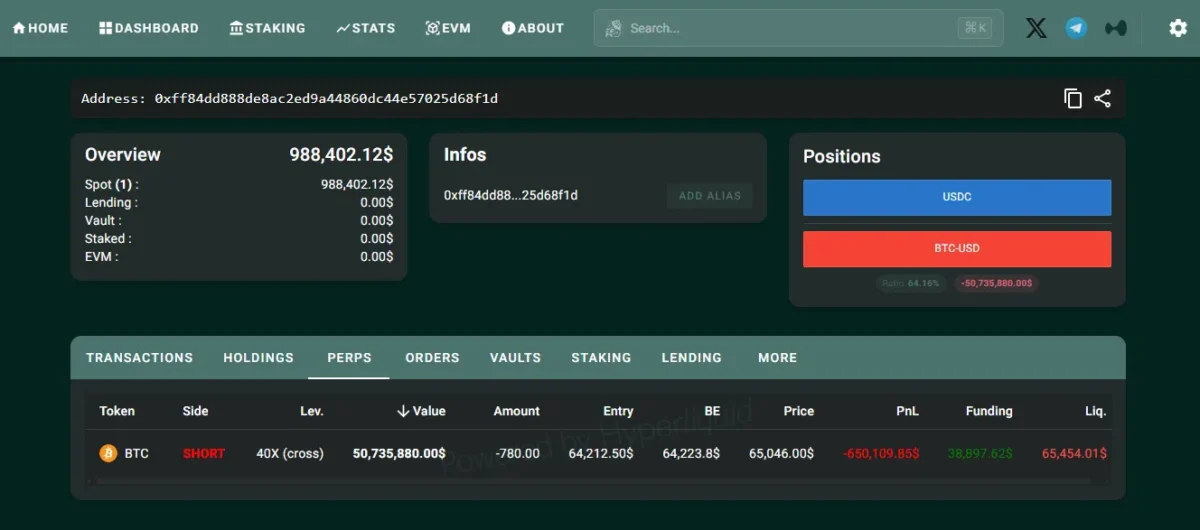
Those numbers are the whole point. A short profit when the price falls and a loss when it rises, and this one was already deep in the red, with the gap to liquidation narrower than a single volatile candle.
Why 40x Compresses the Buffer to Almost Nothing
Leverage is simply the ratio between a position’s size and the margin backing it. At 40x, roughly $1.27 million in margin controls a $50.7 million position—about one-fortieth of the notional. The trade-off is unforgiving: because the margin is so thin relative to the position, a price move of only about 2.5% in the wrong direction is enough to erase it entirely, since 1/40 equals 2.5%.
In practice the liquidation buffer is even tighter than that headline figure, because the position was already carrying losses and because exchanges close positions before margin hits exactly zero to protect against a shortfall. That is how a short entered near $64,212 ended up with a liquidation trigger just above $65,454—the cushion between “underwater but alive” and “forcibly closed” had shrunk to a few hundred dollars on a fifty-million-dollar bet.
Cross Margin, Funding, and the Liquidation Engine
The position uses cross margin, meaning it draws on the account’s entire balance as collateral rather than a walled-off amount. Cross margin can delay liquidation by pulling in the wider balance, but it also puts the whole account at risk if the position fails, rather than isolating the loss. That is a materially different risk profile from isolated margin, where only the funds assigned to the trade are exposed.
Two other forces act on a position like this over time. Funding payments, periodic transfers between longs and shorts that keep a perpetual future tethered to spot, accrue continuously; the on-chain data showed this position had a positive funding balance of around $38,900, a small offset against the far larger price loss. And Hyperliquid, like other venues, runs an automated liquidation engine: once the mark price crosses the liquidation level, the position is force-closed at market, and on a short, that means the engine buys back Bitcoin.
On a position this size, that forced buying can create a brief, localized upward squeeze, though relative to Bitcoin’s total futures open interest, a single $50 million close is generally contained.
The Takeaway
The enduring lesson has nothing to do with the fate of this specific trade, which may resolve in any number of ways. It is that platforms offering 40x or higher leverage compress the distance between a position and its liquidation to a razor’s edge—a margin of error measured in hundreds of dollars even on notional sizes in the tens of millions.
High leverage magnifies gains identically to losses, but the asymmetry that matters is psychological and structural: being directionally right is worthless if a routine intraday swing liquidates the position first. Risk management—position sizing, isolated margin, stop levels, and leverage discipline—is what separates a survivable trade from an account-ending one, and no amount of conviction substitutes for it. That is the reminder a fifty-million-dollar short, sitting a few hundred dollars from the brink, offers anyone watching.
Also Read: Diverging Paths in Corporate Bitcoin Strategy: Strive Stacks While MARA Sells