
Bitcoin is starting October near the low $80,000s, about a third below its October 2025 peak above $126,000 and well above the mid-year trough near $58,000. The calendar has revived a familiar argument: whether the month marks a late-cycle floor or a seasonal bounce.
At 1:25 PM UTC on September 30, Bitcoin traded near $85,300 with a 24 hour trading volume of $33 billion—as per CoinGecko data.
Bitcoin’s 2026 chart is still a corrective structure off the early-October 2025 peak, not a clean new uptrend. The first half of the year traced a lower-high, lower-low sequence into the February area near $60,000 and a slightly deeper June trough near $58,000, which now reads as the year-to-date base.
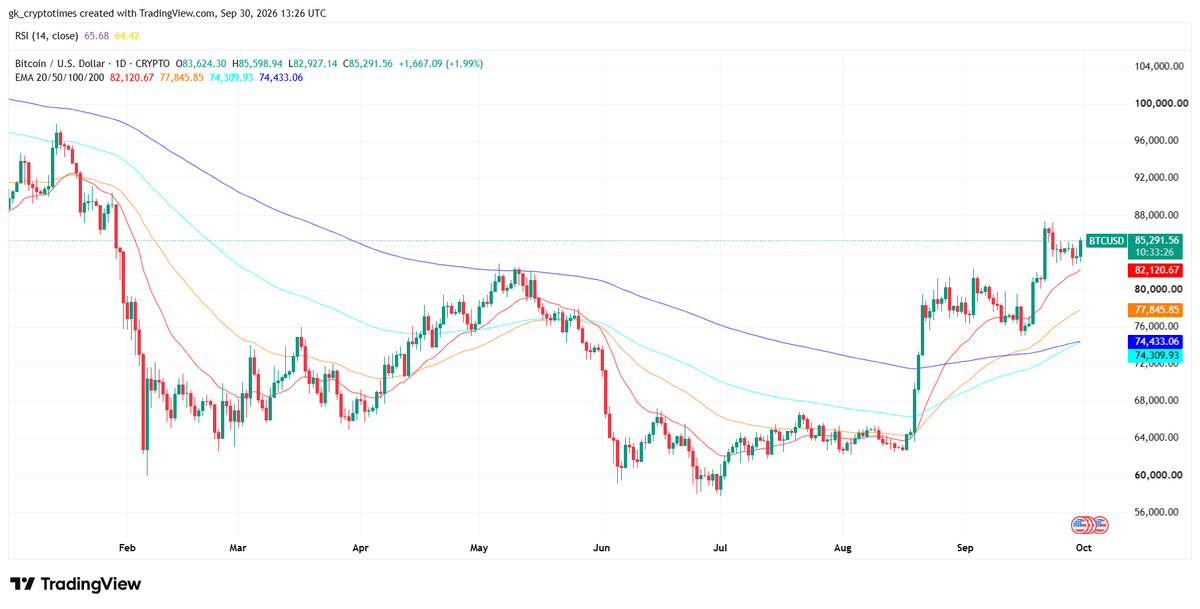
From that June low the market reversed hard: August produced the impulse that reclaimed the mid-$70,000s and pressed the psychologically important $80,000 region, and September added a second leg that tagged roughly $87,000 before stalling. That September spike failed to hold the high, leaving a lower close in the low $83,000s and a visible supply zone between about $84,000 and $87,000.
As long as price remains beneath that cluster, the rally from $58,000 is best treated as a large recovery inside the broader drawdown rather than confirmed trend reversal.
The constructive case now rests on whether the June low and the $80,000 handle continue to act as demand. A hold above the late-September pullback, followed by a weekly close back through $87,000, would turn the $84,000–$87,000 bands from resistance into support and keep the October path pointed toward $90,000. Failure to defend the low $80,000s would reopen the mid-year range, with $75,000 as the first checkpoint from the September 15 swing low and the $58,000–$60,000 base as the last major higher-timeframe floor on the year-to-date map.
Named analysts who publish their own research or primary posts do not agree on a single October print. What they do offer is a timing window, a valuation band, and an explicit revision after price reclaimed levels that some models treated as unlikely.
Brandt’s October Window, Not a Fixed Print
Peter Brandt has been the most direct about the month itself. In a June post, the veteran chartist wrote that Bitcoin had met an initial target at the February low, but that this “does not mean that BTC cannot work lower or have a terminal wash-out.” His conclusion was unambiguous on timing: “I do not see a tradable low until October.”
That is a date window, not a year-end bank target. Brandt’s public work treats Bitcoin’s four-year rhythm as a charting pattern rather than a guarantee. He has long framed post-peak declines as multi-month processes that often resolve with capitulation volume, not with a quiet summer low. The June note left room for a deeper washout after the February trough and treated October as the first period in which he expected a low he would consider tradeable.
What Brandt did not publish on his own account is a locked October 31 dollar target. Later interview remarks about an early-October date or a high-$40,000s probe circulated widely, but those comments sat outside his primary feed. The primary record that can be cited without a recap desk is the October timing and the warning that a terminal flush remained possible after February.
That distinction matters for readers tracking price action in the low $80,000s. A tradable-low call in October can be satisfied by a higher low if the February–June range already did the heavy work. It can also still be read as a risk that October opens with another down-leg. Brandt’s own wording supports both readings. It does not support treating $40,000 or $90,000 as his official October close.
Galaxy’s Q4 Map: $40,000 to $46,000 if the Cycle Is Unfinished
The clearest institutional research note on where a remaining bottom could sit comes from Galaxy Research, not from a price-target roundup. In its halving-cycle study, the desk led by Head of Firmwide Research Alex Thorn said prior peaks have typically been followed by bottoms about 12 to 13 months later. From the early-October 2025 high, that arithmetic points into the fourth quarter of 2026.
Galaxy was careful about language. The note said the work “is not a formal Bitcoin price prediction for 2026.” It then laid out historical analogies: a base-case bottom between $40,000 and $46,000, a shallower outcome near $51,000 to $54,000, and a harsher washout near $30,000 to $37,000. Those bands were tied to realized price, MVRV, and the 200-week moving average, not to October seasonality.
A separate Galaxy paper then asked whether the bottom might already be in. In “All Eyes on BTC’s 50-Week Moving Average,” Thorn’s team argued that, in most completed bear markets, the first weekly close back above the 50-week average was a strong sign the low was in. In late August that average sat near $81,000, with price pressing it after the largest weekly dollar gain on record.
Those two Galaxy notes sit side by side rather than in contradiction. One says that if the cycle is unfinished, Q4 remains the historical window and $40,000 to $46,000 is the base zone. The other says a sustained reclaim of the 50-week line would argue the opposite: that the June low already completed the drawdown. Galaxy’s 2026 predictions separately declined to pin a 2026 year-end number, calling the year too chaotic and keeping $250,000 as a 2027 marker instead.
Cowen’s October Base Case, Then a Public Correction
Benjamin Cowen, founder of Into The Cryptoverse, made the calendar explicit. In a February post he later quoted, he wrote that “the most likely low for BTC is October 2026, based on the 4 year cycle,” with May as the earlier alternative if drawdowns arrived fast. Through the summer he continued to treat October as the favored month and told readers that four-year lows are not exact science.
The market then took out the May high and pushed into the mid-$80,000s. On September 21, Cowen posted: “I was wrong. Not going to make excuses. I deserve to be dunked on.” Days later he clarified that the admission applied to his view that Bitcoin would not reclaim the May high. He added that a higher high did not, by itself, erase a separate discussion of possible Q4 weakness and that he still wanted to watch weekly closes.
That sequence is the primary record. Cowen did not replace October with a new official price target. He conceded a specific tactical call, kept the midterm-year framework on the table, and shifted the immediate test to whether the rebound holds on a weekly basis. The four-year cycle debate itself remains open: some researchers argue institutional flows have stretched the old rhythm, while Cowen’s own work still treats midterm-year second halves as historically useful accumulation windows.
None of these sources publishes a consensus October close. Brandt’s primary post times a tradable low to the month. Galaxy’s research keeps a Q4 bottom in view only if the cycle is incomplete, with $40,000 to $46,000 as the base analogy and the 50-week average as the invalidation. Cowen’s October preference was the most widely cited calendar call of 2026, and he has now said part of the accompanying price path was wrong.
For October, the live questions are narrower than the headline ranges imply. Does Bitcoin hold the low $80,000s and the 50-week area, or does the month reopen the valuation gap Galaxy mapped toward the $40,000s? The named analysts have given the market a window and a set of conditions. They have not given it a single number.
Also read: Monero (XMR) Price Prediction 2026, 2027-2030: Can It Hit $1,000?