Monero (XMR) is trading near $540 as of late September 2026, with a market capitalization of about $10.1 billion and a circulating supply close to 18.81 million coins.
The token sits roughly 32% below its January 14, 2026 all-time high of $798.91. Unlike Bitcoin, Monero has no hard cap. After the main emission ended in 2022, a permanent tail emission of 0.6 XMR per two-minute block kept issuance alive at a low, declining inflation rate.
That combination — default privacy, a small float, and ongoing exchange restrictions — is what the price bands below try to price. The ranges are scenario analysis, not targets. They convert plausible market-cap outcomes into a price per coin as supply slowly rises.
What is Monero (XMR)
Monero launched in April 2014 as a fair, pre-announced fork of the CryptoNote reference code. There was no premine. Monero’s official site still lists the same design goals: hide sender, receiver, and amount on every transaction, keep mining accessible through RandomX, and avoid a hard cap so miners retain a subsidy after the main curve.
Privacy is mandatory, not optional. Stealth addresses, ring signatures, and RingCT sit in the base protocol. That is the contrast with coins that offer a transparent default and a shielded mode. It is also why licensed venues treat XMR differently from most large-cap assets.
Supply mechanics matter for any multi-year price path. Monero’s official documentation states that Monero has a fixed emission rate, not a set maximum supply. Tail emission began at block 2,641,623 on June 9, 2022 and remains 0.6 XMR per block, or 0.3 XMR per minute. That is about 157,000 XMR a year — under 1% inflation now and falling as the stock grows.
The next protocol change under discussion is Full-Chain Membership Proofs (FCMP++), intended to replace small ring-signature decoy sets with a membership proof against the full set of eligible outputs. As of late September 2026 the work is still in testing rather than a completed mainnet migration. Markets can re-rate on delivery, delay or a botched rollout.
How these scenarios were built
The bands convert market-cap outcomes into price. Circulating supply is treated as about 18.81 million XMR today and about 19.4 million by the end of 2030 if tail emission continues at the official rate. That is a slow float increase, not a Dogecoin-style annual flood, but it still means the same market cap produces a slightly lower price each year.
Assumptions behind the three columns:
- Bear assumes further licensed-exchange exclusion, thin non-custodial liquidity, and a weaker Bitcoin cycle.
- Base assumes Monero keeps its niche as default private cash, DEX routes partially offset CEX exits, and the broader crypto market does not collapse.
- Bull assumes successful FCMP++ adoption, deeper permissionless liquidity, and a larger privacy-demand cycle without a legal shock that hits self-custody itself.
| Horizon | Bear | Base | Bull | What the band implies |
|---|---|---|---|---|
| Remainder of 2026 | 320–430 | 480–680 | 740–980 | Year-end market cap of about $6–8B, $9–13B, or $14–18.5B |
| 2027 | 280–450 | 500–780 | 850–1,250 | First full year under tighter EU CASP rules on anonymity-enhancing coins |
| 2028 | 300–480 | 550–900 | 950–1,500 | Mid-cycle year: either deeper DEX liquidity or a hangover after the 2027 rule date |
| 2029 | 280–500 | 580–1,000 | 1,050–1,800 | Supply is larger; price needs more capital to hold the same level |
| 2030 | 300–520 | 650–1,150 | 1,200–2,200 | Market cap of about $6–10B, $13–22B, or $23–43B against ~19.4M coins |
These are internally consistent ranges, not a poll of prediction websites. They can be wrong in either direction if Bitcoin liquidity, regulation or protocol delivery surprises the market.
Weekly setup: A $10 billion privacy asset below the January high
On September 30, 2026, CoinMarketCap listed XMR near $540 with a 24-hour range around 537–550 and 24-hour volume near $100 million. That volume-to-cap ratio is thinner than Bitcoin or the largest listed altcoins, which is expected after years of venue exits.
The January 2026 high near $799 remains the overhead reference. A market that cannot reclaim that zone on rising volume stays a large-cap niche asset. A market that does reclaim it with durable DEX depth starts pricing a different liquidity regime. Neither outcome is guaranteed by the weekly close.
Monero (XMR) technical analysis
On the weekly XMR/USD chart through September 30, 2026, Monero is holding $543.70 after a small weekly decline of 0.64%, with the week opening at $547.23, high at $553.40 and low at $525.89. Price sits well above a fully bullish moving-average stack: the 20-week EMA at $442.84, the 50-week at $391.34, the 100-week at $339.06 and the 200-week at $277.33. That alignment has been intact since the 2025 breakout from the long 2022–2024 base near $130–180. The January 2026 spike toward 800 remains the major overhead supply zone; the current tape is a retest of the mid-$500s after that wick, not a breakdown of the higher-low structure that began in early 2025.
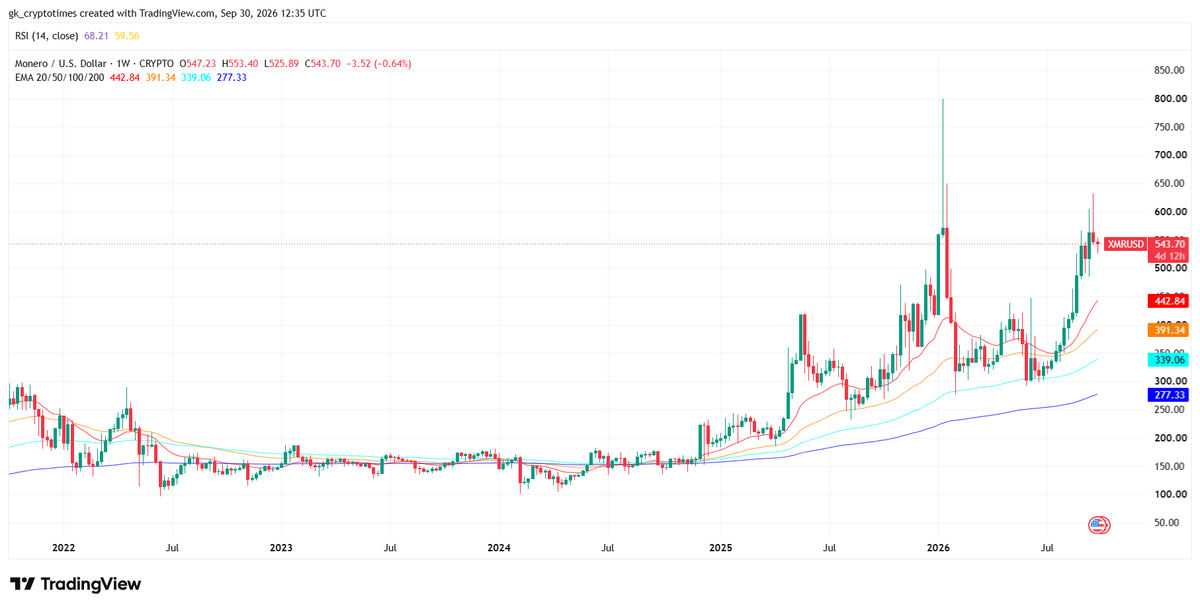
Momentum is still constructive but no longer stretched in the same way as the January thrust. Weekly RSI (14) reads 68.21 on the close, with a secondary print at 59.56, which keeps the market above the midline without a fresh overbought extreme. The practical map is straightforward: 525–536 is near-term weekly support from this candle’s low; $442 is the first major dynamic support if that shelf fails; 550–570 is immediate resistance, then the $800 spike high.
As long as weekly closes stay above the 20-week EMA, the five-year trend remains an advancing market digesting a blow-off high rather than a completed top. A weekly close back under $442 would be the first serious challenge to that read.
Monero (XMR) price prediction 2026
Only one quarter of 2026 is left. The base case for year-end is 480–680, which is a wide band around the current $540 print. That range assumes no new shock that removes the remaining offshore and peer-to-peer ramps, and no melt-up that treats XMR as a leveraged privacy trade.
The bear band of 320–430 would fit a broad crypto drawdown or another wave of listings disappearing before non-custodial routes can replace them. The bull band of 740–980 would require the market to treat the January high as a launchpad rather than a ceiling, usually on a combination of Bitcoin strength and a visible upgrade or liquidity catalyst.
FCMP++ testing is the main protocol event on the calendar. A clean test does not automatically raise price. A failed or delayed test can still cap the bull case for the rest of the year because the market has already started to discount “better anonymity sets later.”
Monero (XMR) price prediction 2027
Twenty-twenty seven is the first year in which European rules on licensed crypto-asset service providers become a hard scheduling problem rather than a headline. Regulation (EU) 2023/1114 (MiCA) already tells trading-platform operators to prevent admission of crypto-assets with an inbuilt anonymization function unless holders and transaction history can be identified. Regulation (EU) 2024/1624 then goes further in Article 79: credit institutions, financial institutions and crypto-asset service providers shall be prohibited from keeping anonymous crypto-asset accounts “as well as any account otherwise allowing for the anonymization of the customer account holder or the anonymization or increased obfuscation of transactions, including through anonymity-enhancing coins.”
That text regulates intermediaries, not home wallets. The distinction matters. A 2027 that only hits CASPs can leave self-custody and peer-to-peer demand intact while starving listed liquidity. That is the base-case shape: 500–780, with higher volatility around rule dates.
The bear band of 280–450 assumes the liquidity exit is larger than the demand that stays on-chain. The bull band of 850–1,250 assumes the opposite: that “cannot be listed in the EU” becomes a feature for a smaller, more convicted holder base, and that non-custodial routes such as THORChain’s Monero integration work are deep enough to clear size.
Monero (XMR) price prediction 2028 and 2029
These are mid-cycle years in most four-year crypto frameworks. For Monero they are also the years when the 2027 rule change is either digested or still leaking listings.
Base case: 550–900 in 2028 and 580–1,000 in 2029. That path needs two things at once. First, the network has to keep producing blocks and transactions without a consensus failure around FCMP++ or a later migration. Second, some replacement liquidity — DEX, atomic-swap style venues, or offshore books — has to be real, not just announced.
Bear case: 300–480 then 280–500. That is what a failed liquidity migration looks like: the coin still works, but the bid is thinner and more event-driven.
Bull case: 950–1,500 then 1,050–1,800. Those numbers imply a market cap that starts to look like a primary private-settlement network rather than a restricted large-cap alt. They need privacy demand to broaden beyond the existing holder set.
Among dedicated privacy assets, Monero remains the default-private design in the privacy-coin set. Relative performance versus optional-shield coins will depend less on branding and more on which asset still has a usable path in and out of the fiat system.
Monero (XMR) price prediction 2030
By 2030 tail emission will have added roughly 600,000 XMR to the 2026 float. Price therefore has to rise a little just to keep market cap flat.
- Bear 300–520: Monero remains legal to hold in most places but economically boxed in as a niche tool with shallow exits.
- Base 650–1,150: the privacy thesis compounds slowly, issuance stays predictable, and the coin holds a double-digit-billion valuation.
- Bull 1,200–2,200: private digital cash wins a larger share of cross-border and censorship-resistant settlement. That is a high-variance outcome, not a base plan.
No 2030 number is useful without the market-cap translation. At ~19.4 million coins, $1,000 is about $19 billion. $2,000 is about $39 billion. Those are large figures for an asset that major licensed platforms have spent years removing.
What would push the coin from one band to another
Toward the bull band
- FCMP++ (or a later successor) ships without breaking wallets or sync times, and usage actually moves to the new proof system. The official FCMP write-up frames the change as expanding the anonymity set from a small ring to the chain-wide output set.
- Non-custodial XMR routes deepen. THORChain’s own posts describe native Monero support as operationally harder than transparent UTXO chains and warn that early pools can be shallow.
- Bitcoin liquidity expands and altcoins receive a second-wave bid. XMR has historically needed that tide; it rarely decouples for long.
- Demand for default fungibility rises because more payment rails become identifiable by default.
Toward the bear band
- More jurisdictions copy the CASP prohibition in Article 79 and apply it earlier or more broadly.
- A protocol bug, consensus split or failed upgrade damages the “it just works” reputation that Monero has used to survive delistings.
- DEX and swap venues stay too thin to replace CEX books, so every risk-off day becomes an air-pocket.
- A broader crypto winter cuts speculative capital while leaving the structural issuance intact.
What probably does not decide the band by itself
- A single ransomware or darknet headline. Those stories move the tape for days, not the 2030 cap table.
- Short-term hashrate noise. RandomX is designed so commodity CPUs can mine; security is a function of sustained honest work, not one week’s chart.
Bottom line
Monero on September 30, 2026 is a roughly $540, $10 billion asset with default privacy, a known tail emission of 0.6 XMR per block, and shrinking licensed-exchange access. The rest of 2026 most plausibly clears inside 480–680 if the market stays orderly. 2027 is the regulatory stress year. 2030 is a market-cap question: whether private settlement can support $13–22 billion in the base case, or whether the coin remains a smaller, harder-to-exit niche.
The float will be larger in 2030 than it is today. The protocol may be more private. The list of regulated places to sell it may be shorter. Those three facts can be true at the same time. Price will settle wherever capital still agrees to meet.
This article is for information only and is not investment, legal, or tax advice. The ranges above are scenario analysis, not guarantees. Cryptocurrency prices are volatile. Do your own research and consider speaking with a licensed adviser before risking capital.
Also read: Dogecoin (DOGE) Price Prediction 2026, 2027-2030: $1 Target or Supply-Capped Rally?