In the evolving world of Bitcoin-linked finance, Strategy Inc.—the company formerly known as MicroStrategy and still helmed by Michael Saylor—continues to push boundaries.
Strategy’s Stretch perpetual preferred stock (STRC) pays a steady 11.5% annual dividend, adjusted monthly to trade near its $100 par value. But on decentralized finance platforms, particularly Pendle, investors are locking in significantly higher fixed returns on tokenized versions of that same exposure.
Pendle, a leading yield-trading protocol, recently highlighted markets offering fixed APYs as high as ~18.9% on principal tokens derived from STRC-backed digital credit products. These come through partners like Saturn Credit, which tokenizes STRC exposure into on-chain instruments.
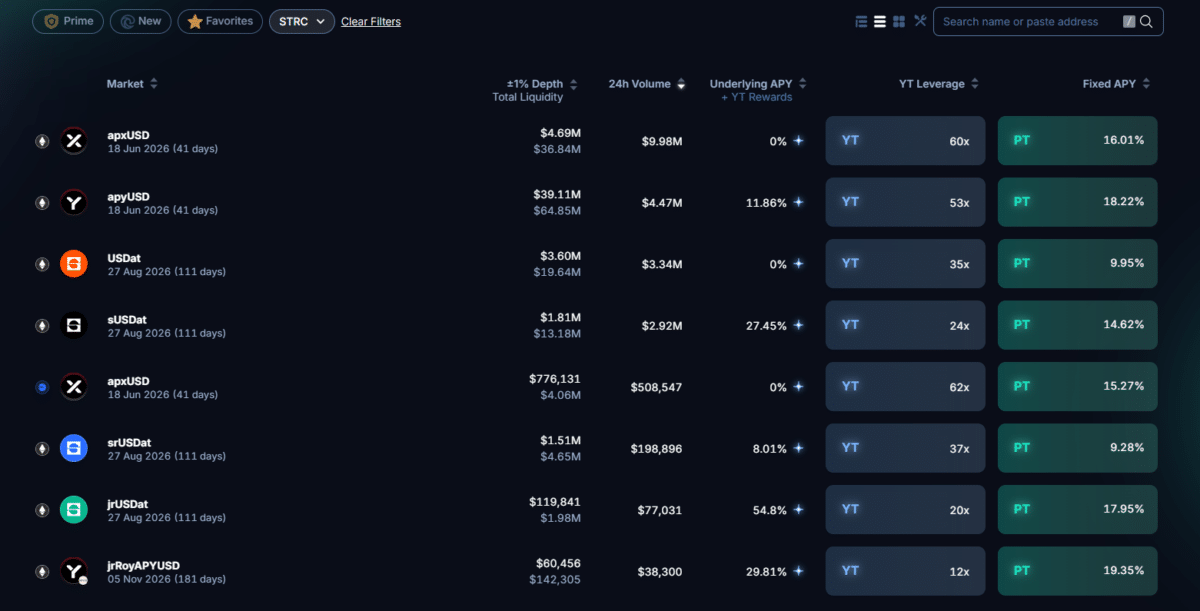
The gap arises from DeFi’s yield separation mechanics where users split assets into Principal Tokens (PTs), which trade at a discount and deliver fixed redemption at maturity, and Yield Tokens (YTs) that capture the variable upside.
The mechanics behind the spread
STRC itself functions as a Bitcoin proxy for income-seeking investors. Strategy, sitting on over 818,334 BTC, uses proceeds from issuing these preferred shares to acquire more Bitcoin.
The 11.5% dividend—paid monthly in cash—stays attractive because the company actively manages the rate to keep the stock hugging par, minimizing price volatility compared to its more volatile common shares.
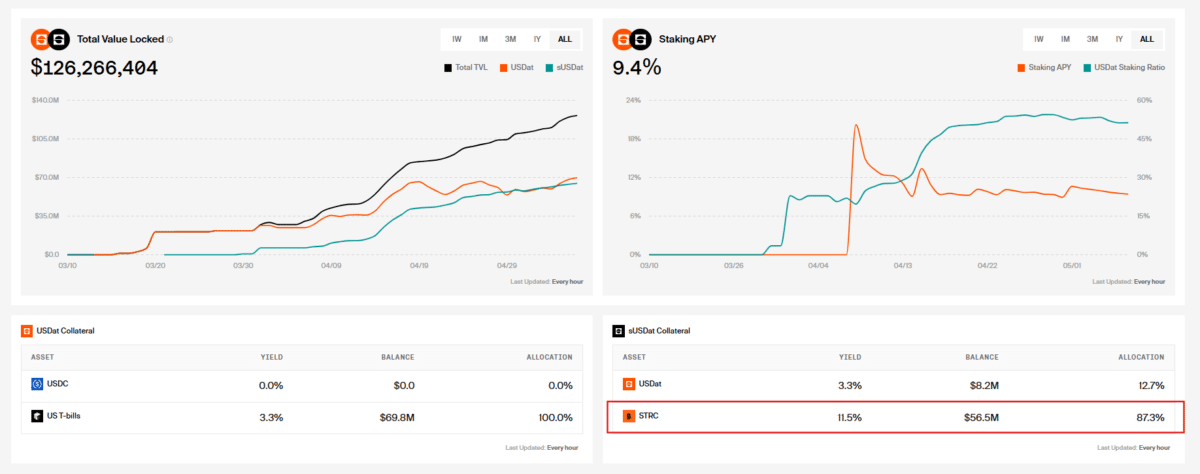
Yet traditional markets cap the effective yield near that headline rate. By tokenizing STRC-linked yields (via wrappers like sUSDat), Pendle lets sophisticated traders and institutions buy the principal portion at a discount. That discount to future redemption value translates into a locked-in fixed rate that exceeds the underlying dividend—currently reaching nearly 19% for certain maturities in 2026.
“It’s digital credit meeting DeFi,” the Pendle announcement noted, underscoring how RWA (real-world asset) structures backed by Bitcoin treasury mechanics now trade on-chain with programmable maturities and no lockups.
Why higher yields on Pendle?
The premium yield on Pendle stems from market dynamics. PT buyers forgo variable dividends in exchange for certainty, while YT holders speculate on yield performance. Liquidity providers and arbitrageurs in Pendle’s pools push implied rates higher amid demand for fixed income in a volatile crypto environment.
Saturn Credit, a DeFi protocol focused on Bitcoin yields, has routed significant TVL—tens of millions—into these markets, with half of some products’ liquidity sitting on Pendle. As of May 7, 2026, nearly $57 million in STRC stock has been tokenized on the protocol.
For context, STRC’s notional value exceeds $8.5 billion, making it one of the largest preferred stock issuances tied to a single corporate Bitcoin hoard.
Strategy’s playbook—issuing equity-like instruments to buy more BTC—has funded massive accumulation, turning the company into a de facto leveraged Bitcoin play with yield layers for different risk appetites.
Risks and Realities
However, this premium yield isn’t risk-free. STRC dividends, while currently stable, remain variable and subject to monthly resets. They aren’t guaranteed, and the preferreds sit senior to common equity but lack direct collateral from Strategy’s Bitcoin holdings—relying instead on the company’s overall credit and residual assets.
On-chain versions add smart contract, counterparty, and oracle risks. Redemption depends on underlying token performance and STRC price stability near par. Broader Bitcoin volatility could pressure Strategy’s ability to sustain payouts if capital raising slows. Tax treatment, liquidity, and regulatory scrutiny around tokenized RWAs also loom.
Still, the setup appeals to yield hunters. Traditional fixed income yields sit far lower, while pure crypto remains speculative. Pendle’s markets offer a hybrid: Bitcoin-proxy exposure with engineered fixed returns that outpace the base dividend through efficient yield stripping and trading.
Broader implications
Saylor has long championed Bitcoin as superior capital. With STRC, Strategy created a “digital credit” layer that funds more BTC buys while offering income. Pendle’s integration supercharges this by bringing it on-chain, accessible globally without brokerages, with maturities and leverage options traditional markets can’t match easily.
As tokenized RWAs surpass $31 billion in market cap, products like these blur lines between Wall Street preferreds and DeFi primitives.
For now, the arbitrage persists: 11.5% variable in traditional wrappers versus up to 19% fixed in digital form. Investors betting on Strategy’s Bitcoin flywheel, and Pendle’s yield engineering, see it as one of the more compelling real-yield plays in crypto today.
Whether this spread narrows as more capital flows in remains to be seen. But in a world hungry for yield on hard assets, STRC-powered digital credit via Pendle is turning heads—and delivering returns.
Also read: Project Eleven CEO Warns Bitcoin Quantum Upgrade Won’t Be Easy at Consensus Miami