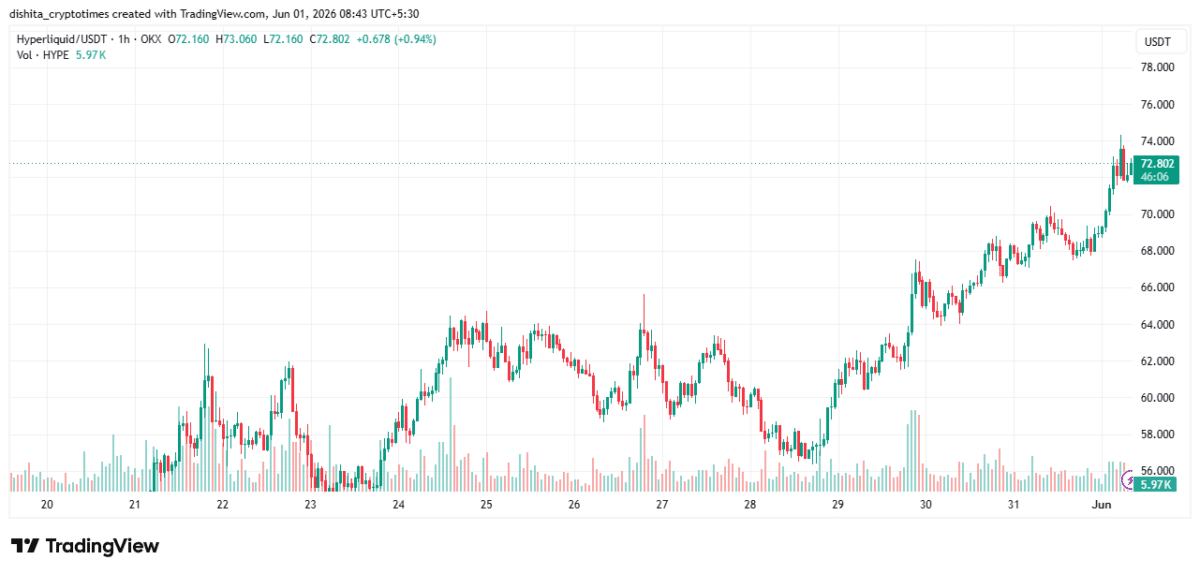
Hyperliquid’s $HYPE token has surged to a new all-time high of $73.48, extending one of the most dominant runs in the 2026 altcoin cycle.
As of press time, the token is trading around $72.71, up roughly 6.27% over the past 24 hours and over 17% on the weekly chart. The 24-hour trading volume has crossed $1.3 billion.
With the latest move, $HYPE’s market capitalization has pushed past $18.4 billion, making it the 9th largest cryptocurrency by market cap. The token has gained nearly 190% year-to-date after starting 2026 near the $25 range.
Spot HYPE ETFs Drive Institutional Demand
A major catalyst behind the rally has been the launch of the first U.S. spot $HYPE ETFs in mid-May. 21Shares launched its THYP fund on Nasdaq on May 12, followed by Bitwise’s BHYP on the New York Stock Exchange on May 15.
The two products logged a combined opening-day volume of $6.11 million, the strongest altcoin ETF debut of 2026 by a wide margin. Within 10 trading sessions, the funds absorbed over $100 million in combined net inflows, equal to roughly 1.04% of $HYPE’s total market cap. According to FalconX research, this proportional penetration rate surpasses the early-stage metrics of Bitcoin, Ethereum, and Solana ETFs.
Bitwise’s BHYP is also the first U.S. crypto ETF where the issuer runs its own staking infrastructure rather than outsourcing to a third party.
Grayscale has also filed its own spot HYPE ETF with the SEC, with plans to rename the product as the Grayscale Hyperliquid Staking ETF upon listing on Nasdaq. This signals that the institutional race for $HYPE exposure is far from over.
CFTC Perpetual Futures Approval Validates Hyperliquid’s Model
On May 29, the U.S. Commodity Futures Trading Commission (CFTC) approved the first regulated perpetual futures contract in the United States. While the contract was submitted by KalshiEX, the approval itself validates the exact financial framework that Hyperliquid is built on.
The perpetual futures market grew from $28 trillion in 2023 to over $90 trillion in 2025 but had remained largely closed to U.S. institutional capital. The CFTC’s move lowers regulatory risk for the entire decentralized derivatives sector and opens a new pathway for institutional participation.
After a brief 3% dip on the initial news, $HYPE quickly recovered and went on to set a new all-time high, as traders recognized the long-term bullish implications.
Revenue Flywheel and Token Burns Continue to Accelerate
What sets Hyperliquid apart from most Layer-1 projects is its direct revenue-to-token-value pipeline. The protocol directs 97% of all trading fees into the Assistance Fund, which continuously buys back and burns $HYPE from the open market. Only 3% goes to HLP liquidity providers.
Key on-chain metrics paint a clear picture of the protocol’s dominance:
- Cumulative trading volume has crossed $4.4 trillion, perDefiLlama data.
- Cumulative protocol revenue has surpassed $1.18 billion.
- 30-day fee generation stands at roughly $56.9 million, annualizing to nearly $694 million.
- Open interest across Hyperliquid L1 exceeds $9.6 billion.
- The platform commands roughly 44% of all perpetual DEX volume globally.
Grayscale’s latest research report, published on May 27, called Hyperliquid “the breakout success story of modern digital assets,” highlighting that the platform processed nearly $2.9 trillion in perpetual futures volume in 2025 alone with no venture capital backing.
Ecosystem expansion beyond crypto perps
Hyperliquid is no longer just a crypto perpetuals platform. The introduction of HIP-3 in late 2025 allowed the community to deploy permissionless markets for real-world assets. RWA trading pairs have accounted for as much as 44% of the platform’s total volume, with commodities like oil and gold seeing heightened activity during periods of geopolitical tension.
Coinbase recently became Hyperliquid’s official USDC treasury deployer, a deal that analysts estimate could inject $160 to $180 million in annual revenue back into the DEX.
The protocol has also expanded into prediction markets through HIP-4 outcome contracts, further diversifying its revenue streams.
What’s next for $HYPE?
With $HYPE now trading in price discovery territory, the focus shifts to whether the current momentum can be sustained. Several analysts have pointed to $100 as the next major psychological target, including Arthur Hayes, who published a detailed investment thesis setting a price target of $150 by August 2026.
A token unlock of 9.92 million $HYPE (roughly $674 million) is scheduled for June 6, going to Core Contributors. This represents about 1% of the total supply and could introduce short-term volatility.
Community sentiment remains overwhelmingly bullish, with 67% of CoinMarketCap voters marking the token as bullish. The combination of real cash-flow generation, aggressive token burns, institutional ETF demand, and regulatory tailwinds continues to set $HYPE apart in a crowded altcoin market.
Short-term pullbacks remain possible after such a sharp move, but the structural thesis around Hyperliquid’s dominance in on-chain derivatives remains firmly intact.
Also Read: Bitcoin’s May 2026 Reckoning, Beneath the $73K Surface