Welcome to this week’s cryptocurrency market update. If last week was about LayerZero’s post-mortem on the $292M KelpDAO exploit and the deepening Bitcoin ETF sell-off, this week the battlelines shifted from DeFi infrastructure to Washington and Wall Street.
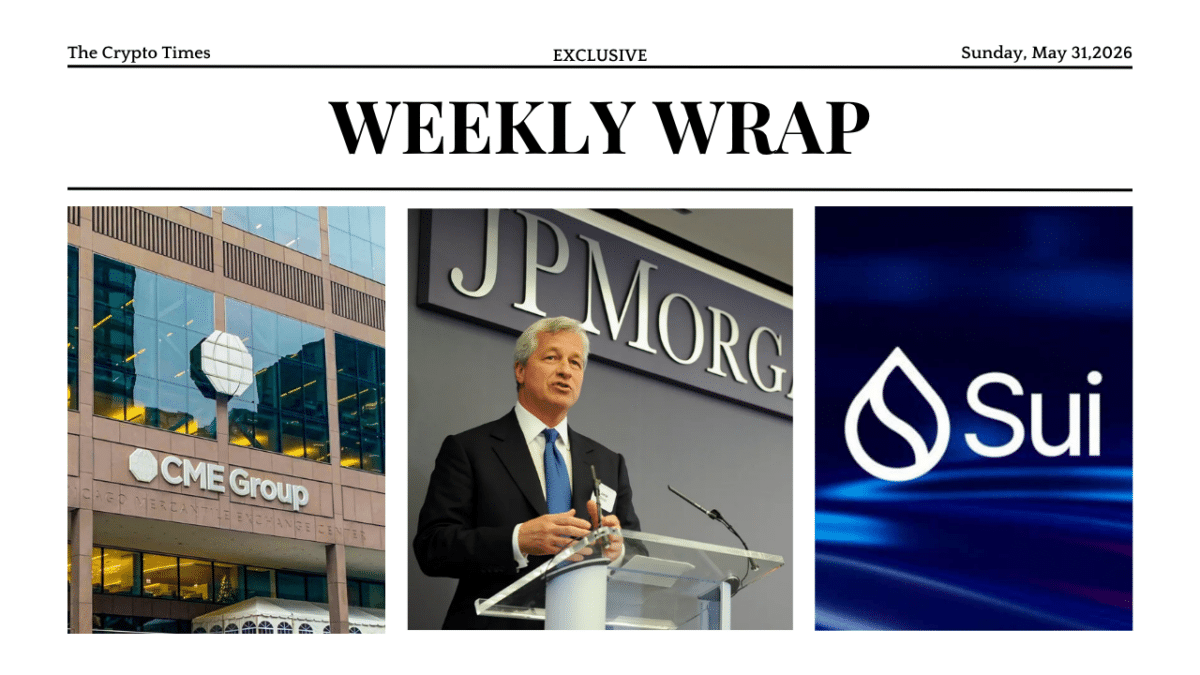
JPMorgan CEO Jamie Dimon publicly attacked Coinbase CEO Brian Armstrong and vowed to fight the CLARITY Act in its current form; Sui’s mainnet crashed three times in 48 hours, liquidating nearly $2 million and tanking SUI below $1; CME Group flipped the switch on 24/7 crypto futures trading, killing the weekend gap forever; and Ondo Finance founder Nathan Allman passed away unexpectedly, leaving the RWA sector without one of its most important builders. Let’s get into it.
Top headlines for this week
Below are the major headlines, giving an overview of what happened in the crypto market this week.
Jamie Dimon declares war on the CLARITY Act and goes after Brian Armstrong
The most explosive moment of the week came from JPMorgan CEO Jamie Dimon, who used a Fox Business interview on Friday to tear into both the CLARITY Act and Coinbase CEO Brian Armstrong personally. Dimon said the bill allows crypto firms to effectively pay interest on stablecoin deposits without the consumer protections that banks are required to maintain, and warned bluntly that banks would not accept the legislation in its current form.
He went further, accusing Armstrong of spending “hundreds of millions of dollars” in Washington to push crypto-friendly legislation that benefits Coinbase’s business model rather than the broader industry. Dimon reportedly told Armstrong directly at Davos earlier this year that he was “full of sh–,” and repeated the sentiment on air without using Armstrong’s name.
The clash over the CLARITY Act is no longer a policy disagreement. It is now a personal, public war between the CEO of the largest U.S. bank and the CEO of the largest U.S. crypto exchange. The bill passed the Senate Banking Committee in May with bipartisan support, but Dimon’s comments signal that the traditional banking lobby is gearing up for an all-out fight before it reaches the Senate floor.
The American Bankers Association, community banks, and credit unions are all aligned against the current version, and the stablecoin yield question has become the central obstacle to the bill’s progress.
Sui crashes three times in 48 hours, SUI drops below $1
Sui had the worst week of any major Layer 1 blockchain in 2026. The network’s mainnet stalled for nearly six hours on May 28 after a crash bug in the gas charging logic introduced in the version 1.72 software release caused validators to fail consensus. Block production halted entirely, and no new checkpoints were recorded during that window.
The relief lasted less than a day. A second stall hit on May 29, with mainnet settlement issues freezing the chain for over an hour. Then came the third outage, triggered by the very patch that was supposed to fix the first crash. As validators restarted to deploy the long-term fix, a latent bug in epoch transition handling froze transactions again.
The triple outage liquidated $1.88 million in SUI positions and sent the token below $1, down roughly 17% on the week. This marks the third major disruption for Sui in 2026 alone, following a six-hour consensus divergence event in January and a November 2024 outage tied to congestion control. The pattern is no longer one of isolated incidents. It is a recurring infrastructure reliability problem that is drawing direct comparisons to Solana’s early-era outage history.
CME goes 24/7, kills Bitcoin’s most-traded technical signal
On Friday, May 29, CME Group officially switched its Bitcoin and Ether futures and options to a 24-hour, seven-day-a-week trading schedule on its Globex platform. The only remaining interruption is a two-hour weekly maintenance window. The weekend CME gap, one of the most widely followed technical signals in Bitcoin trading since 2017, is effectively dead.
The move covers a broad roster of digital asset products, including futures on Bitcoin, Ethereum, Solana, XRP, Cardano, Chainlink, and Stellar. CME noted its crypto suite facilitated nearly $3 trillion in notional volume across cryptocurrency futures and options in 2025, driving the push toward round-the-clock access.
For traders, the structural change is massive. The CME gap was never just a chart artifact. It was a trading strategy, a meme, and for many retail traders, a belief system built on the thesis that gaps always fill. That thesis is now dead. More practically, institutional traders can now hedge Bitcoin risk during weekends and holidays for the first time on a regulated venue, which could reduce the wild weekend volatility spikes that have historically moved Bitcoin 5% to 10% while futures markets were closed.
Ondo founder Nathan Allman passes away, RWA sector loses a key builder
The crypto industry lost one of its most important figures this week. Nathan Allman, founder of Ondo Finance and a driving force behind the tokenized real-world asset movement, passed away unexpectedly. President Ian De Bode has been named CEO at what is one of the most consequential moments for tokenized asset markets.
Ondo Finance had positioned itself as one of the leading protocols in the RWA space, building infrastructure for tokenized U.S. Treasuries and institutional-grade financial products on-chain. Allman’s death comes at a time when the RWA sector is under intense institutional scrutiny, with BlackRock’s tokenized treasury filings, SEBI’s blockchain bond pilot in India, and a wave of new entrants all converging on the space simultaneously.
The ONDO token held up relatively well in the immediate aftermath, but the leadership transition introduces a new layer of uncertainty for a protocol that was built around its founder’s vision. How De Bode navigates the next few months will determine whether Ondo maintains its position at the front of the RWA race.
DeFi exploits drain over $25 million across multiple chains
The exploit cycle that has defined May 2026 continued without pause this week. Hackers drained $7.3 million from DxSale’s legacy BNB Chain liquidity lockers, exploiting old smart contracts that had not been upgraded. A $3 million hack hit 86 Gnosis Safe wallets on Ethereum and Base through a fake token scheme. The Manta-incubated Superfortune protocol was hit by a $15 million multisig exploit, sending the GUA token plunging.
The Alephium bridge was exploited for $815K, with 13.76 million unbacked ALPH tokens minted in the process. The team later revealed the root cause and promised compensation. On BNB Chain, the SKP liquidity exploit drained $212K from DeFi protocols. And the WUSD.fi GLOVE reward exploit drained liquidity from Uniswap V3 pools in an Ethereum DeFi attack.
Six separate exploit events in a single week. The combined damage across DxSale, Gnosis Safe, Superfortune, Alephium, SKP, and WUSD.fi exceeds $25 million. Legacy smart contracts, multisig configurations, and bridge infrastructure remain the three primary attack surfaces in 2026, and the pace is not slowing down.
Hyperliquid’s rise forces institutional recognition
The Hyperliquid narrative crossed a new threshold this week. ICE CEO Jeffrey Sprecher said Hyperliquid is “bigger than Nasdaq” in trading activity, a statement that would have been unthinkable a year ago coming from the head of one of the world’s largest exchange operators.
Grayscale followed up by filing its fifth amendment for its Hyperliquid ETF plan under the HYPG ticker, continuing its aggressive push to bring the first regulated Hyperliquid investment product to market. Meanwhile, Bitcoin ETFs bled $334 million in outflows as capital rotated into HYPE-linked products, a dynamic that is being called “the great crypto rotation.”
Hyperliquid’s trajectory from niche perps DEX to a protocol that the CEO of Intercontinental Exchange publicly compares to Nasdaq is one of the defining stories of 2026. The Grayscale ETF filing adds a regulated on-ramp dimension that could accelerate institutional flows if approved.
Circle freezes $12.6M in confidential USDC, ZAMA drops 18%
Circle made a controversial enforcement move this week, blocking a Zama confidential USDC contract and freezing $12.6 million in user funds. The action targeted a privacy-preserving smart contract built using fully homomorphic encryption technology, effectively cutting off users who had deposited USDC into the Zama protocol.
The ZAMA token dropped 18% on the news. The incident highlights the tension between privacy-focused crypto infrastructure and stablecoin issuers who maintain centralized control over their tokens. Circle has blacklisted addresses before, but freezing funds inside a confidential computing contract is a new escalation that will likely chill development in the encrypted DeFi space.
SEC’s Paul Atkins signals regulatory pivot on crypto
SEC Chair Paul Atkins used a public appearance this week to signal a significant shift in the agency’s approach to crypto, IPOs, and disclosure requirements. The remarks suggested a more accommodating stance toward crypto companies seeking to go public and a potential rethinking of how digital assets are classified for disclosure purposes.
The pivot matters because the SEC under Gensler spent years enforcing through litigation rather than rulemaking. Atkins signaling a different direction could open the door for more crypto firms to pursue public listings, which in turn would bring greater transparency and regulatory scrutiny to the space through market mechanisms rather than enforcement actions.
Regulation and policy moves: prediction markets, India, and European tax
The prediction market sector had a dramatic week. Kalshi sued Minnesota over its prediction market ban, escalating the legal fight over state-level restrictions on federally regulated platforms. Indonesia blocked Polymarket after a bet on President Prabowo’s presidency went viral, while Trump publicly backed prediction markets even as his family holds financial ties to both Polymarket and Kalshi. Polymarket itself denied mandatory KYC plans for its main platform.
In India, SEBI launched a blockchain pilot to tokenize corporate bonds, one of the most significant moves by an Asian regulator toward on-chain securities infrastructure. In Europe, a widening gap emerged between the continent’s tax-heavy approach and America’s embrace of crypto perpetuals trading, with new tax frameworks threatening to push trading activity offshore.
Italy’s Banca Sella became the first MiCA-regulated crypto bank, and Aave’s UK subsidiaries received FCA approval as crypto exchange providers, marking two milestones for regulated crypto operations in Europe.
Bitcoin treasury moves and institutional shifts
The Bitcoin treasury accumulation trend continued but with a notable counterpoint. Strive snapped up another 1,109 BTC, stacking its holdings to 16,500 BTC. DDC boosted its treasury to 2,714 BTC with back-to-back purchases. Bitmine went the other direction, buying $237 million in Ethereum during the ETH dip.
On the sell side, Sequans ditched its Bitcoin treasury entirely, selling its BTC holdings to redeem debt and refocus on its core IoT chip business. Strategy’s STRC preferred stock fell short of its $100 target as cash concerns mounted, and Michael Saylor’s Bitcoin bets faced new scrutiny over how the company deploys its capital. The 107-Bitcoin burn event, where $8 million was destroyed across five transactions, added a bizarre footnote to the week’s BTC activity.
News you might have missed
- $ESPORTS crashes 92% after supply dump: The token collapsed after a wallet dumped 43% of the total supply in a single move worth roughly $13 million, wiping out holders in minutes.
- Stellar rockets 33% in a single day: XLM surged on the back of $1.25 billion in 24-hour trading volume, one of the sharpest single-day moves for the token in years.
- Zcash rests after massive weekly rally: ZEC pulled back after a strong weekly run, with analysts divided on whether the privacy coin’s momentum has more room to run.
- HTX breaks silence on UK sanctions: The exchange defended its wallet safety after Bybit, OKX, and Bitget flagged transfers linked to sanctioned entities, insisting that same brand does not mean same legal entity.
- Coinbase, Binance.US, and Kraken join Blockworks’ transparency alliance: Three of the largest U.S. exchanges signed onto a new Crypto Transparency Alliance aimed at standardizing exchange reporting.
Buzz of the Week
The buzz this week belongs to Jamie Dimon’s public attack on Brian Armstrong and the CLARITY Act, not because a banking CEO criticizing crypto is new, but because this time the opposition is organized, personal, and backed by the entire traditional banking system.
Dimon did not just express policy concerns. He went after Armstrong by name, accused him of buying legislation, and declared that every bank in the country would fight the current version of the bill. The American Bankers Association, community banks, and credit unions are all lined up behind him. This is not one bank’s opinion. It is the formal position of the traditional financial system.
The irony is that both sides claim to speak for consumers. Armstrong argues that stablecoin yield products give everyday users access to returns that banks keep for themselves. Dimon argues that letting crypto firms offer those returns without bank-level protections will “eventually blow up.” The stablecoin yield question has become the single most contentious provision in the CLARITY Act, and it is the hill both sides have chosen to die on.
Meanwhile, Sui’s triple outage and CME’s 24/7 launch tell two very different infrastructure stories. Sui crashed three times in 48 hours because of a cascading bug in a software update, then crashed again when the fix itself failed. That is not a one-off incident. That is a version deployment problem, and it is the kind of reliability failure that erases months of developer and investor confidence in a single weekend.
The comparisons to Solana’s early outage era are not flattering, and $1.88 million in liquidations is a concrete cost that someone paid because the chain could not stay online.
CME’s move in the opposite direction is a structural upgrade to how institutional crypto markets work. For nine years, the weekend gap was a fixture of Bitcoin technical analysis, a meme that generated real trading strategies, real profits, and real losses. Now it is gone.
Institutional traders can hedge around the clock on a regulated venue, and the old Sunday reopen volatility spikes that moved Bitcoin 5% to 10% while CME sat closed should diminish over time. Three gaps from the old regime remain unresolved on the chart, and whether they ever fill is now a question that may never be answered.
The DeFi exploit pace is the story that nobody wants to hear, but everybody needs to. Six separate events in one week, $25 million drained, and the attack vectors are not changing. Legacy contracts, misconfigured multisigs, bridge vulnerabilities. It is the same playbook, different protocols, different weeks.
The Superfortune multisig exploit alone was $15 million. DxSale lost $7.3 million from liquidity lockers that were never upgraded. These are not sophisticated zero-day attacks. They are the cost of technical debt that protocols chose not to pay down.
Nathan Allman’s death adds a human dimension to a week that was otherwise dominated by numbers, code, and politics. Ondo Finance was one of the protocols that made the RWA narrative credible, and losing its founder at the exact moment when institutional capital is flooding into tokenized assets is a loss the space will feel for a long time.
What to expect for next week?
Next week has several clear pressure points.
First, the CLARITY Act fallout from Dimon’s public broadside will shape the legislative conversation heading into June. Watch for responses from Armstrong, from crypto PACs, and from the Senate leadership on whether the bill’s timeline has shifted.
If the banking lobby forces meaningful amendments to the stablecoin yield provisions, the bill could stall. If the White House pushes ahead regardless, the July 4 signing deadline stays alive but the fight gets uglier.
Second, Sui’s incident review is the most important document Mysten Labs will publish this year. Three outages in 48 hours demand a thorough post-mortem, and the developer and investor community will judge the protocol’s future based on how transparent and actionable that review is. If the underlying architecture has a systemic version deployment problem, no amount of patching will restore confidence.
Third, the DeFi exploit pace shows no signs of slowing. May 2026 is already one of the worst months for exploits in crypto history, and with legacy contracts, bridge infrastructure, and multisig setups all proving vulnerable, the question is not whether another major hack will land but which protocol is next.
And keep watching the Bitcoin ETF flow data. The rotation from BTC products into Hyperliquid-linked vehicles is a new dynamic that did not exist a month ago. If Grayscale’s HYPG filing advances, the rotation could accelerate. If Bitcoin finds a bid at current levels, the ETF outflows may reverse. The data will tell the story before the narratives do.
Also Read: Crypto PACs Reshape US Elections: Trump’s Pro-Crypto Agenda Takes Shape