Key Highlights
- Bitcoin is trading around $64,982, nearly 48% below its October 2025 all-time high of $126,000.
- Reclaiming the ATH would require a 93.85% price increase, making it an ambitious target for 2026.
- ETF inflows, Fed policy, institutional adoption, and the July 17 CLARITY Act hearing could influence Bitcoin’s direction.
As Bitcoin (BTC) lingers near $64,982 in mid-July 2026, investors are asking the question dominating crypto conversations: Will Bitcoin reclaim its staggering $126,000 all-time high by the end of this year? Just nine months after hitting that record peak in October 2025, BTC sits roughly 48% below its ATH.
For holders watching their portfolios, traders hunting the next big move, and institutions weighing fresh entries, the stakes couldn’t be higher. Can ETF inflows, favorable macro shifts, institutional adoption, and upcoming regulatory clarity spark the comeback? Or will persistent headwinds keep Bitcoin trapped in consolidation?
In this analysis, we break down the technical levels, key catalysts, risks, and expert forecasts shaping Bitcoin’s path through the rest of 2026.
Bitcoin price today: Why is the token still down?
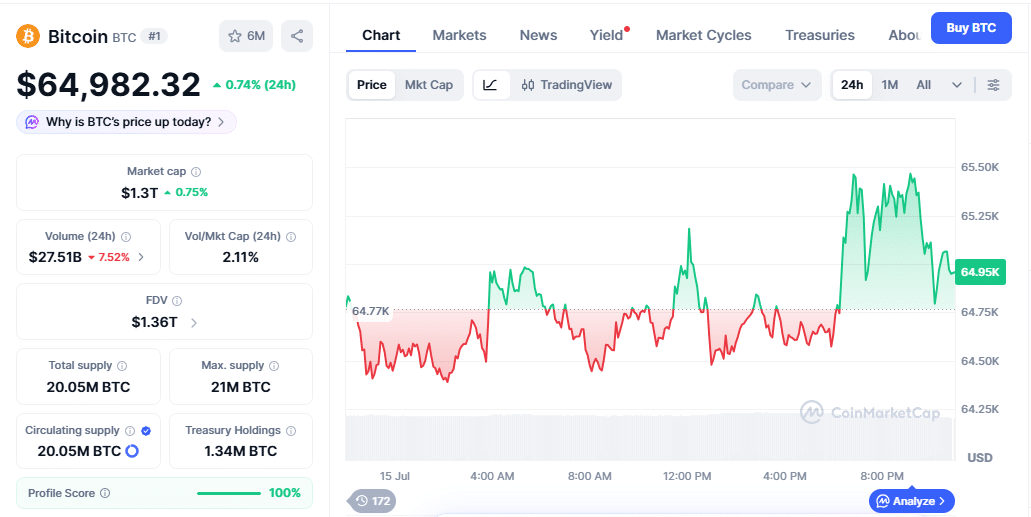
Bitcoin is trading at $64,982 as of July 15, 2026, up approximately 0.74% over the past 24 hours but is still down from its previous rallies. The market capitalization stands at $1.3 trillion, reflecting a similar modest uptrend, while 24-hour trading volume has declined 7.11% to $27.5 billion, indicating lower market activity amid the price weakness.
The intraday chart reveals persistent pressure. After briefly testing $65,507 earlier, BTC experienced a sharp pullback before a partial recovery, only to stall near current levels. This comes as the cryptocurrency remains roughly 48% below its all-time high of around $126,000 recorded in October 2025.
Several factors appear to be weighing on sentiment. Continued ETF outflows, US-Iran tensions, cautious macroeconomic conditions, and a lack of strong bullish catalysts have kept Bitcoin range-bound in the low-to-mid $65,000 zone for weeks. Another factor contributing to BTC’s price uptrend was the release of US CPI data released on July 14.
However, weaker-than-expected PPI data released today can also have a significant impact and pull the price further in the near trading session.
While institutional interest and long-term fundamentals remain intact, with circulating supply near 20.05 million BTC out of a 21 million maximum, short-term traders are grappling with resistance and profit-taking pressure.
Analysts remain divided on the near-term outlook. Some see the current consolidation as a healthy reset ahead of a potential Q3 or Q4 recovery, while others warn of further downside if support around $60,000 fails to hold. For now, Bitcoin’s price action underscores the market’s ongoing wait for decisive momentum.
Bitcoin price prediction for 2026
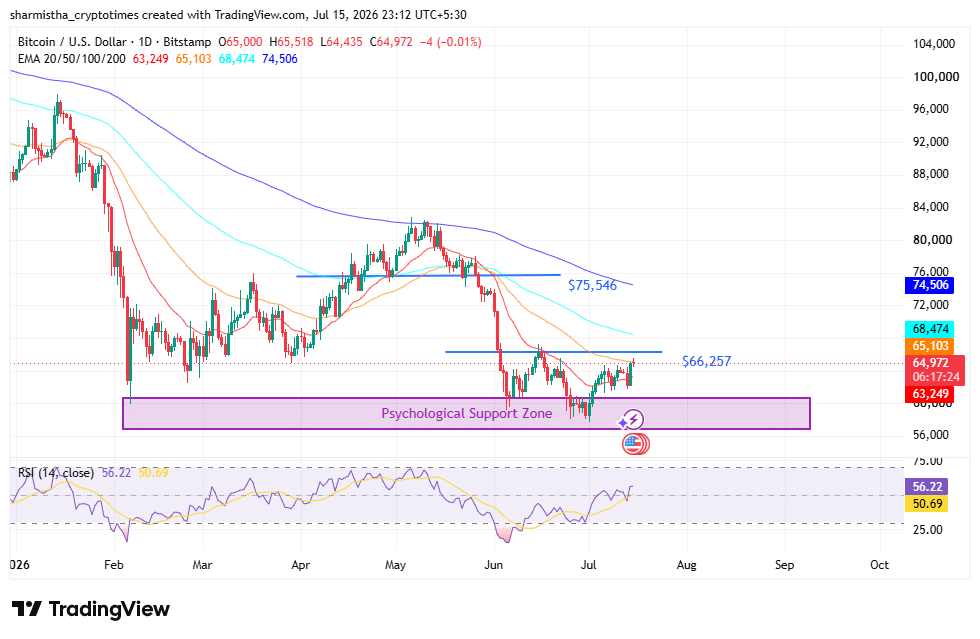
For the rest of the months in 2026, traders are closely monitoring if Bitcoin can go up and break its higher resistance of $75,546. A price level of $60,876 acts as a major support zone for the asset; any constant movement below this level can drag the price to further lows and can take it to a breakdown zone of around $62,000.
If the momentum continues to improve, then it may break its resistance to trade around $80k. However, BTC has to show strong momentum to break several resistances to trade near its all-time high.
For strong momentum to be maintained, several powerful factors need to propel Bitcoin back toward its $126,000 all-time high by year-end.
First, institutional adoption needs to accelerate, with corporations and nation-states adding BTC to their balance sheets. Renewed inflows into spot Bitcoin ETFs could reverse recent outflows and spark fresh buying pressure.
Second, macroeconomic shifts, such as potential Federal Reserve rate cuts, weakening of the US dollar, or rising inflation, historically favor Bitcoin as a store of value. Third, the supply shock from the 2024 halving remains in play, with daily new supply dwindling while demand grows.
One major factor that could determine the momentum will be the CLARITY Act hearing of July 17. Reportedly, if positive outcomes are there, it could also affect the market positively and vice versa.
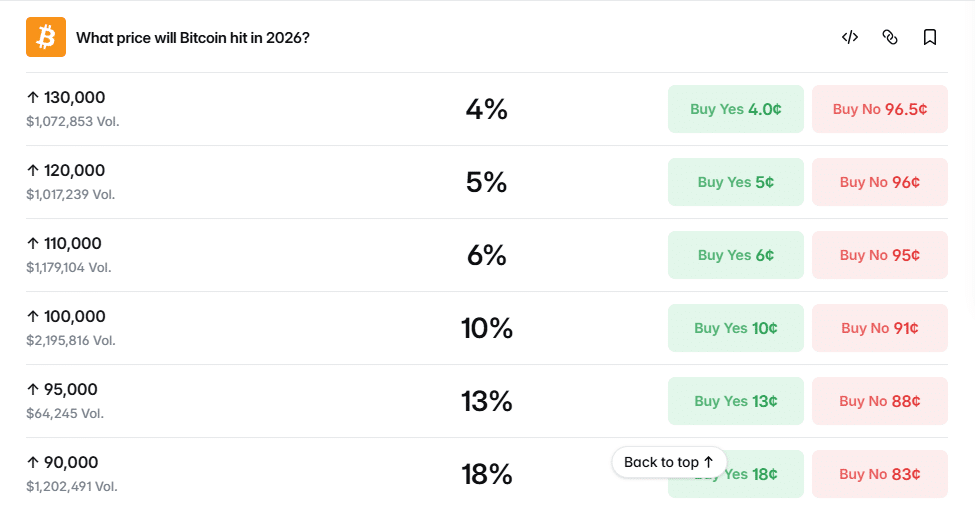
According to Polymarket, traders are pricing in modest odds for Bitcoin reaching higher price targets by the end of 2026. The probability of BTC hitting $130,000 stands at just 4%, while $120,000 sits at 5% and $110,000 at 6%.
The market assigns a 10% chance to $100,000 and 13% to $95,000. Even reaching $90,000 is only given an 18% probability. These low odds reflect current market caution and suggest that a return to the $126,000 all-time high remains a low-conviction bet among prediction market participants.
Will BTC actually reclaim its $126K level?
To reach the $126K level from the current level of around $65K, BTC needs to reclaim a 93.85% increase. To attain such a gain, the market needs to go through a major restructuring and constant positive developments to push the price; otherwise, any negative pull can act as a barrier in the journey.
21Shares, a crypto asset manager, has predicted Bitcoin to reach around $100K to $110K by the year-end, which still remains below its all-time high. The asset manager considers 2026 price drops as a consolidation phase.
A blockchain researcher crypto proselyte mentions, while analyzing the previous patterns, that “$BTC is 49% below its ATH, but history shows no bear market ended this early with deeper past drawdowns of 77-93%. Each cycle has seen shallower corrections as Bitcoin matures, yet the pattern still points to a possible 60-65% low ahead.”
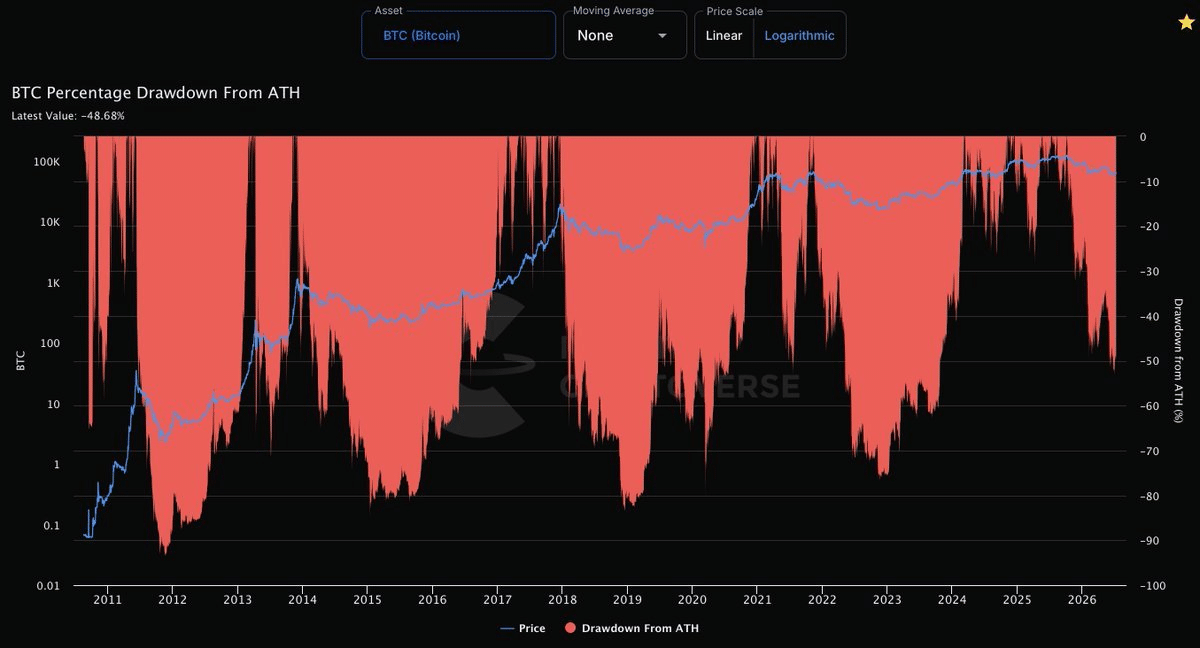
Analyzing the patterns and the price momentum, $126K appears to be an aggressive target for the end of 2026.
Can BTC price slump further?
Bitcoin is currently trading near $64,982, clinging just above a critical breakdown zone. After a steep decline from its October 2025 all-time high near $126,000, the price has been consolidating in a prolonged downtrend, repeatedly testing lower highs and finding temporary relief around the $62,000–$65,000 area.
The chart shows Bitcoin trading well below its key EMAs (50, 100, and 200-day), signaling persistent bearish momentum. A sharp wick lower in recent sessions tested the lower boundary of the highlighted support zone, though a modest recovery is visible. The RSI at 56.22 sits in neutral territory, neither oversold nor overbought, leaving room for further downside if selling pressure intensifies.
Analysts are watching the $60,000–$62,000 region closely. A decisive break below this psychological support could open the door to deeper corrections toward $58,000 or lower, especially if macroeconomic headwinds persist or ETF outflows continue. However, strong volume on bounces and holding above the zone might signal accumulation and a potential base-building phase.
While the long-term bull thesis remains intact, the near-term technical picture suggests caution. Another leg down cannot be ruled out without a clear catalyst for reversal. Investors should monitor support integrity closely in the coming days.
What does fear and greed index chart suggest
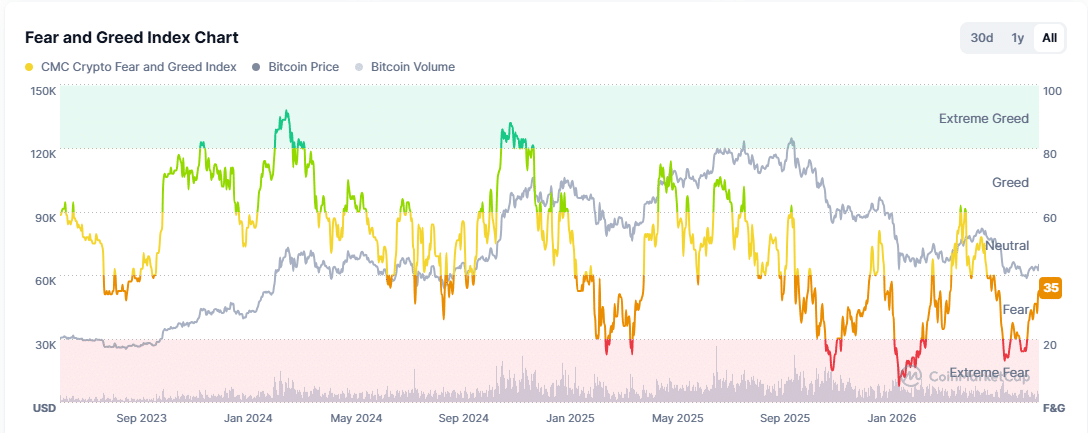
The CMC Crypto Fear and Greed Index currently stands at 35, firmly in fear territory as of mid-July 2026. This reading reflects widespread investor anxiety, caution, and reduced risk appetite following Bitcoin’s steep decline from its $126,000 all-time high in late 2025.
The chart illustrates a clear correlation between market sentiment and price action. Periods of Extreme Greed (70–100) in 2024 and early 2025 coincided with strong Bitcoin rallies and elevated prices.
Conversely, sharp drops in the index into Extreme Fear (<25) often marked capitulation phases and local bottoms, such as the red spikes visible in early 2025 and recent months. The current 29 level is low but not at outright panic extremes, suggesting fear is elevated, yet some stabilization may be underway.
Bitcoin’s price (gray line) has closely tracked sentiment shifts. As greed cooled through late 2025, prices corrected significantly. Volume (purple) shows spikes during high-volatility periods, often aligning with sentiment swings.
The current fear environment suggests Bitcoin is undervalued relative to sentiment. While it doesn’t guarantee an immediate surge, it tilts the odds toward eventual recovery, provided key technical supports hold.
Contrarian investors may view this as a buying opportunity, while cautious traders should wait for sentiment to shift toward neutral before expecting a sustained rally.
Also Read: Bitcoin Price Prediction July 2026: Will BTC Go Up or Crash?