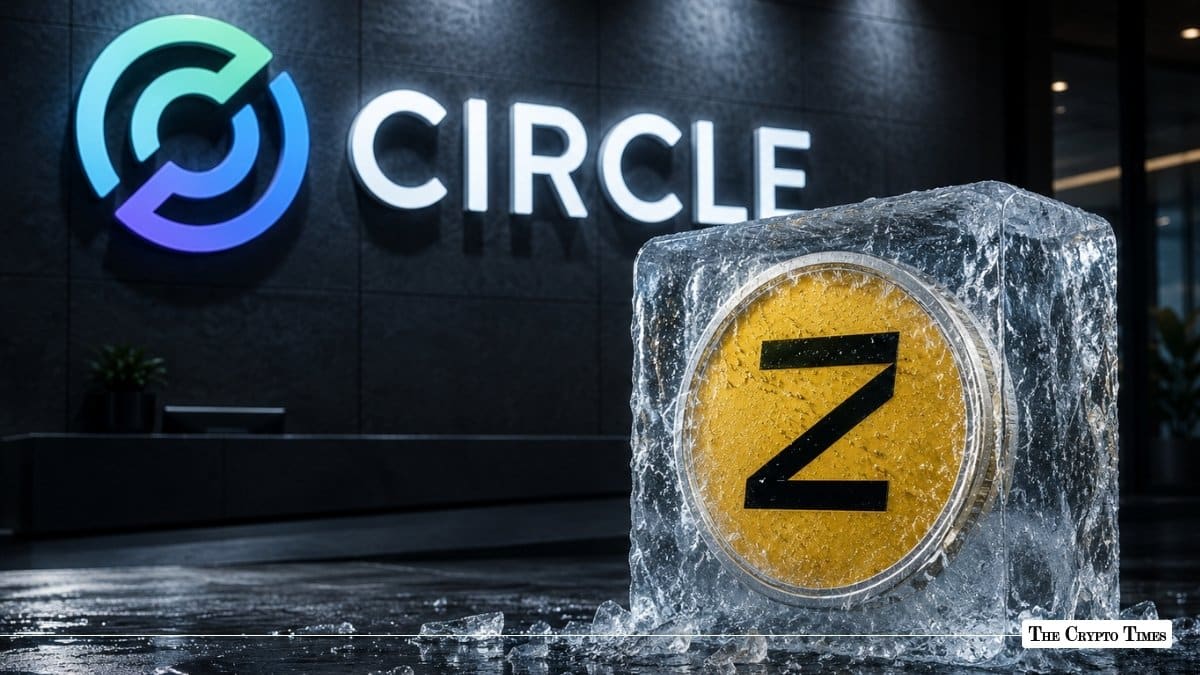
Circle has blacklisted the smart contract address for Zama’s Confidential USDC (cUSDC) token on Ethereum, freezing approximately 12.6 million USDC held inside the privacy protocol’s wrapper contract.
The freeze was executed at 01:08 UTC on May 30, 2026, according to data from the USDT/USDC Ban List Telegram tracker. The blacklisted address—0xe978F22157048E5DB8E5d07971376e86671672B2—is publicly labeled on Etherscan as “Zama: cUSDC Token,” a proxy contract using Zama’s ConfidentialWrapperV2 architecture deployed by the Zama team 154 days ago.
Circle has not disclosed the reason for the blacklist. However, on-chain evidence and governance records point to an indirect connection involving Overnight Finance, a DeFi yield protocol embroiled in a community dispute over alleged rug-pulling and treasury mismanagement.
The Overnight Finance Connection
On-chain analysis shows that the address 0xf7Fcc767dE537953b3519D4b3097A24A6dFE1c84 deposited approximately 12.4 million USDC into the Zama cUSDC contract on May 11, 2026. That address appears linked to Overnight Finance’s treasury operations.
Overnight Finance has been the subject of a recent governance crisis. The project’s Snapshot vote, which received 36 votes, describes the situation directly: “There has been co-mingling of personal wallets and protocol wallets.” The proposal estimates that approximately $15 million of the co-mingled assets belong to OVN token holders and lists five treasury wallet addresses whose assets the community has proposed to distribute.
The vote indicates that OVN holders believe the Overnight Finance team improperly mixed personal funds with protocol treasury funds—a pattern that has in previous cases triggered legal action by token holders seeking to recover assets.
Zama Hit as Collateral Damage
What makes the freeze precedent-setting is that the blacklisted address does not belong to Overnight Finance. It belongs to Zama, a privacy protocol that provides confidential token wrappers using fully homomorphic encryption (FHE) technology. The cUSDC contract allows users to wrap USDC into a privacy-preserving version for confidential transactions.
According to reports, Zama’s team was not notified before Circle executed the blacklist. The freeze effectively locks all USDC held inside the cUSDC contract—not just funds linked to Overnight Finance, but any user funds that had been deposited into Zama’s wrapper for legitimate privacy use.
This creates a scenario where a privacy protocol’s entire contract is frozen because one depositor’s funds were allegedly connected to a separate civil dispute. Users who deposited USDC into Zama’s cUSDC contract for unrelated reasons are now unable to redeem their wrapped tokens.
Zama Responds: ‘Nothing to Do With Privacy’
Zama co-founder Rand Hindi confirmed the root cause of the freeze in a post on X following investigation assistance from on-chain investigator ZachXBT. Hindi said the freeze stemmed from a court-issued restraining order targeting wallets linked to the Overnight Finance hack—not from any action against Zama or its privacy technology.
According to Hindi, the hacker deposited over $12.5 million USDC into Zama’s cUSDC wrapper contract at a time when the address was not on any sanctions list and was not flagged by Zama’s KYT (Know Your Transaction) tools. Because the cUSDC wrapper had limited utility at the time, that single deposit accounted for more than 99% of the total funds in the contract—which led the court order to target the wrapper contract itself rather than just the hacker’s address.
Hindi said Zama was not notified before the freeze was executed and emphasized that the protocol is “not a mixer”—it does not obfuscate senders or recipients, only balances and amounts, making it ineffective as a tool for laundering. He pointed to the hacker’s cUSDC transaction history, which remains fully visible on Blockscout, as evidence.
As an immediate precaution, Zama has paused its cUSDC, cUSDT, and cWETH contracts pending a full investigation to identify all addresses linked to the case. Hindi said a detailed post-mortem and a framework for handling future freeze requests would follow.
Patagon Management and the Civil Case
One of the plaintiffs reportedly connected to the civil action against Overnight Finance is Patagon Management, a Delaware-based entity with a track record of pursuing legal claims against DAO projects. Patagon previously sued the founder of SpartacusDAO in the Southern District of New York over fraud and securities violations and led a $300,000 legal fund approved by the Aragon DAO to sue the Aragon Association after its controversial dissolution.
Patagon has described itself as an investment company and has been characterized by critics as an entity that pursues hostile DAO takeovers and RFV (risk-free value) raiding of protocol treasuries. The firm’s involvement in the Overnight Finance case raises questions about whether the temporary restraining order (TRO) application accurately represented the nature of the frozen address—specifically, whether the court was informed that the target was a third-party protocol’s smart contract rather than a wallet directly controlled by the defendants.
A Pattern of Circle Freeze Controversies
The Zama freeze is the latest in a series of controversial USDC blacklisting actions by Circle in 2026. In March, Circle froze 16 unrelated business hot wallets in response to a sealed civil case, including the DFINITY Foundation’s ckETH Minter contract—a bridge between Ethereum and the Internet Computer Protocol. On-chain investigator ZachXBT called it potentially the most incompetent freeze he had seen in five years.
In April, Circle drew further criticism for failing to freeze over $230 million in stolen USDC during the Drift Protocol hack, where attackers bridged funds via Circle’s own CCTP infrastructure over six hours during U.S. business hours. ZachXBT and others highlighted the contradiction: Circle froze legitimate business wallets rapidly for a civil dispute, but did not act during an active exploit involving hundreds of millions.
Circle CEO Jeremy Allaire later defended the company’s position, saying Circle freezes wallets only when directed by law enforcement or courts, not in real time during hacks.
Why This Matters
The Zama freeze raises a question that the stablecoin industry has not yet resolved: what happens when a court-ordered freeze targets a smart contract that pools funds from multiple unrelated users?
Unlike a wallet freeze, which affects a single address holder, blacklisting a wrapper contract locks funds for every user who interacted with it. If the plaintiffs in the Overnight Finance case misrepresented the address to the court—presenting a Zama protocol contract as if it were a defendant’s wallet—the TRO may have been granted on incomplete or inaccurate information.
For Zama, the immediate consequence is that its cUSDC product is effectively bricked on Ethereum until the freeze is lifted. For the broader DeFi ecosystem, it is a warning that confidential or pooled-fund protocols carry a unique counterparty risk: any single user’s legal exposure can trigger a freeze that impacts every other user in the same contract.
Also Read: How Tether Freezes USDT From Ponzi Schemes, Hacks, and Other Illicit Activity