Key Highlights
- ICE CEO Jeffrey Sprecher said Hyperliquid is “bigger than Nasdaq” in trading activity, mainly because of its huge derivatives trading volume.
- Hyperliquid dominates over 70% of decentralized perpetual futures trading and runs 24/7 markets, including weekend oil trading when exchanges are closed.
- The rise of Hyperliquid is pushing traditional finance to adjust trading hours and raising new questions about how crypto platforms should be regulated globally.
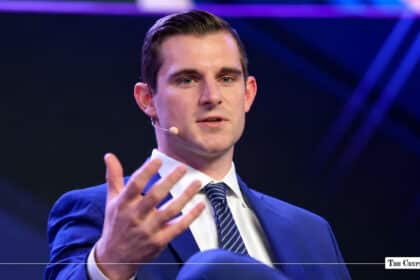
Jeffrey Sprecher, the CEO of Intercontinental Exchange (ICE), recently made a rare and striking statement that might stick with the crypto space for a while. He said the decentralized trading platform Hyperliquid is “bigger than Nasdaq” in trading activity.
“This Hyperliquid that we’re talking, if you haven’t heard about it, it’s bigger than NASDAQ, okay? It’s 11 people,” Sprecher said at Bernstein’s 42nd Annual Strategic Decisions Conference on May 27, during a fireside chat with Bernstein analyst Chinedu Bolu. “You look at it, you’re like, wow, that’s pretty something.”
He also praised the small team behind it, calling them “very, very smart people,” and pointed out that the core builders are only about 11 people.
A bold comparison to Nasdaq
Sprecher’s point was not about company wealth or size. As of now, Hyperliquid’s HYPE token carries a market value of about $15.1 billion, while Nasdaq’s roughly $50 billion valuation. So in terms of valuation, Nasdaq is still much larger.
However, when it comes to trading activity, Hyperliquid now handles billions of dollars in daily perpetual futures trading and controls more than 70% of the decentralized perp market. That level of market activity is what led Sprecher to describe it in such strong terms.
He explained that Hyperliquid Labs, the “11 people” core team behind the platform, runs a system that has grown far beyond what its size would suggest. The project also depends on open-source contributors and blockchain validators, but the core development group remains extremely small compared to traditional financial exchanges.
He also mentioned that ICE has met Hyperliquid’s founders several times, which shows that traditional exchange operators are paying closer attention to crypto-native trading venues.
24/7 trading is changing the game
One reason ICE took notice is Hyperliquid’s around-the-clock trading model. Unlike traditional markets that close on weekends, Hyperliquid stays open all the time, including weekends when even ICE’s energy markets are shut. This became especially important during recent geopolitical tension in the Middle East, when oil prices moved sharply over the weekend and traders needed a place to react instantly.
Spreacher said this shift was impossible to ignore. “There have been a lot of activity that happens, a lot of decisions and things happen on the weekend. So it’s gotten a lot of interest,” he said.
ICE starts adjusting its own schedule
Because of this, ICE itself has started changing how it operates. Sprecher said the company spoke with major oil firms and decided to reduce the gap when markets are closed.
“So we went to all the major oil companies and said, good news, we can stay open,” Sprecher said.
He added that ICE plans to remain open later on Fridays and reopen earlier on Mondays to reduce the gap when traditional trading is unavailable.
The regulation question growing louder
Sprecher also used Hyperliquid’s rise to highlight what he described as a regulatory gap. Under U.S. law, perpetual futures like those on Hyperliquid are treated as swaps under the Dodd-Frank Act, which brings strict rules around reporting and risk control.
ICE follows these rules, but Hyperliquid operates offshore and does not fall under the same system. Sprecher said this creates an uneven playing field and raised a bigger question for regulators.
“Why are you prohibiting us from doing this when it’s already happening? And can’t we have a level playing field? And by the way, this stuff is global,” Sprecher said.
He said regulators may soon face a choice between creating a new legal category for perpetual futures or bringing offshore venues under existing rules such as Dodd-Frank in the U.S. and EMIR in Europe.
Sprecher added that retail and professional trading are increasingly moving toward a 24/7 model and said traditional finance can no longer ignore the shift.
HYPE token is up over 90% in a year
HYPE itself is up about 93% year to date. At the time of writing, the token is currently trading for $62.42, representing an 8% surge today alone. The token saw an increase of 56% in the month of May alone, from a low of $40.
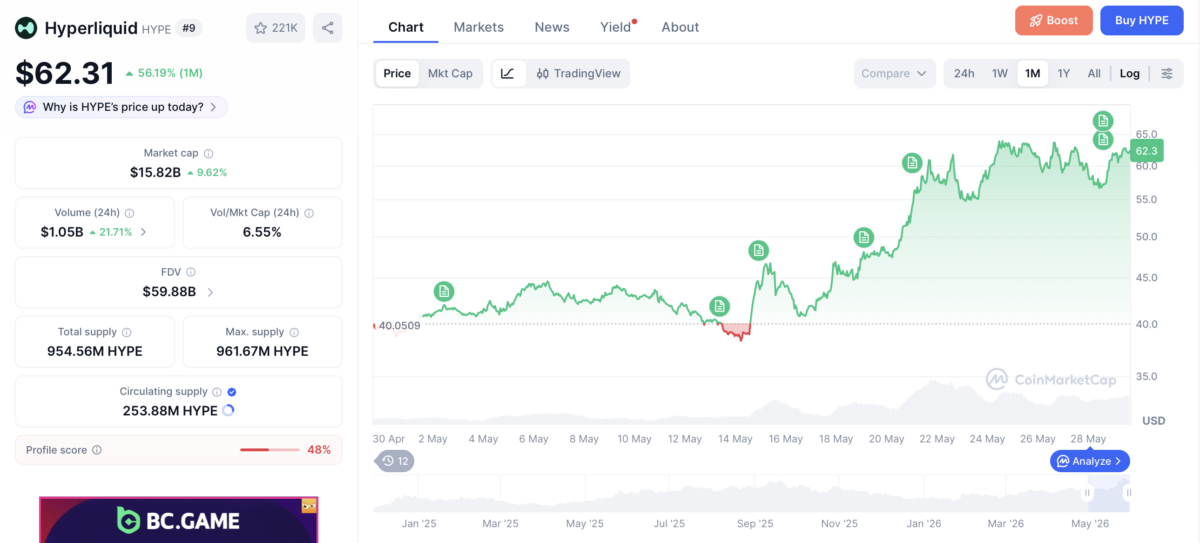
Meanwhile, Sprecher’s comment seems to have impacted. Trading activity has surged to about 21.47% within the last 24 hours to about $1.05 billion, while the market cap sits at $15.78 billion.
According to DefiLlama, Hyperliquid is ranked the fourth-largest fee-generating protocol in the crypto industry, generating $15.6 million in weekly fees in the past seven days.
Also Read: Sui Blockchain Suffers Second Major Outage in 48 Hours, SUI Price Falls Sharply