Key Highlights
- Robinhood shares rose more than 8% intraday, reaching around $91.92 on May 29.
- The rally followed Robinhood’s rollout of AI-agent trading and AI-enabled card spending.
- The move suggests HOOD is finding a new investor narrative beyond Bitcoin and crypto trading volumes.
Robinhood Markets Inc. shares jumped sharply on May 29 as investors latched onto the company’s new AI-agent rollout, giving the brokerage stock a fresh catalyst that was not directly tied to Bitcoin or broader crypto market momentum.
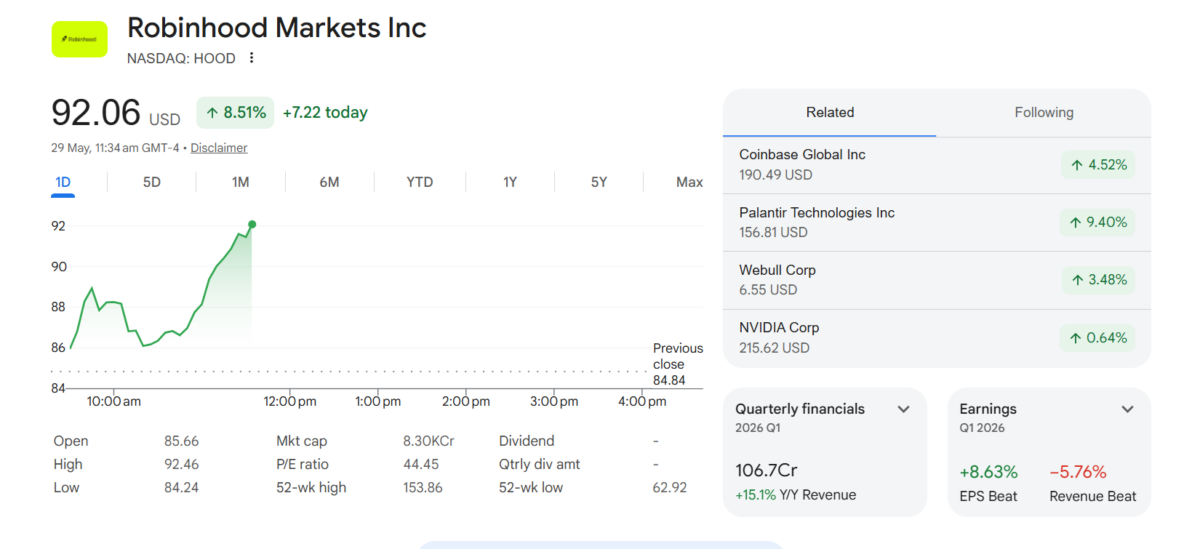
HOOD was trading around $91.92, up 8.35% on the day, according to the market snapshot shared by Google Finance. The stock opened near $85.66, hit an intraday high of $92.46, and moved well above its previous close of $84.84.
The rally lifted Robinhood’s market value to roughly $83 billion, while the stock traded at a P/E ratio of 44.45. Even after the sharp move, HOOD remained below its 52-week high of $153.86, though it has recovered strongly from its 52-week low of $62.92.
Robinhood’s latest quarterly snapshot also helped frame the move. The company’s Q1 2026 revenue stood at about $1.07 billion, up 15.1% year over year, while earnings showed an 8.63% EPS beat and a 5.76% revenue miss. That mixed financial backdrop makes the AI-agent rollout more important for investors, as the market appears to be pricing HOOD on future product expansion rather than only crypto trading activity or near-term transaction revenue.
The move also came during a stronger session for several fintech, brokerage, and AI-linked names. Coinbase Global rose 4.52%, Webull gained 3.48%, Palantir climbed 9.40%, and Nvidia added 0.64%, showing that Robinhood’s rally was part of a broader risk-on move across AI and trading-platform stocks.
The rally came after Robinhood said users will be able to connect AI agents to its platform for trading and spending functions. The company’s official support page says users can create a dedicated Robinhood Agentic account, connect a third-party AI agent through Robinhood’s Trading MCP, and allow the agent to access account information and place orders inside that separate account.
AI Agents Give Robinhood a New Stock Catalyst
Robinhood’s AI-agent trading product currently allows long equities orders only, with the company saying support for more assets will be added later. That means the initial investor excitement is centered on stock trading automation, not crypto trading.
The company says AI agents can help users build portfolios, automate trading strategies, rebalance allocations, and analyze portfolio risks. Robinhood’s help center also notes that users remain responsible for trades made by their agents, and that agents can place trades without confirmation if users allow that setup.
This matters for HOOD because Robinhood has often traded like a crypto-linked stock when Bitcoin was moving sharply. But the latest rally shows investors are now also pricing Robinhood as an AI-finance platform, where automation, spending controls, brokerage access, and financial data could become part of a wider product ecosystem.
Robinhood Expands AI Into Card Spending
Robinhood is also extending the same agentic model into spending. The company said its Agentic Credit Card lets Gold Card users create a dedicated virtual card for AI agents, set spending limits, require approvals, and revoke access.
The official Robinhood newsroom said customers can connect agents to a dedicated virtual Gold Card, set a spending limit, and choose whether manual approvals are required. The company said agents could scan prices, monitor availability, and make purchases based on user instructions, while users remain able to delete the virtual card at any time.
That gives Robinhood a broader AI story than a simple trading feature. The company is trying to position itself across investing, spending, banking, and automation, with AI agents acting under user-defined limits rather than simply providing chatbot-style recommendations.
Why This Is Not Just a Bitcoin Trade
The key market signal is that Robinhood’s stock is rising even as the immediate catalyst is not Bitcoin. Crypto still matters to Robinhood’s business, but this move gives investors a different reason to buy HOOD: the possibility that Robinhood becomes one of the first major consumer finance apps to let AI agents act directly inside brokerage and card products.
Reuters reported that Robinhood will allow customers to deploy AI agents to trade stocks and make purchases through its credit card, with users able to create a dedicated trading account separate from their primary one.
That separation is central to the product’s risk framing. Robinhood’s own disclosure says agentic trading may execute trades without direct input on each transaction and carries the risk of losing the entire investment.
For investors, the bet is not that Robinhood has removed risk. The bet is that Robinhood may be early to a new retail-finance interface where users do not just click buttons inside an app, but delegate tasks to AI agents operating under preset rules.
HOOD Rally Signals a Shift in Investor Narrative
Robinhood’s two-day jump points to a possible shift in how the market values the company. Earlier rallies in HOOD were often linked to Bitcoin strength, crypto trading activity, or retail risk appetite. This time, the stock is being rewarded for product expansion into AI-led trading and payments.
That does not mean Bitcoin is irrelevant to Robinhood. Crypto volumes still influence the company’s transaction revenue. But the AI-agent rollout gives Wall Street a second story to price into the stock: Robinhood as an infrastructure layer for agentic finance.
The risk is equally clear. Automated trading by AI agents could invite regulatory scrutiny, user-loss disputes, and suitability questions, especially if retail investors allow agents to trade without manual approval. Robinhood appears aware of that risk, repeatedly emphasizing separate accounts, spending limits, approvals, fraud detection, and the ability to disable agents.
For now, investors are treating the rollout as a growth signal. HOOD’s sharp move on May 29 shows that the stock can rally on an AI-fintech narrative, even when Bitcoin is not the main driver.
Also Read: XLM’s Next Stop: $0.25 or Pullback? Key Levels to Watch After Stellar’s 40% Surge