
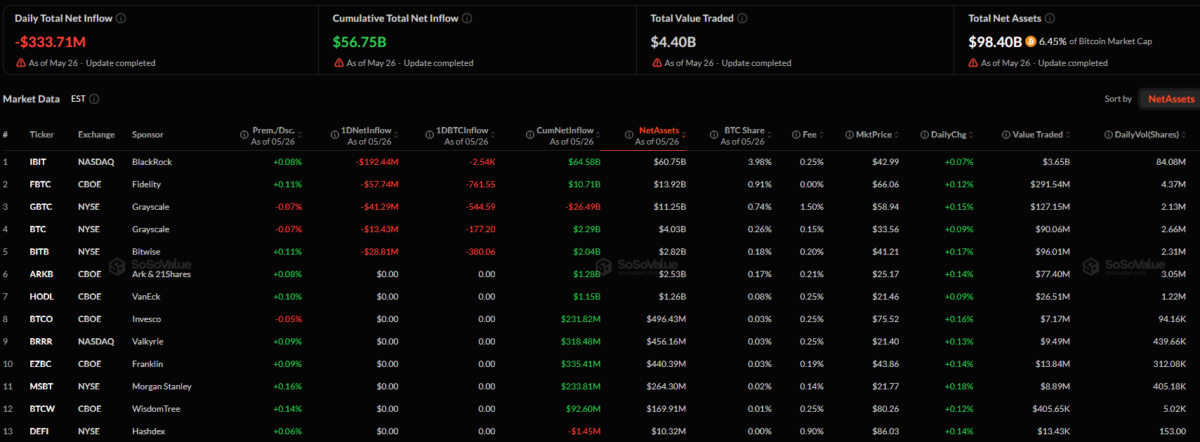
In a striking display of selective institutional appetite, U.S. spot Bitcoin ETFs continued their prolonged outflow streak on May 26, shedding approximately $334 million in a single day—the seventh consecutive session of net redemptions.
Ethereum ETFs added to the pain with another $35 million outflow, extending an 11-day losing streak. Yet amid this apparent retreat from the crypto majors, a new narrative is emerging with investors rotating aggressively into higher-beta alternatives, with Hyperliquid’s HYPE spot ETFs standing out as the clearest beneficiary.
On May 26 alone, the two primary HYPE ETFs—Bitwise’s BHYP and 21Shares’ THYP—pulled in a combined $20.45 million in net inflows. BHYP led with $19.05 million, pushing its cumulative total since mid-May launch to around $55 million, while THYP added $1.41 million for a roughly $44 million haul.
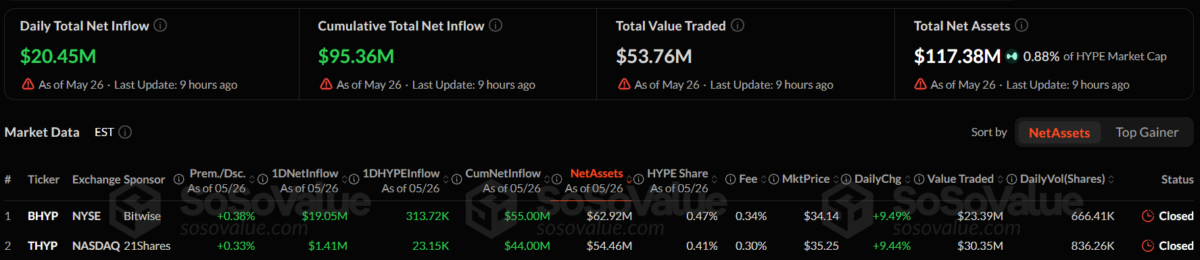
Across their first 10 trading days, HYPE products have amassed nearly $95 million, absorbing 0.88% of the token’s market cap—the strongest debut performance of any spot crypto ETF to date, outpacing Bitcoin (0.59%), Ethereum (0.41%), and Solana (0.31%) on a comparable basis.
This divergence highlights a maturing crypto investment landscape. No longer is capital flowing blindly into the largest assets by market cap. Instead, sophisticated allocators appear to be hunting for asymmetric upside in protocols demonstrating real utility and structural demand drivers.
The Bitcoin Exodus: What’s Driving the Bleed?
Spot Bitcoin ETFs have now seen outflows totaling over $1 billion in the past week and roughly $2.26 billion over the last 14 trading sessions, according to aggregated data from SoSoValue.
The largest cryptocurrency’s cumulative inflows since the 2024 launch remain robust at $56.75 billion, with approximately 722,000 BTC held across products, but recent pressure has dragged total Bitcoin ETF assets below the $100 billion threshold for the first time in months.
BlackRock’s iShares Bitcoin Trust (IBIT) bore the brunt on May 26, with outflows exceeding $192 million in some reports. Fidelity’s FBTC followed with around $58 million, while Grayscale’s GBTC and Bitwise’s BITB contributed additional tens of millions in redemptions.
The pattern echoes broader macro headwinds: rising Treasury yields, a strengthening U.S. dollar, fading rate-cut expectations, and potential December rate-hike pricing have weighed on risk assets. Bitcoin itself traded resiliently around the $76,000 level during the period, dipping toward $74,000 intraday before stabilizing, but the ETF flows exerted visible selling pressure on spot markets.
Ethereum mirrored the weakness. Spot ETH products lost another $35 million on May 26, with BlackRock’s ETHA and Fidelity’s FETH leading outflows. The sector has now shed hundreds of millions over nearly two weeks, reflecting diminished enthusiasm for smart-contract platforms amid competition from faster, more specialized Layer-1s.
XRP and Solana ETFs also saw modest positives—around $22 million and $15.6 million weekly, respectively—underscoring a broader altcoin rotation rather than outright crypto capitulation.
HYPE’s Meteoric Rise: Utility Meets Institutional Access
In sharp contrast, Hyperliquid’s ecosystem is thriving. The native HYPE token, powering one of the leading on-chain perpetual futures DEXes, has rallied strongly in 2026. It recently touched the new all-time high of $64.59, outperforming majors even as Bitcoin and Ethereum posted double-digit year-to-date losses in some stretches.
Currently, several tailwinds are powering HYPE’s resilience and strong ETF appeal. At the core is Hyperliquid’s robust protocol-level buyback mechanism. The project’s Assistance Fund recycles approximately 99% of trading fees from its decentralized perpetuals exchange into open-market HYPE purchases. This has already generated more than $1.16 billion in cumulative buybacks, creating consistent structural demand that operates independently of market sentiment.
The explosive debut of spot HYPE ETFs has also supercharged momentum. Launched between May 12 and 15, 2026, the both the ETFs have attracted rapid capital with an average of roughly $10 million in daily inflows.
On-chain data from Arkham Intelligence shows the ETF issuers accumulated tens of millions of HYPE tokens within the first week alone, meaningfully reducing circulating supply and supporting price action.
Market Implications and Outlook
This rotation carries significant implications. For Bitcoin maximalists, the outflows raise questions about sustained institutional conviction in “digital gold” during sideways or corrective phases. Yet Bitcoin’s price resilience despite heavy ETF selling suggests offsetting demand from OTC desks, Asian buyers, and long-term holders.
For Hyperliquid, the story validates its model: a high-performance L1 optimized for decentralized derivatives trading, with sub-second finality and self-custody. The platform’s success in attracting volume has translated into fee revenue that directly supports the token.
However, uncertainty lingers over HYPE’s rapid run, as the token has surged by over 100% year-to-date in stretches, inviting a wave of profit-taking and volatility. At the time of publishing, HYPE was trading near $63—up nearly 28% in the past seven days.
Many whales have already booked gains, and the token’s fully diluted valuation has briefly exceeded major centralized exchange market caps. Still, with Grayscale’s potential GHYP product on the horizon and continued protocol buybacks, many see structural support.
Whether this marks the start of a sustained altseason or a temporary tactical shift remains to be seen. What is clear is that the era of one-size-fits-all crypto exposure is evolving. Investors are voting with capital—and right now, they’re placing bigger bets on the next wave of decentralized infrastructure.
Also read: Ethereum’s ‘ETH Is Money’ Era Is Over? Bankless Co-Founder Dumps ETH