
Key Highlights
- PYTH dropped 10.4% over 24 hours to $0.08421 on October 16, trading between $0.0836 and $0.09643.
- The token’s market capitalization stood at $661.7 million, with $75.85 million in 24-hour trading volume and a fully diluted valuation of $840.3 million.
- The global crypto market capitalization fell 0.7% to $2.84 trillion, while Bitcoin declined 1.2% and Ethereum lost 0.4% over the same period.
Pyth Network’s token PYTH declined 10.4% over the past 24 hours to $0.08421, according to market data. The token traded within a 24-hour range of $0.0836 to $0.09643.
According to the CoinGecko data (on October 16 at 17:35 UTC), market capitalization stood at $661.703 million. Fully diluted valuation was $840.262 million. Twenty-four-hour trading volume reached $75.85 million. Perpetual futures open interest was $118.926 million. Circulating supply totaled 7.875 billion tokens against a total and maximum supply of 10 billion.
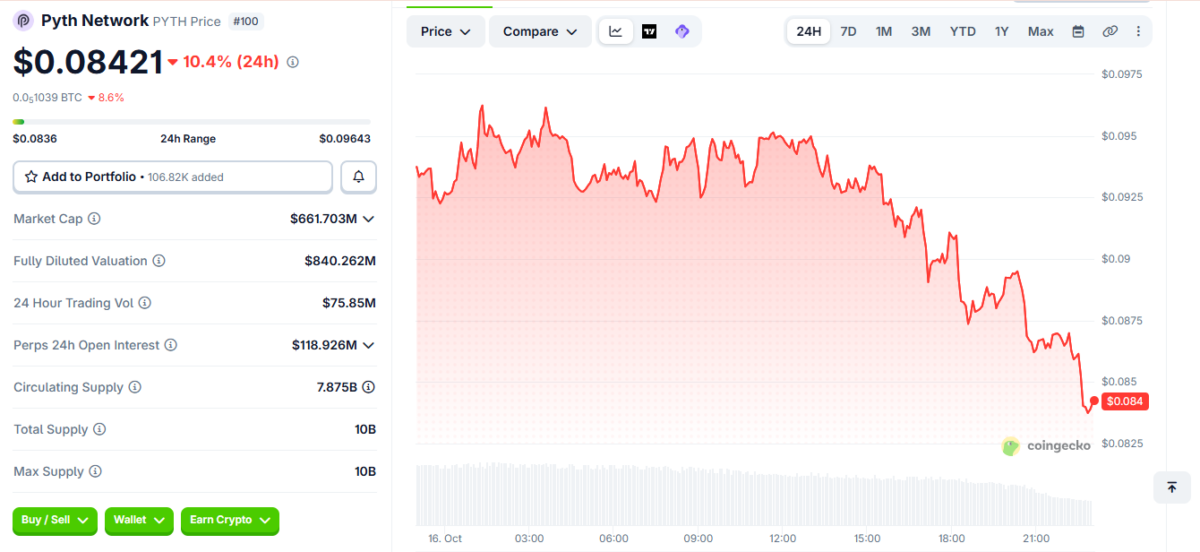
The 24-hour chart showed PYTH trending lower, with its price nearing $0.084. Over the past seven days, PYTH traded between $0.07611 and $0.1005. The all-time high remains $1.20, placing the current price 93.0% below that level. The all-time low is $0.02953, from which the token has advanced 185.1%.
Broader market context
PYTH’s decline coincided with a modest pullback in the broader cryptocurrency market. In the same timeframe (on October 16 at 17:35 UTC), CoinGecko data further showed that the global cryptocurrency market capitalization stood at $2.84 trillion, reflecting a 0.7% decline over the previous 24 hours. Total cryptocurrency trading volume for the day was $76.8 billion. Bitcoin dominance measured 57.3%, while Ethereum dominance was 10.3%. CoinGecko tracked 22,312 cryptocurrencies at the time of the data.
Bitcoin traded at $80,928.24, down 1.2% over 24 hours. Ethereum stood at $2,403.99, down 0.4%. Tether remained near $0.9993. BNB traded at $720.02, down 1.4%, and XRP at $1.30, down 2.4%.
Reported RWA perpetuals volume
On October 16, Pyth reported third-quarter 2026 volume figures for real-world asset (RWA) perpetual futures markets using its price data. Equities accounted for $1.26 trillion, representing 98.3% of that category.
Commodities totaled $458 billion, or 91.6%. Indices reached $317 billion, or 91.2%. The combined volume across the three asset classes was $2.03 trillion, equivalent to approximately 96% of RWA perpetual futures volume in those categories.
Background on treasury accumulation rule
On October 8, Pyth announced a change approved under OP-PIP-136, described as the “100% Rule.” Under the prior arrangement, the DAO allocated one-third of its non-PYTH treasury balance to monthly PYTH purchases, with each transfer requiring a separate DAO vote. The new rule establishes standing approval for the use of all funds received from Pyth products toward PYTH accumulation without requiring a monthly vote.
The rule applies to revenue from Pyth Pro subscriptions, Listing as a Service, the Data Marketplace, and Pyth Indices. According to the announcement, 60% of the revenue from products owned by the DAO is directed to the DAO. Under the updated system, the full amount of that portion is allocated to PYTH accumulation for the reserve.
The price decline of 10.4% occurred against this backdrop of reported quarterly volume figures and the earlier treasury rule adjustment. No additional protocol changes or volume updates beyond the stated Q3 2026 data were included in the October 16 release.
Also Read: Tokenized Stocks Reach $3.8B as DEX Trading Volume Rises 55x