Key Highlights
- Pyth DAO will now use 100% of the funds it receives from its products to accumulate PYTH tokens in its reserve.
- Pyth’s annual recurring revenue reached $11.5 million in September 2026, showing strong growth in its data business.
- PYTH climbed from around $0.0732 to a daily high near $0.08 after the announcement before pulling back to around $0.0752.
Pyth Network’s token, PYTH, surged 6.21% on Thursday after the network announced that its DAO will now use 100% of the funds it receives from its products to accumulate PYTH tokens.
In a post on X, the firm said this new rule, reportedly approved under OP-PIP-136, means the more money Pyth earns from its data products, the more PYTH the DAO will buy and add to its reserve.
Pyth changes how it buys PYTH
The firm said the change is part of what Pyth calls the “100% Rule.” Before this decision, the DAO used one-third of its non-PYTH treasury balance for monthly PYTH purchases, with a separate DAO vote needed for each transfer. Under the new system, a standing approval allows all funds received from Pyth products to be used for PYTH accumulation without another vote every month.
According to the announcement, the rule covers revenue from Pyth Pro subscriptions, Listing as a Service, the Data Marketplace, and Pyth Indices. Pyth said 60% of the revenue from products owned by the DAO goes to the DAO. Under the new plan, all of that amount will be directed toward PYTH accumulation.
Data business grows across key markets
The change comes as Pyth’s data business continues to grow. The network said its overall annual recurring revenue reached $11.5 million in September 2026, up 86% from the previous quarter. That figure was below $1 million in late 2025, according to Pyth. Pyth Indices also reached $1.81 million in fixed annual recurring revenue.
A large part of the growth is coming from markets for real-world assets, including perpetual contracts linked to stocks, gold, oil, and indices. Pyth said more than 94% of tracked real-world asset perpetual volume used its data over the past three months, with more than $2 trillion in total volume during that period.
Pyth also said its data is being used by several trading and prediction market platforms. Trade[XYZ], Lighter, Kraken, Coinbase, and Phoenix are among the venues using Pyth data for perpetual markets. Kalshi and Polymarket also use Pyth prices for some stock and commodity prediction markets.
The network has also expanded its data products. Pyth said 50 indices are now live across US equities, metals, oil, foreign exchange and other markets. Its Data Marketplace has also grown, with Nasdaq distributing Nasdaq Basic through the platform. Corporate action data covering events such as stock splits, dividends, mergers and ticker changes is also available through the same API.
How the new PYTH buying system works
The new rule sets out how the money will be turned into PYTH. If the DAO receives PYTH directly, the tokens go straight into the reserve. If it receives stablecoins, a pre-authorized council will use them to buy PYTH on the open market before transferring the tokens to the DAO Treasury.
The purchases will still follow set limits. These include a 5% slippage cap, a $25,000 limit per transaction, aggregator routing, public transaction proofs, and monthly reporting. The first acquisitions under the new authorization were carried out on September 30.
Pyth said its PYTH Reserve held about 42 million PYTH as of the announcement. The DAO has maintained the reserve since December 2025, when it began making monthly PYTH purchases on the open market.
Mike Cahill, CEO of Douro Labs and a core contributor to Pyth Network, said, “The DAO committing all of it to the Reserve is the strongest alignment this network has had.”
PYTH price climbed after the announcement
Shortly after the announcement, the network’s token PYTH surged from around $0.0732 and was trading at $0.0752, according to data from CoinMarketCap as of October 8 (17:29 UTC).
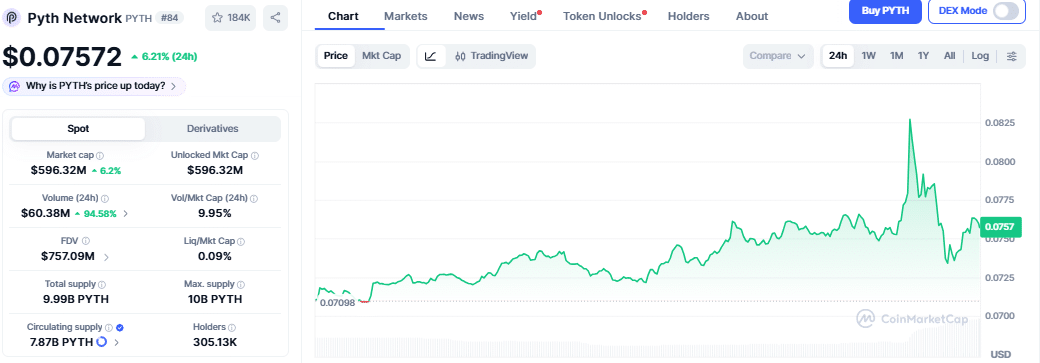
The token has initially climbed up to a daily high around $0.08 before pulling back. The surge pushed its market cap to approximately $596.32 million, with its trading activity sitting at $80.38 million within the last 24 hours.
Also Read: Moscow Exchange Plans December 1 Start for Crypto Trading in Russia