
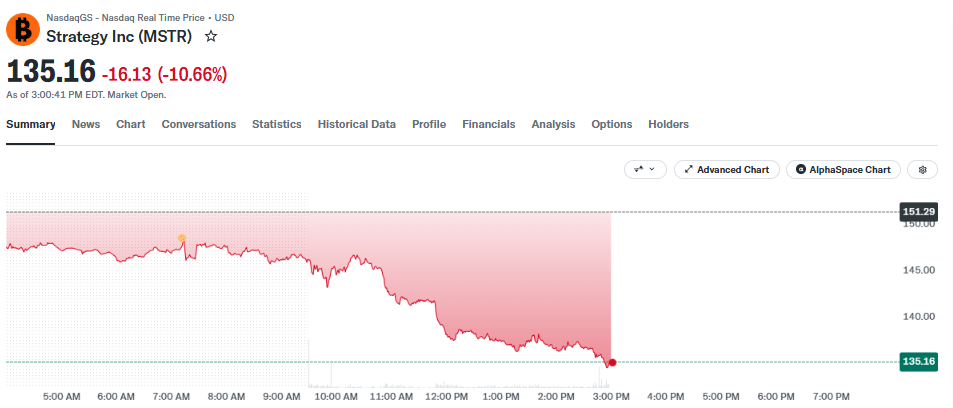
Strategy’s shares, MSTR, fell 10% on Friday as investors assessed the potential impact of new MSCI screening rules that could make the company ineligible for inclusion in the index provider’s benchmarks.
According to data from Yahoo Finance (on October 16 at 7:00 PM UTC), MSTR traded at $135.16, after sliding from an intraday high of around $147.14. The drop pulled Strategy’s market capitalization to approximately $57.169 billion. The stock’s average trading volume stood at around 21.9 million shares. MSTR was also down approximately 12% over the previous seven days and 52.63% over the past year.
MSCI to target Bitcoin treasury firms
MSCI, a global index provider, announced the decision on Thursday, October 15, following a review of a proposal first introduced in August. It targets companies that hold large amounts of investments but have limited assets used to run a regular business. Strategy and Japan-based Metaplanet are among the companies that could be affected.
The screening process has two stages. First, MSCI checks whether a company has enough operating assets, meaning assets used to run its business. Companies that fail this check must then pass five financial tests covering operating assets, expenses, cash flow, the value of non-operating assets and reliance on outside capital.
A company must fail at least four of the five tests to become ineligible. MSCI has also introduced a safeguard for companies already in its indexes. Existing members must fail the screening test in each of their two most recent annual reporting periods before they can be removed.
When MSCI will name affected companies
MSCI is expected to identify affected companies on November 11, 2026. The new rules are scheduled to take effect at the close of November 30. Strategy’s removal therefore remains uncertain.
The potential impact on MSTR shares has drawn attention because of the amount of stock held by index-tracking funds. In late 2025, JPMorgan analysts estimated that removing Strategy from MSCI indexes could lead to about $2.8 billion in selling by funds that follow those indexes. The estimate could rise to $8.8 billion if other index providers adopted similar rules.
Strategy challenges MSCI’s approach
Strategy disputes the potential scale of the selling. The company says funds tracking MSCI indexes hold around 13 million of its shares, equal to 3.1% of its basic shares outstanding. It argues that this amount represents less than one day of average trading volume for MSTR.
Strategy has also pushed back against MSCI’s approach. In an August 31 letter, the company asked MSCI to withdraw the proposal, arguing that the terms “operating” and “non-operating” do not have a clear basis in major accounting standards. Strategy says its Bitcoin business is an operating segment.
Meanwhile, Strategy announced on October 16 that it had conditionally declared daily dividends on its STRC preferred stock for November. The stock will maintain its 12% annual dividend rate if shareholders approve the changes at a special meeting on October 28. If approved, the daily dividend schedule would begin November 1, with the first payment due November 2.
As investors await MSCI’s final decision, the key question is whether the new rules will lead to actual index removals and additional selling pressure on MSTR.
Also Read: Does Google’s Quantum Research Put Bitcoin at Risk? What Willow Really Means