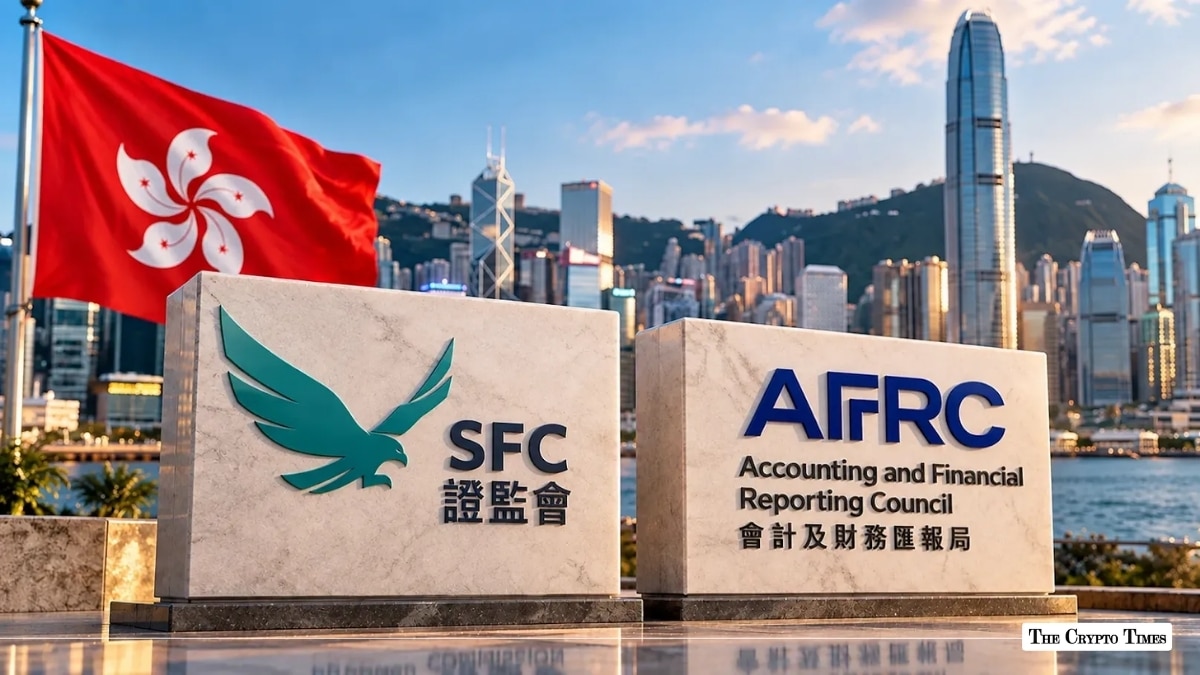
Hong Kong’s securities regulator is broadening its cooperation with the city’s accounting watchdog to cover financial reporting and audit work at licensed crypto firms, including virtual asset service providers.
The Securities and Futures Commission (SFC) and Accounting and Financial Reporting Council (AFRC) signed a new memorandum of understanding (MOU) on September 28, replacing a 2021 agreement and expanding their coordination beyond listed companies.
The framework covers financial and compliance reporting by SFC-licensed corporations, licensed virtual asset service providers, SFC-authorized funds and registered open-ended fund companies. It also applies to related audit and assurance work. The agreement provides for information sharing, referrals, regulatory assistance and coordinated inspections and investigations where the agencies have overlapping interests.
Crypto firms enter broader reporting framework
The inclusion of licensed virtual asset service providers gives the SFC and AFRC a formal mechanism to coordinate on accounting and reporting issues involving Hong Kong’s regulated crypto sector.
Under Hong Kong’s existing framework, licensed firms and licensed VAS providers must appoint auditors and submit financial statements and other required documents to the SFC. Auditors can also be required to report matters such as qualifications or adverse statements in their reports, material issues affecting a firm’s financial position, or failures to meet specified regulatory requirements.
The new MoU does not create those underlying obligations. Instead, it establishes how the two regulators will cooperate when matters involving financial reporting, auditing or regulatory compliance fall within their respective mandates.
Auditors become a key link between regulators
The agreement gives the AFRC and SFC a process for referring matters to one another when an issue crosses their regulatory boundaries.
If the SFC identifies a matter that may fall within the AFRC’s remit, including concerns about professional standards, it can refer the case to the accounting regulator. The AFRC can similarly refer matters involving regulatory requirements applicable to licensed firms, funds and other entities to the SFC.
The agencies can also coordinate investigations and inspections in significant or urgent cases. Where both regulators are involved in the same matter, the MoU calls for them to coordinate enforcement activity to limit unnecessary duplication.
For crypto firms, that could bring accounting and audit concerns into closer coordination with the SFC’s existing supervision of financial soundness and compliance.
VASPs specifically covered by investigation rules
The agreement sets out additional notification and consultation requirements when the AFRC investigates matters involving licensed virtual asset service providers.
For example, when the AFRC begins certain investigations involving a licensed VAS provider, it is required to notify the SFC. The AFRC must also consult the SFC before exercising specified investigative powers in cases involving a licensed VAS provider or certain responsible persons.
The same framework extends to certain investigations involving auditors and financial-reporting compliance where regulated entities are involved.
This gives the SFC visibility into relevant accounting and audit investigations involving firms under its crypto licensing regime while preserving the AFRC’s statutory responsibilities.
Funds and other regulated entities also included
The expanded cooperation is not limited to crypto companies.
The MoU also covers SFC-authorized collective investment schemes and registered open-ended fund companies, including their financial reporting and audit arrangements.
The SFC is responsible for setting authorization standards for collective investment schemes offered to the public and for registering open-ended fund companies. The AFRC, meanwhile, oversees the accounting profession, including auditor registration, inspections and investigations.
The two agencies said the expanded framework is intended to support reliable financial reporting and audit quality across a broader part of Hong Kong’s financial system.
Digital bond push adds to Hong Kong’s tokenization drive
The expanded reporting framework comes as Hong Kong continues to develop blockchain-based financial infrastructure. Bloomberg reported on September 24 that the government was preparing a multi-currency digital green bond of HK$15 billion and HK$20 billion ($1.9 billion to $2.6 billion), citing people familiar with the matter. If completed at the upper end, the transaction would be the largest digital bond sale of its kind, according to the report.
The proposed bonds would be denominated in U.S. dollars, Hong Kong dollars, euros and offshore yuan, with investor meetings planned ahead of potential pricing. The initiative adds to Hong Kong’s use of tokenized infrastructure in traditional financial markets, alongside its regulatory expansion around licensed virtual asset businesses.
Separately, the SFC has been tightening operational safeguards for licensed crypto platforms. In July, it directed licensed virtual asset service providers and internet brokers to adopt phishing-resistant authentication methods, including passkeys and bound devices, and to strengthen monitoring of suspicious account activity.
The SFC said firms must implement the stronger authentication measures as soon as practicable and no later than July 8, 2027, while large internet brokers are expected to implement them immediately.
Information sharing and joint investigations
The MoU establishes a broader mechanism for exchanging information relevant to each regulator’s statutory functions, subject to applicable laws and confidentiality requirements.
The agencies can notify one another about regulatory developments, provide technical assistance and coordinate training. They can also establish task forces for coordinated investigations or inspections, with responsibilities and evidence-gathering procedures agreed between the regulators.
Where enforcement matters overlap, the agencies are expected to determine which regulator has the more appropriate powers and functions to lead the action.
The agreement also provides for consultation when one regulator’s investigative steps could affect the other’s case.
MoU does not change Hong Kong’s laws
The agreement is a statement of intent between the SFC and AFRC and is not legally binding. It does not amend Hong Kong law, transfer regulatory powers between the agencies or create new obligations for regulated firms.
Instead, it replaces the previous 2021 MoU and sets out a more extensive framework for cooperation across licensed firms, VAS providers, funds and related auditors.
For Hong Kong’s regulated crypto market, the main change is the formal inclusion of licensed virtual asset service providers and their associated financial reporting and audit work in the two agencies’ cooperation framework.
Also Read: California Bans Official Meme Coins, Cites Trump’s Crypto Venture