Key Highlights
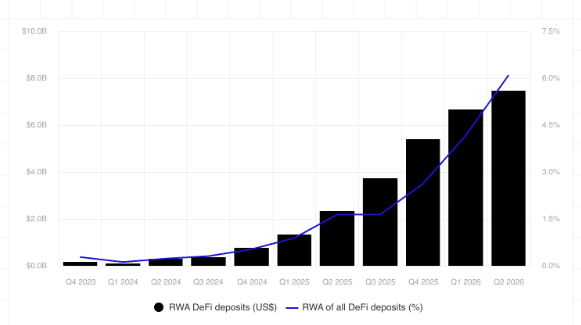
- RWA deposits in DeFi more than tripled to $7.4 billion in Q2 2026, even as total DeFi deposits fell by about 15%.
- Tokenized Treasury funds and other traditional financial assets drove most of the growth in the RWA market.
- RWA trading continued to grow, with spot trading volume rising about 220% while overall DEX trading volume dropped around 70%.
Real-world assets (RWAs) are accounting for a larger share of decentralized finance (DeFi) activity even as the broader crypto lending market slows.
According to a report released on August 6 by CoinShares and Token Terminal, deposits of tokenized RWAs into DeFi lending platforms and decentralized exchanges (DEXs) reached $7.4 billion in the second quarter of 2026, up from $2.3 billion during the same period last year.
This means that more investors are putting traditional financial assets on blockchain networks and actively using them.
RWA growth stands out as DeFi slows down
The report showed a different picture for the rest of the DeFi market. While RWA deposits more than tripled, total deposits across DeFi fell by about 15% from a year earlier as crypto prices weakened and investors pulled money out of many crypto-based products.
According to CoinShares, this gap suggests that tokenized traditional assets continued to attract users even during a slower period for the broader market. Instead of holding these assets without using them, investors are now putting them to work. The report said the money flowing into RWAs is no longer just about creating tokenized assets. More investors are using them as collateral to borrow, earn yield, and trade on blockchain-based platforms.
CoinShares said most of the growth came from tokenized Treasury and multi-strategy funds. The report identified JTRSY, BlackRock’s BUIDL, and Sky’s sUSDS as some of the biggest contributors. Private credit products, including JAAA, syrupUSDT, syrupUSDC, and PRIME, also added to the growth. Another contributor was Ethena’s sUSDe, which follows a delta-neutral strategy.
Why investors are using these assets
CoinShares said these products remain attractive because they can continue earning income while they are being used as collateral.
This allows investors to borrow against their assets without giving up yield. According to the report, this has supported deposits on lending platforms such as Aave, Morpho, and Kamino, where lending activity remains strong.
Ethereum remains the main home for RWAs
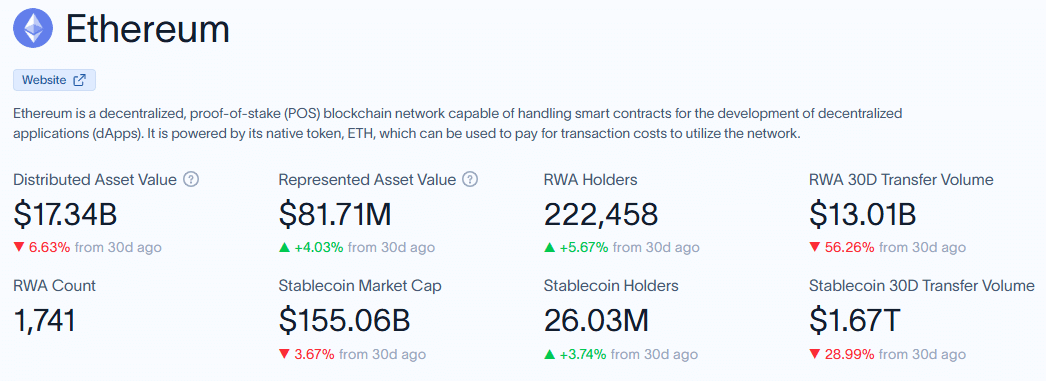
Ethereum remained the largest network for tokenized RWAs. Nearly 70% of all RWA deposits were held on lending markets built on Ethereum.
According to the report, Plasma ranked second, while Solana continued to grow through Kamino. CoinShares also said Ethereum still leads because borrowers and lenders prefer markets with deep liquidity, making it easier for users to find loans and trading opportunities.
Trading activity continues to grow
Growth was not limited to lending. Trading activity for tokenized assets also increased even as the wider DeFi trading market lost momentum. The report found that RWA spot trading volume climbed by about 220% over the past year, while overall decentralized exchange trading volume dropped by around 70%.
Tokenized gold products XAUT and PAXG made up a large share of that trading. Investors bought and sold these assets as gold prices moved during the year. Ethena’s sUSDe also recorded higher trading after liquidity shifted from Uniswap v3 to Uniswap v4.
RWAs expand beyond retail investing
Activity also picked up in perpetual futures linked to real-world assets. CoinShares highlighted TradeXYZ, an RWA-focused platform built on Hyperliquid, where trading volume increased by about 20x since launch.
Trading was mainly focused on products linked to oil, precious metals, the S&P 500, the Nasdaq-100, and technology stocks. Open interest also continued to grow, showing that more traders were keeping positions open in these markets.
The report said tokenized Treasury products are also becoming more useful in institutional finance. It pointed to BlackRock’s BUIDL, which has started being used as collateral in institutional trading arrangements. CoinShares said this shows that tokenized funds are becoming part of financial infrastructure instead of being simple investment products.
Despite the growth, the report said the RWA market is still small compared with the wider DeFi sector. Revenue across DeFi applications declined between the second quarters of 2025 and 2026, indicating RWA activity has not yet grown enough to make up for weaker crypto-native lending and trading.
Still, the latest data shows that tokenized traditional assets are playing a larger role in how people lend, borrow, and trade on blockchain networks.
Also Read: SpaceX Unlock Frees 911.5M Shares as SPCX Climbs 7% to $113