Administration officials were negotiating ethics language with Senate Democrats as late as Wednesday, two days before the chamber left without voting.
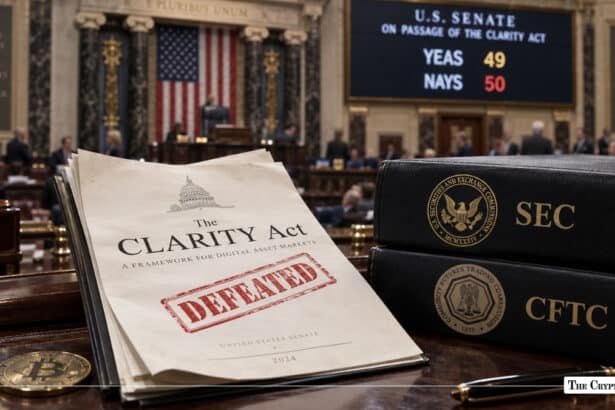
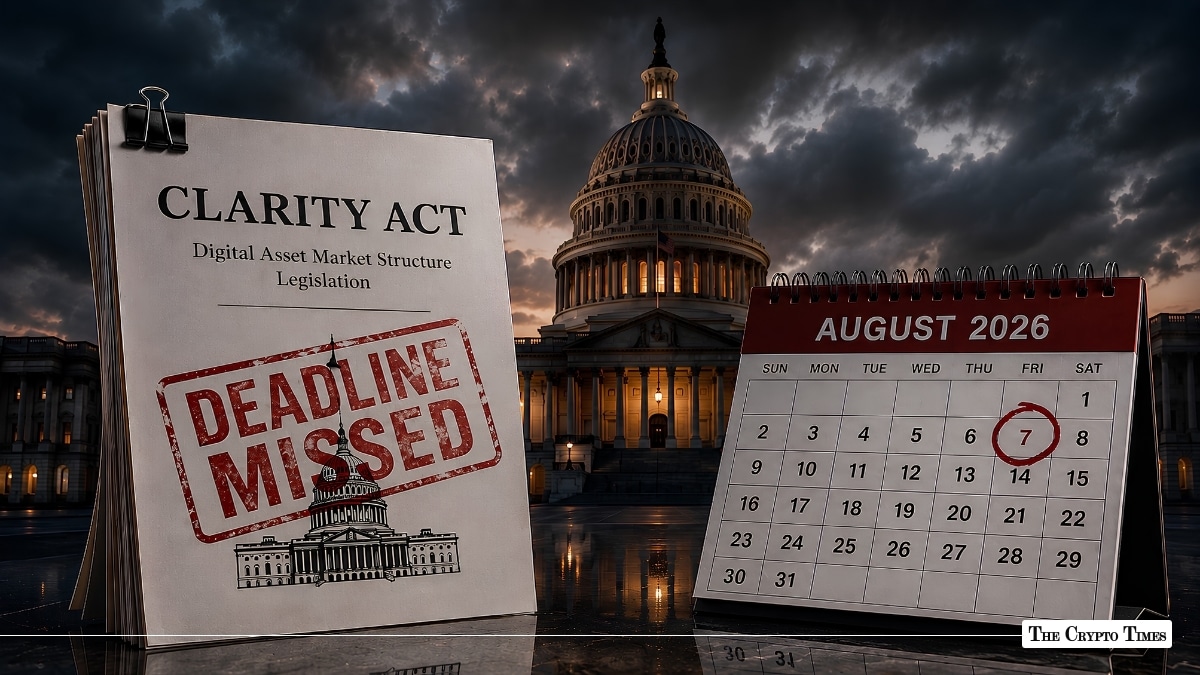
The Digital Asset Market Clarity Act missed its Aug. 7 deadline after Senate Majority Leader John Thune declined to file the cloture motion required to start a floor vote, ending a push in which the White House engaged directly on the bill’s final sticking point.
The administration entered the talks late
The executive branch’s involvement intensified in the closing days rather than the closing weeks. Senator Thom Tillis told reporters Wednesday that White House staff were working through bipartisan ethics text with Senator Ruben Gallego, describing aides as going through the lines.
That followed a Gallego-Tillis proposal that would have allowed state attorneys general to enforce certain crypto-related ethics rules rather than relying solely on the Justice Department, addressing Democratic objections that an earlier version lacked independent enforcement. The proposal was still under White House review when the final week opened.
Treasury Secretary Scott Bessent had pressed publicly for immediate Senate action. The administration had earlier taken a harder line, warning Democrats that rejecting its ethics offer would sink the bill. None of it produced a filing.
Markets priced the failure before the senate confirmed it
Kalshi’s contract on whether the Senate would vote on the CLARITY Act before the August recess traded at 4.7% on Aug. 7, down 37.6 points, on volume of $861,615. The market had held above 70% through mid-July before breaking down across the final two weeks.
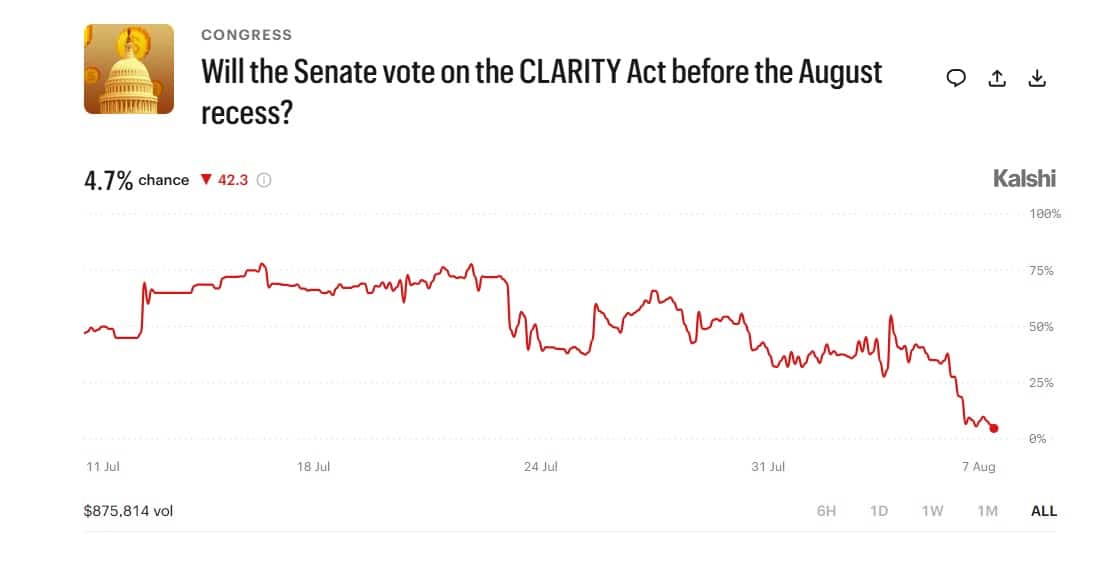
Kalshi’s rules specify that a recorded Senate vote to invoke cloture on a motion to proceed satisfies the payout criterion, meaning traders were pricing the procedural step, not passage.
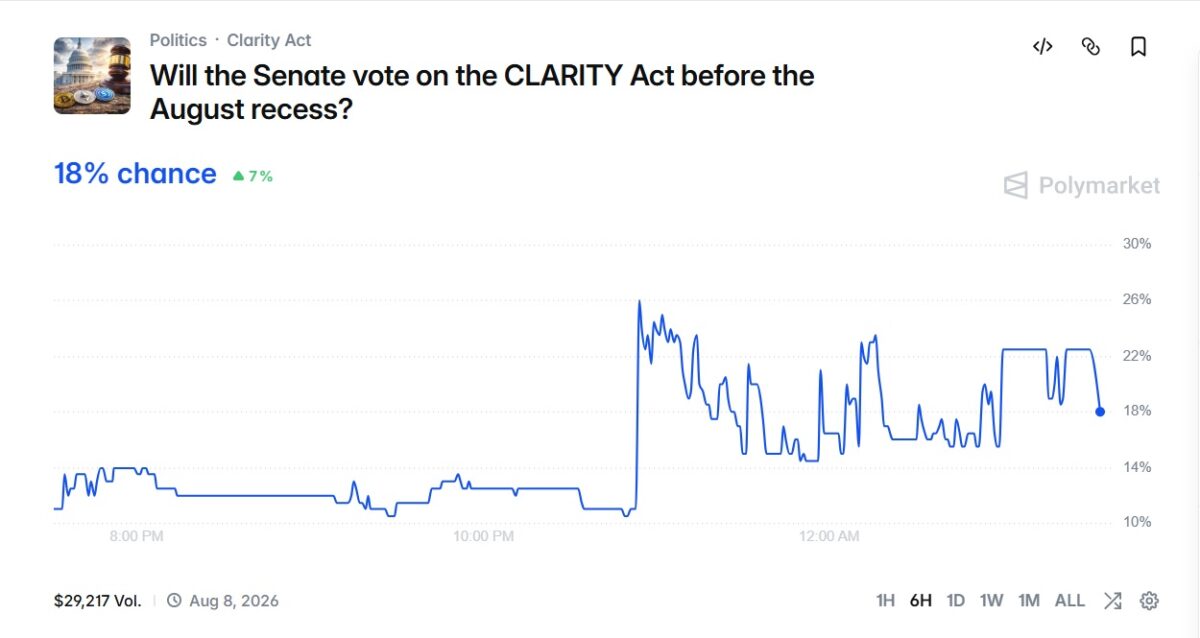
Polymarket’s equivalent contract sat higher, at 23% on volume of $29,217, after a sharp move upward late in the session. The gap between the two venues reflects differing resolution language and far thinner liquidity on Polymarket.
Longer-dated contracts moved in the same direction. Kalshi contracts on the bill taking effect before July 1, 2027, fell eight points to 41% on Aug. 5.
The procedural step that never came
Advancing H.R. 3633 required a cloture motion on the motion to proceed. Under Rule XXII, that motion must ripen for an intervening day before a vote, which meant a Wednesday night filing was the last option for a Friday vote.
Thune instead filed cloture Wednesday on the motion to proceed to S. 4668, the Protect College Sports Act of 2026, on a substitute amendment to the H.R. 6500 continuing-resolution vehicle, and on Todd Blanche’s nomination to be attorney general, with no corresponding filing for CLARITY.
Crypto journalist Eleanor Terrett read the college sports filing as a signal that no bipartisan agreement existed on the crypto bill. Thursday passed with no attempt to bring CLARITY to the floor; Thune described the delay as ordering rather than abandonment, saying the chamber was sequencing the bill and that other items remained outstanding. The Crypto Times reported the cloture hold and the negotiations behind it Thursday.
Ethics language stayed unresolved
The dispute the White House entered concerned restrictions on crypto holdings by senior federal officials, a question inseparable from the president’s own digital asset interests.
The July 22 Republican draft would have barred covered officials from issuing or sponsoring cryptocurrencies, required them to divest or place holdings in a blind trust they do not control, granted the Justice Department civil enforcement authority, and carried a sunset date of January 20, 2029. Democrats sought enforcement independent of DOJ.
A Senate Banking Committee minority staff analysis renewed Democratic objections that the bill preserved pathways for the president to continue profiting from crypto ventures, following disclosures of roughly $1.4 billion in 2025 earnings tied to those activities.
Senator Cynthia Lummis defended the existing text against calls for stricter divestment rules, arguing the bill already addressed the issue. She said she believed the Senate would get a vote and put members on the record, pointing to 11 months of negotiating with Democrats and more than 300 pages added at their request.
The math behind the failure
Republicans hold 53 seats, leaving cloture’s 60-vote threshold roughly seven Democratic votes away without an ethics deal. The gap was not entirely partisan: GOP Senator Josh Hawley raised objections tied to community bank impact.
Opposition also came from outside Congress. New York Attorney General Letitia James told the Permanent Subcommittee on Investigations the bill would preempt state enforcement authority as federal enforcement retreated, an argument set out in her written testimony.
Industry pressure ran the other way without moving the calendar. Grayscale urged Senate leaders to schedule a vote, and Stand With Crypto reported supporters had contacted lawmakers one million times, and Strategy’s Michael Saylor endorsed the bill on July 31.
What happens in September
H.R. 3633 stays on the Senate Legislative Calendar as Calendar No. 423, where it has been eligible for floor consideration since June 1. Reviving it requires no reintroduction, no new markup, and no fresh committee vote, only a cloture filing.
The 2026 Senate calendar keeps the chamber out until September 14, returning to government funding work before a stretch that empties through October ahead of the November 3 midterms.
The bill has advanced further than any prior crypto market structure legislation — House passage in July 2025, a 15-9 Senate Banking vote in May, calendar placement in June. The floor vote is the step it has not taken, and the next opening is five weeks out.
Also Read: White House Engages on CLARITY Act Ethics Proposal as Talks Continue