ZetaChain token holders have voted to wind down the project’s Layer 1 blockchain and move ZETA to Solana, marking a major change in the network’s direction.
The vote on Proposal 68, which opened on September 17 and ran for 72 hours, closed on September 20 at 14:58 UTC (10:58 a.m. ET) with 99.4% support and 58% voter participation, exceeding the 40% quorum requirement. Both opposition and abstentions accounted for 0.3% each. The tally was reported on ZetaHub, the project’s governance portal.
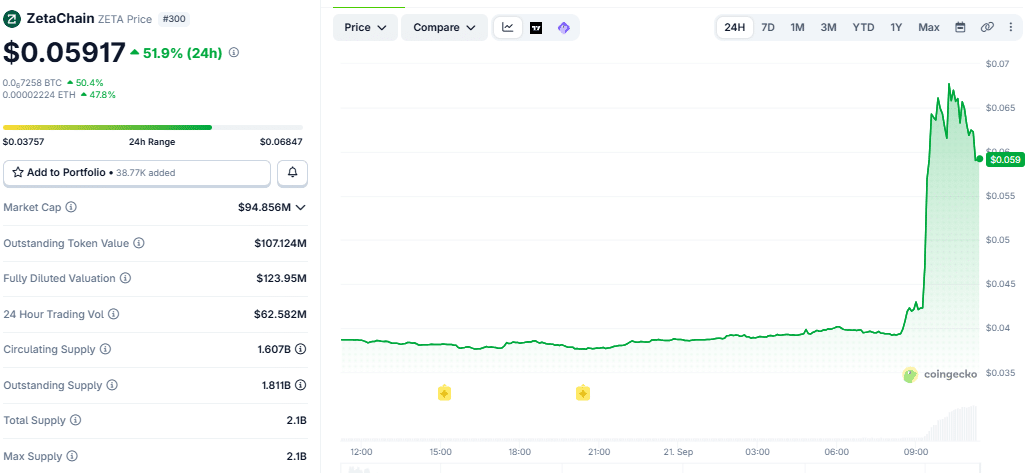
Following the approval, ZETA’s price rose sharply. According to CoinGecko, the token was trading at around $0.059 at the time of writing, up more than 50% over the previous 24 hours as of 5:50 a.m. UTC on September 21.
The vote approves the migration plan but does not immediately shut down ZetaChain. A second governance proposal will determine the specific shutdown block, balance snapshot, token-claim process and other migration details.
ZETA to move to Solana
Under the approved proposal, ZETA will become a native Solana SPL token at a one-to-one conversion rate while retaining its ticker and total supply. The migration will cover ZETA native to ZetaChain, while ZETA tokens already issued on Ethereum and BNB Chain are excluded.
The proposal also states that existing vesting schedules will remain unchanged. No new ZETA tokens will be created as part of the migration. Some coverage of the proposal also states total supply remains capped at 2.1 billion tokens.
Balances will be converted from 18 to nine decimals on Solana, with amounts rounded down. ZetaChain said the Solana version will become the canonical ZETA token once the migration is completed. The project said a wrap or bridge would not work because a wrapped token would still depend on an origin chain that is scheduled to shut down.
The network will continue operating for now. Validators will keep validating blocks, and staking and delegation will continue until the shutdown process is approved and executed.
ZetaChain said it will submit the second proposal only after exchanges supporting ZETA have confirmed how they will handle the token conversion.
Shift toward AI application
The move is tied to ZetaChain’s focus on Anuma, a private AI application launched in February.
According to figures provided by the project, more than 300,000 people have joined Anuma, which has processed about 1 million requests across 35 AI models.
Anuma uses a memory system designed to allow users to carry encrypted information across different AI models, applications and agents. ZETA is used within the application through a credit system, where users can lock tokens in exchange for credits to spend on AI services.
The team said running a separate Layer 1 no longer helps its plans for private AI. The proposal describes the decision by saying, “Running our own L1 no longer helps us build private AI.”
The proposal also pointed to the maintenance burden of operating a Cosmos SDK-based blockchain. ZetaChain said the network inherits upstream security advisories and patches that must be coordinated across its validators.
“AI tooling is making such vulnerabilities easier to find,” the proposal said, citing the August 25 patch as an example.
Second vote will set shutdown details
Although the migration direction has been approved, several key steps remain.
The next proposal is expected to establish the balance snapshot height, chain shutdown block, withdrawal period for connected-chain assets and the process for claiming migrated ZETA on Solana.
ZetaChain has not provided a firm shutdown date. The timing will depend partly on exchange confirmations, with the team saying major exchanges require advance notice before supporting token migrations.
The proposal states that “nothing moves before” the second vote passes. Until then, validators will continue operating the network and staking will remain active.
ZetaChain also plans to publish the snapshot export and checksum and maintain an archive node and explorer so the migration balances can be independently verified.
From cross-chain network to Solana
ZetaChain raised $27 million in 2023, with investors including Blockchain.com and Jane Street Capital. At the time, the project was building a blockchain that would let applications work with assets from different networks, including Bitcoin and Ethereum.
Its mainnet launched in January 2024.
The latest proposal represents a shift away from operating an independent Layer 1 toward building its AI application on Solana. The final migration will still depend on the second governance vote and the completion of exchange arrangements. The full case was published on the ZetaChain blog on September 17.
Also Read: a16z-Backed Linera Ceases Operations After Sonar Sale Falls Short