Key Highlights
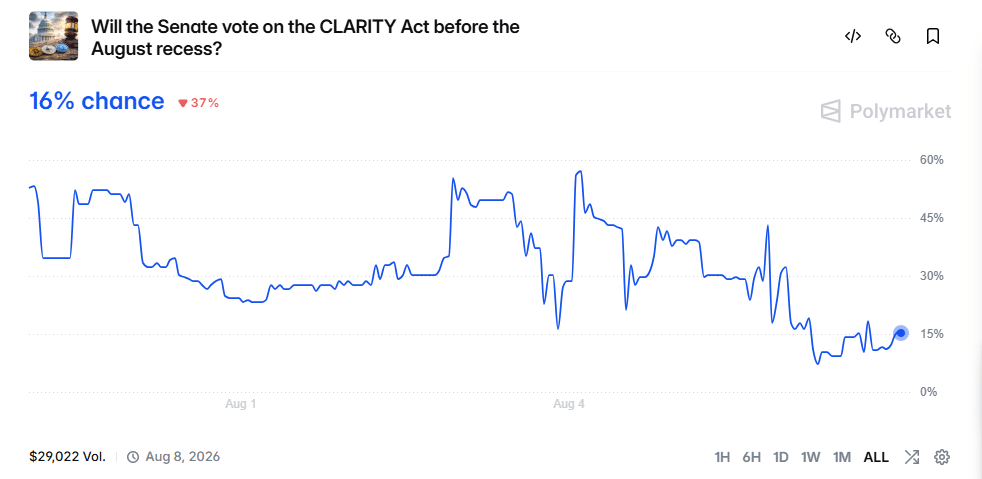
- Polymarket lowered the odds of a Senate vote on the CLARITY Act before the August recess to 16%, reflecting uncertainty over the bill’s timeline.
- Negotiations continue as the White House reviews a bipartisan ethics proposal, while Senate Republicans push for a procedural vote before lawmakers adjourn.
- Democratic concerns over consumer protection, corruption, and national security remain unresolved.
Prediction market platform Polymarket currently assigns only a 16% probability that the U.S. Senate will vote on the Digital Asset Market CLARITY Act before lawmakers leave for the August recess.
Data from Polymarket on August 7 showed the odds had fallen 37% in recent days. Trading volume on the contract stands at roughly $29,000, with the market set to resolve on August 8, 2026. The decline reflects uncertainty as legislative priorities and unresolved disagreements continue to delay the bill’s progress.
What makes CLARITY Act important in the US
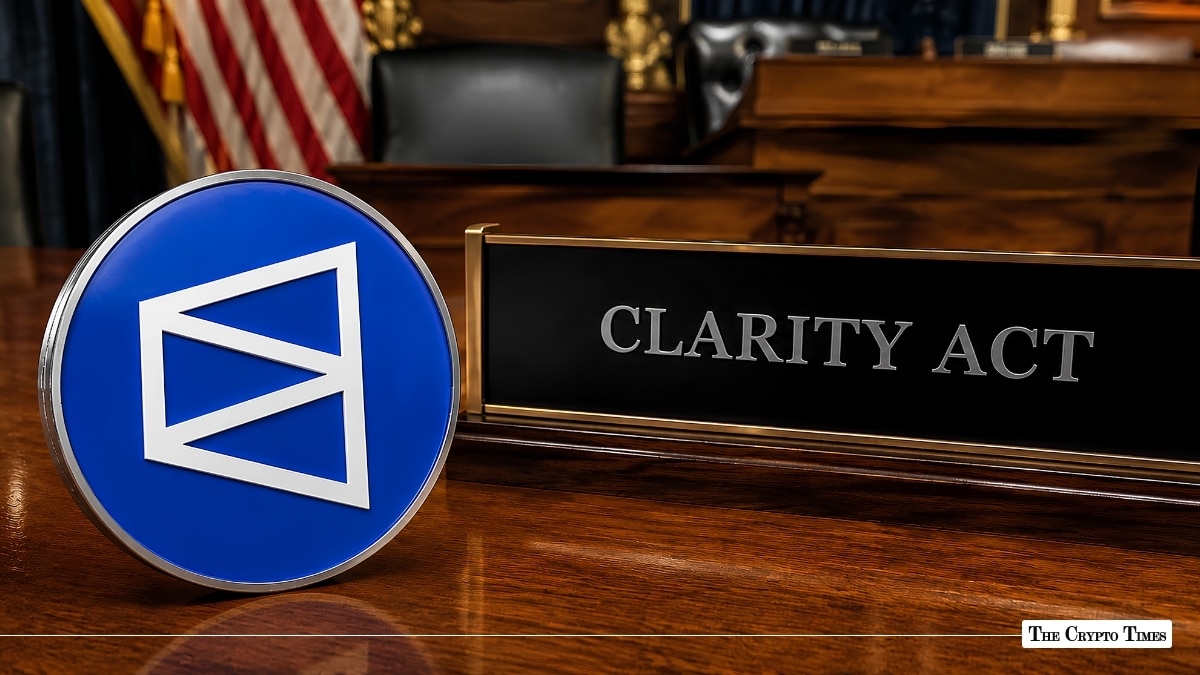
The CLARITY Act is a bipartisan crypto market-structure bill designed to establish clearer regulatory boundaries for digital assets in the United States. It would define which tokens fall under the oversight of the Securities and Exchange Commission (SEC) and the Commodity Futures Trading Commission (CFTC), establish registration pathways for exchanges and other intermediaries, and provide legal certainty for market participants.
Supporters argue the legislation would reduce regulatory ambiguity that has hindered institutional participation and innovation. Critics maintain that the current text leaves gaps in consumer protection, enforcement, and systemic risk safeguards.
Latest negotiations and White House involvement
Discussions around the bill remain active but unresolved. Earlier today, journalist Eleanor Terrett reported that the White House has begun reviewing a bipartisan ethics counterproposal put forward by Senators Thom Tillis (R-N.C.) and Ruben Gallego (D-Ariz.). The proposal seeks to expand enforcement authority while keeping the core framework of the CLARITY Act intact.
The development follows earlier reports that the administration had not yet formally responded to the senators’ submission. Negotiators continue working through remaining sticking points that have so far prevented the bill from reaching the Senate floor.
Meanwhile, Senate Banking Committee Chairman Tim Scott (R-S.C.) has continued to push for a procedural vote before the recess. In a Fox Business interview, Scott stated that the Senate has sufficient time to begin consideration of the crypto market-structure legislation despite other pressing items, including government funding, defense bills, and judicial nominations.
“This is something we should have a first vote on before we leave, without any question,” Scott said. “We have the time to get it done.”
Democratic concerns persist
Opposition from key Democrats remains one of the main obstacles to advancing the legislation. Senator Elizabeth Warren (D-Mass.) has argued that the Senate should not advance the CLARITY Act until stronger protections are added.
Warren said she supports the principle of establishing a regulatory framework for digital assets but believes the present proposal falls short on corruption risks, consumer safeguards, national security, and broader economic stability.
“As far as I’ve heard, they’ve still not solved the problem of corruption, of consumer protection, of national security, or protecting our economy,” Warren stated. “And until you solve those problems, I just don’t see how anyone, Democrat or Republican, moves forward on this bill.”
Negotiations weigh on market expectations
The differing positions help explain the lower probability reflected on Polymarket. While Republican leadership continues to push for floor action, unresolved ethics and consumer-protection issues, combined with a crowded Senate calendar, have reduced expectations of a vote in the immediate window before the August break.
Even if the Senate holds a procedural vote, the legislation would still require additional debate and agreement on amendments before final passage.
For now, Polymarket traders continue to assign a low probability to the Senate holding a CLARITY Act vote before the August recess.
Also Read: Coinbase CEO Questions Bank Lobby’s CLARITY Act Stance