Two of crypto’s most widely followed ETF analysts are disputing a Wall Street Journal report that places Coinbase chief executive Brian Armstrong at the center of the CLARITY Act’s collapse. Nate Geraci says the banking industry killed the bill. Eric Balchunas says partisan politics did.
The Journal’s account, published on the night of September 19, 2026, reconstructs nine months of negotiations through people involved in the talks and describes a chief executive who, those people said, blocked compromises other parties were ready to accept. Coinbase says the opposite: that it repeatedly gave ground to keep the bill alive.
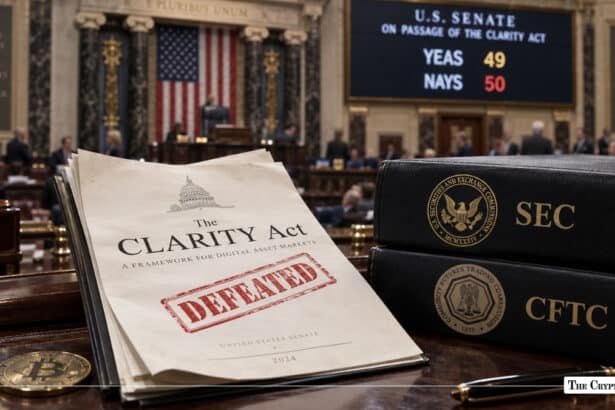
The report, headlined “Crypto Blew Its Big Moment—and the Blame Game Has Begun,” ran at 9:00 PM ET, four days after the Digital Asset Market Clarity Act failed a Senate cloture vote of 49 to 50, eleven votes short of the 60 required to open debate. Armstrong had said that morning that the story was coming.
A Voicemail in January
The Wall Street Journal’s account opens in the first days of 2026. Senator Angela Alsobrooks, a Maryland Democrat and one of the bill’s key negotiators, was finishing her holiday break when she found a voicemail from Armstrong on her phone, about three minutes long, according to the report.
Alsobrooks had been pushing for changes that could have curtailed Coinbase’s ability to pay rewards on stablecoins—interest-like payments the exchange offers to customers who hold dollar-pegged tokens such as USDC. Banks were fighting to ban the practice, arguing it would draw deposits away from them. According to people familiar with the voicemail, Armstrong’s message was that if she gave banks an inch, they would take a mile.
Less than two weeks later, Coinbase withdrew its support for the draft ahead of a planned January 15 Senate Banking Committee markup. “We’d rather have no bill than a bad bill,” Armstrong wrote on X. The markup was scrapped.
A spokeswoman for Alsobrooks told the Journal the senator does not comment on private conversations but has had positive and productive conversations with Armstrong and with digital asset and banking leaders.
The Fight Over Stablecoin Rewards
The Journal traced the dispute to a business arrangement at the core of Coinbase’s revenue. The exchange has a revenue-sharing agreement with Circle, the issuer of USDC, tied to the amount of USDC held on its platform, and it had recently advertised annual rewards of 3.75% on the token.
The GENIUS Act, the stablecoin law Trump signed in 2025, already bars issuers from paying yield directly. Banks wanted the CLARITY Act to go further and stop arrangements they viewed as a way around that ban. Armstrong, the report said, became an aggressive opponent of those restrictions and, according to people involved in the process, could turn inflexible when talks grew difficult, bypassing congressional staff and speaking sharply to senators, including some trying to pass the bill.
Soon after the January markup collapsed, Armstrong said on television that banks were lending out consumer deposits without their consent. The Journal reported that the remarks angered Wall Street executives and led to a confrontation with JPMorgan Chase chief executive Jamie Dimon at the World Economic Forum in Davos later that month.
What followed was five months of negotiation over rewards alone. In May, Alsobrooks and Senator Thom Tillis, a North Carolina Republican, announced a compromise that stopped short of a ban but would force Coinbase to change its program. Armstrong signed off, and the company described it as a significant concession. The banking industry said it did not go far enough.
A 15-Page Offer in June
With rewards settled, negotiators turned to the remaining issues and to the handful of Democratic votes the bill needed to clear the Senate’s 60-vote threshold.
In late June, according to people familiar with the negotiations, Republicans presented Democrats on the Senate Agriculture Committee with a 15-page list of potential compromises. By the next day, those people said, Democrats were ready to accept many of them.
Then, the Journal reported, Armstrong objected. Republicans shelved several of the proposals after learning he did not support them, the people said, leaving Democrats confused about where the talks stood.
The report also said that, earlier in the year, staff for Senator Cynthia Lummis of Wyoming—the bill’s lead Senate sponsor and one of crypto’s closest allies in Congress—began refusing to meet with a member of Armstrong’s lobbying team. A Lummis spokeswoman declined to comment on private meetings but said the senator has maintained “a great relationship with Coinbase and is grateful for their continued dedication to getting the Clarity Act across the finish line.”
The Trump Disclosure and a Summer of Delay
Shortly after the June talks stalled, the politics shifted. Trump disclosed $1.4 billion in 2025 income from his family’s meme coin and crypto businesses, according to the Journal, and Democrats pressed for ethics provisions that would bar public officials, including the president and his family, from holding crypto.
By late summer the bill had grown past 600 pages. The Journal reported that aides in both parties had grown exasperated with the number of negotiators and with the crypto lobby, particularly Armstrong and his team, while community bankers travelled to Washington to lobby their representatives against the bill.
The Senate left for its August recess without a vote. Trump then hosted crypto executives, including Armstrong, at a White House meeting that was streamed online. The weekend before the September 15 vote, Senate Republicans released a final text that would require the president to place his crypto holdings in a blind trust. A White House official told the Journal the administration had agreed to the most comprehensive ethics provision in history. Democrats said it was not enough.
What the Vote Record Shows
On September 15, no Democrat voted to advance the bill. Four Republicans—Susan Collins of Maine, Josh Hawley of Missouri, Jerry Moran of Kansas, and Tillis—voted no, and Senator Chris Coons of Delaware did not vote. Tillis cast his no vote to preserve the option of moving to reconsider.
Each side named a different cause. Lummis blamed Democrats. Hawley and Moran cited the stablecoin yield dispute. Democrats said the ethics language left gaps on ventures tied to public officials, including the president. The Journal itself listed several factors, including the Trump disclosure, the war in Iran, and inflation, which it said had overtaken the bill as priorities for lawmakers.
On the record, Ripple chief executive Brad Garlinghouse, whose company supported the bill, told the Journal the industry had momentum in January until “one group in our industry kind of shot ourselves in the foot.”
Coinbase’s Response
Coinbase Chief Policy Officer Faryar Shirzad said in a statement to the Journal that the company “repeatedly took compromises in order to keep the coalition together and move the legislation forward.” He said Armstrong has strong relationships with senators in both parties and approaches those conversations with respect. “These were high-stakes negotiations and there were certainly moments of disagreement, but disagreement should not be confused with disrespect,” he said.
Armstrong had moved first. On the morning of September 19, before the story ran, he posted that the Journal was preparing to blame him and Coinbase and that his January opposition had produced a stronger bill. “I’m proud to have done it, and would do it again, because it helped create a better bill,” he wrote.
Geraci and Balchunas Respond
Nate Geraci, president of ETF advisory firm NovaDius Wealth Management, shared the Wall Street Journal’s headline on X and wrote that it portrayed Armstrong as overly aggressive in negotiating. “Crypto didn’t blow its big moment. The banking industry & politicians in its pockets got their way,” he wrote. “Let’s not overthink it.”
Eric Balchunas, senior ETF analyst at Bloomberg Intelligence, replied that he understood the ethics concerns, particularly around Trump-linked tokens, but said the industry had worked hard on the bill and that partisanship ultimately killed it. He also said much of the media is inclined to criticize crypto, which he said he found odd given what he described as bitcoin’s censorship resistance and its protection against currency debasement in poorer countries.
In a later post, Balchunas said bitcoin is an apolitical asset and that its association with Republicans stemmed largely from antagonism from Democrats. The asset’s advantages have not changed, he wrote, and its political position could look very different in ten years.
The bill remains on the Senate calendar. Seven Senate Democrats have said they will keep negotiating, potentially after the November midterm elections.