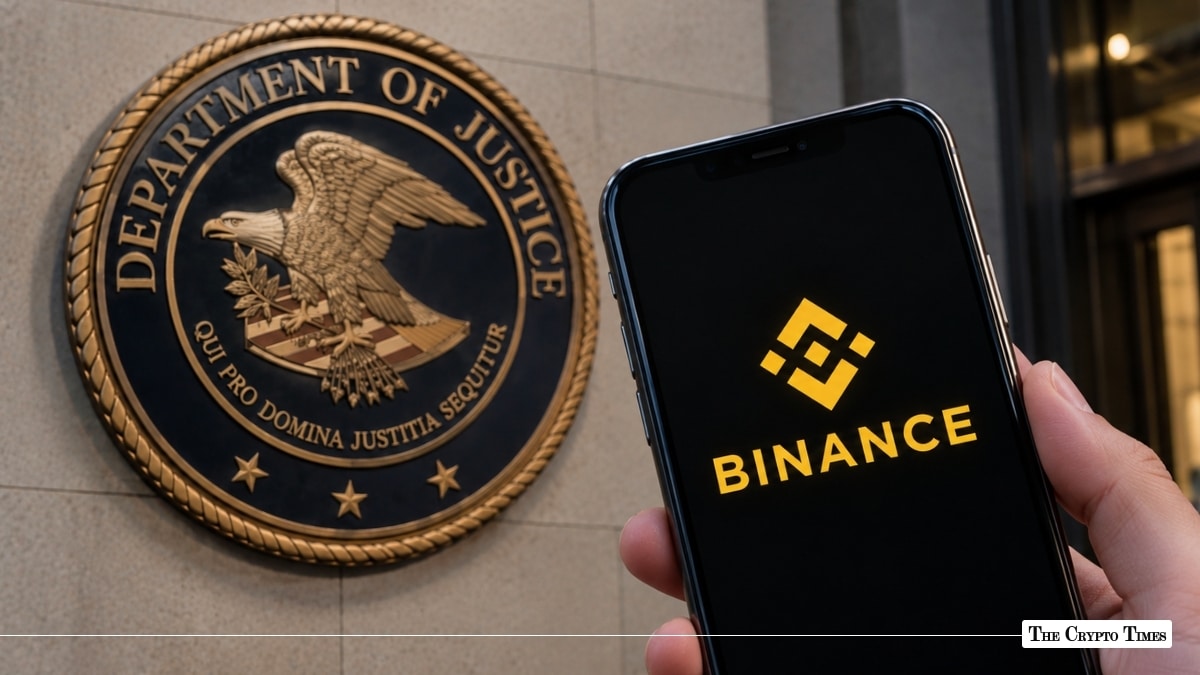
Federal prosecutors in the United States are investigating whether Binance Holdings Ltd., the operator of the world’s largest cryptocurrency exchange by trading volume, violated U.S. sanctions on Iran by failing to stop certain trading activity on its platform.
The inquiry is being handled by the Manhattan U.S. Attorney’s Office, with the U.S. Department of Justice’s (DOJ) Criminal Division in Washington also participating. Authorities are examining whether the exchange knowingly allowed the trading, according to the reporting. An investigation is not a finding of wrongdoing and can conclude without any charges being filed.
How the report surfaced
The news was first published by Bloomberg at 12:38 AM UTC on September 22, citing people familiar with the matter who asked not to be identified due to the sensitivity of the matter. Reuters confirmed the account later the same morning, adding that the DOJ declined to comment, while the Manhattan U.S. Attorney’s Office could not immediately be reached for a comment outside regular business hours.
A Binance spokesperson said the exchange has a zero-tolerance approach to sanctions violations, adding, “We fully cooperate with law enforcement, and we remain committed to rooting out and shutting down bad actors.” The statement did not directly address whether the company is aware of the reported probe.
A sharper question than in March
The September 22 report is the first public account describing prosecutors as focused on Binance’s own conduct in connection with Iran-related activity, rather than only on its users.
In March 2026, WSJ reported that the DOJ was examining whether Iran had used Binance to evade U.S. sanctions and to route funds to networks linked to Iran-backed groups, including Yemen’s Houthi movement, as covered in an earlier report by The Crypto Times. At that stage, it was unclear whether prosecutors were focused on the exchange itself, its users, or both, and Binance said it was not aware of any DOJ investigation.
The Bloomberg account names both the Southern District of New York (SDNY) and the DOJ’s Main Justice Criminal Division, and places knowledge and compliance failures at the center of the review.
The 2023 guilty plea still frames the file
Binance’s regulatory history is central to how each new development is read. In November 2023, the exchange pleaded guilty to violations of U.S. anti-money laundering (AML) and sanctions laws and agreed to pay approximately $4.3 billion in penalties. Its founder, Changpeng Zhao, commonly known as CZ, stepped down as chief executive officer (CEO), pleaded guilty to related Bank Secrecy Act (BSA) charges, and served a four-month prison sentence before receiving a presidential pardon.
The 2023 resolution also installed independent compliance monitors at Binance. U.S. prosecutors said at the time that Binance had allowed customers in sanctioned jurisdictions, including Iran, to use the platform. Following the settlement, Binance has published data on its compliance progress, including a claim that its sanctions-related exposure fell by 96.8% between January 2024 and July 2025, in a company statement released in February 2026.
How the public story began
The current storyline traces back to Binance’s own compliance unit. In February 2026, Fortune first reported on February 13 that internal investigators who said they had found more than $1 billion in Tether flowing to Iran-linked wallets were later fired.
The New York Times, on February 23, put the $1.7 billion figure on the record, writing that about $1.2 billion had moved from a Blessed Trust Binance account and about $500 million from a Hexa Whale account toward wallets investigators tied to Iranian entities, including addresses associated with the Islamic Revolutionary Guard Corps (IRGC), a U.S.-designated terrorist organization.
The Wall Street Journal published a parallel account the same day. Both publications described Blessed Trust and Hexa Whale as Hong Kong firms; later U.S. court papers called them Chinese companies.
Those reports said several investigators had later been dismissed or suspended. Binance denied that anyone was fired for raising compliance concerns. Co-CEO Richard Teng called the Fortune account misleading and asked for corrections, saying an internal legal review had found no sanctions violation, in rebuttal reporting covered by The Crypto Times on February 16.
In a subsequent compliance blog, Binance said the $1.7 billion did not originate or terminate at the exchange and that, after multi-hop tracing, at most about $126.1 million reached wallets with Iranian links, of which at most $24.1 million reached IRGC-related wallets.
On March 6, Binance responded to a written inquiry from U.S. Senator Richard Blumenthal (D-Connecticut) by saying it had not permitted $1.7 billion in Iran-linked transfers, that no account on the platform had sent funds directly to Iran, and that Hexa Whale had been removed in August 2025 and Blessed Trust in January 2026 following law-enforcement contact, according to the letter reporting previously reported by The Crypto Times.
Teng also pushed back on fresh WSJ reporting in May 2026, calling the claims “fundamental inaccuracies” and saying the transactions cited had taken place before the individuals involved were sanctioned.
Senate Democrats, including Blumenthal and later Senator Adam Schiff (D-California), opened parallel inquiries into the same set of facts and into whether the 2023 monitorship was working. Those letters are congressional oversight and do not amount to criminal charges.
September 14 forfeiture: $61 million, not a case against Binance
On September 14, 2026, the U.S. Attorney’s Office for the Southern District of New York filed a civil forfeiture complaint seeking approximately $61 million in cryptocurrency. News coverage of that filing appeared on September 15.
Prosecutors alleged that Blessed Trust and Hexa Whale, described in the complaint as Chinese companies, had used trading accounts at Binance to launder proceeds from black-market sales of sanctioned Iranian crude oil and petroleum products, as part of a wider network of interrelated addresses termed “Entity A” that had received and distributed more than $1.5 billion in illicit oil proceeds. Binance was not charged. Contemporary accounts include The New York Times.
Binance was not named as a defendant. The action is in rem, meaning it targets the assets themselves rather than any person or company. Deputy U.S. Attorney Sean S. Buckley said the office was “seizing and seeking to forfeit more than $61 million of the Government of Iran’s money, which otherwise would have promoted hostile military action and terrorist attacks against the U.S. and our allies.”
Binance said the filing did not allege wrongdoing by the exchange, adding that it had not permitted transactions with sanctioned individuals and had cooperated since the matter was first raised. Teng repeated that position on the social media platform X on the same day, in a response covered here by The Crypto Times.
The civil forfeiture case and the newly reported criminal inquiry share the same geography, in Manhattan, and the same fact pattern of Iran-linked flows through Binance accounts. They remain distinct proceedings, however. A civil complaint against wallets is not an indictment of an exchange.
Reading the September 22 report
Three points are useful for readers who have followed the file since February. First, the standard Bloomberg describes is one of knowledge. Prosecutors are said to be examining not only whether Iran-linked coins passed through Binance order books, but whether the exchange knew or should have known and failed to intervene after the 2023 resolution installed monitors and Binance had already paid $4.3 billion for a related class of failure.
Second, the reporting rests on anonymous sourcing, which is standard for a live white-collar probe. It is not based on an indictment, a search warrant, or an on-the-record DOJ statement. Similar inquiries have concluded without any charges being filed.
Third, markets have treated the news as a continuation of an existing storyline rather than a shock. BNB, the native cryptocurrency of Binance’s exchange ecosystem, and broader crypto prices showed limited immediate reaction in the hours after the Bloomberg headline.
What remains unproven
No court has yet found that Binance violated Iran sanctions after the 2023 settlement. Binance says its internal reviews found no violation, that flagged entities were offboarded, and that its exposure to Iranian venues has fallen sharply. The DOJ, according to Bloomberg, is now testing that account.
The next hard documents, if they come, are likely to include a charging decision, a declination, monitor reports, or additional civil filings out of SDNY. Until then, the public record consists of internal alerts in 2025, press investigations in February and March of 2026, Senate letters through the spring, a $61 million forfeiture complaint in mid-September, and now a reported criminal inquiry into the exchange’s own conduct.
Also Read: Elon Musk’s X Sues Bitcoin Account Network in UK High Court Over Alleged Creator Payout Fraud