MARA stock (Nasdaq: MARA) fell 5.25% on Thursday, August 6, closing at $10.65 after the Bitcoin miner reported second-quarter results that missed Wall Street on both the top and bottom lines. The decline played out over the regular session, with the stock sliding into the close, before steadying to essentially flat in overnight trading.
The headline number behind the move was a net loss of $611.3 million, or $1.60 per share, against analyst expectations for a roughly $0.35 profit, and revenue that fell 27% year-over-year to $174.9 million, about 16% below the $208 million consensus. But the loss was driven far more by an accounting swing on MARA’s Bitcoin holdings than by a collapse in its operations, a distinction that matters for reading both the result and the stock’s reaction.
The Stock Movement
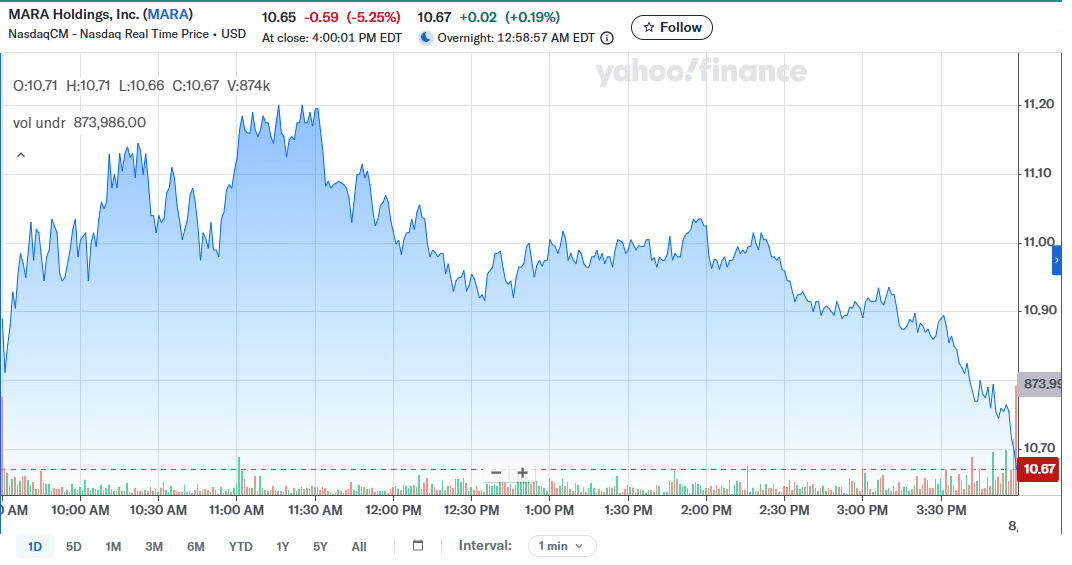
According to Yahoo Finance data, MARA stock opened Thursday around $10.98, briefly climbed above $11.20 in late morning, then slid through the afternoon to close at its session low of $10.65, down 5.25%, or $0.59, from the previous day’s close. In the overnight session, the stock was essentially flat, quoted at $10.67 (up 0.19%) shortly before 1:00 AM EDT.
The timing is worth noting: because MARA released its results and held its earnings call at or after the close, the 5.25% decline occurred during regular trading rather than as an after-hours reaction, and the muted overnight move suggests the market’s repricing had largely happened by the closing bell. (Overnight quotes trade on thin volume and can differ from the next regular session.) MARA is a high-beta stock whose swings are amplified by its dual exposure to Bitcoin’s price and to the AI-infrastructure trade, and it had been trading under pressure alongside other listed miners heading into the report.
Why the Stock Fell: A Loss Shaped by Bitcoin’s Price
MARA attributed the bulk of its loss to the falling price of Bitcoin rather than a deterioration in its core business. On its earnings call, the company said approximately $343 million of the net loss came from unrealized mark-to-market changes on its digital assets, a non-cash adjustment required under fair-value accounting rules, which force companies to revalue their Bitcoin each quarter and run the change through earnings, whether or not any coins are sold.
The mechanism cuts both ways, and it is worth remembering that the same accounting produced MARA’s $808.2 million profit a year earlier, when Bitcoin was rising. This quarter it worked in reverse: the average price of Bitcoin fell about 28% year-over-year, which both shrank mining revenue and reduced the carrying value of MARA’s holdings. Chief Financial Officer Salman Khan described the quarter as one defined by a “challenging revenue environment” created by Bitcoin prices, alongside efforts to restructure the company’s power portfolio and balance sheet.
Still, the operating picture was weak even setting the markdown aside. Adjusted EBITDA, a non-GAAP measure that strips out items including the Bitcoin fair-value change, was negative $360.9 million, an improvement from negative $1.04 billion in the prior quarter but still deeply negative, and the revenue and profit misses gave investors reason to sell regardless of the accounting.
Operational Gains Under the Headline Loss
Beneath the loss, MARA’s mining operations posted their strongest quarter in more than a year, a contrast that helps explain why the stock fell only mid-single digits rather than more sharply. The company mined 2,422 BTC, up 3% year-over-year and a multi-quarter high, and lifted its energized hashrate, a measure of computing power dedicated to mining, 22% to 70.3 exahash per second. It also trimmed its cost per petahash per day by 4% to $27.7 and won 700 blocks through its own mining pool.
MARA’s Bitcoin holdings declined to 35,577 BTC at quarter-end, down 29% from a year earlier, which the company said reflected the strategic deployment of assets, including coins loaned, actively managed, or pledged as collateral. It put total cash and Bitcoin holdings at roughly $2.5 billion, and disclosed that after quarter-end it pledged 18,750 BTC as initial collateral for two Bitcoin-backed credit facilities.
The AI Pivot the Stock Now Trades On
Increasingly, MARA stock is being valued less on mining and more on the company’s effort to reposition itself as a broader “digital infrastructure” business spanning Bitcoin mining, data centers, and AI compute, a transition several large miners are pursuing as demand for AI computing strains power supply. The company framed the quarter as one it used to “fundamentally transform” its power portfolio.
The centerpieces are a series of expansion deals. MARA is acquiring Long Ridge Energy & Power in Ohio, a roughly $1.5 billion transaction it says could support up to 600 megawatts of AI and critical-IT load over time, and in July agreed to buy a 1,200-acre powered land site in Matagorda County, Texas, for about $600 million, targeting up to 2 gigawatts of grid capacity by April 2028. Together with existing operations, MARA put its total potential power capacity at roughly 4.8 gigawatts, contingent on completing the acquisitions and energizing the sites. CEO Fred Thiel said the company expects to sign at least two leases before year-end through its partnership with Starwood Digital Ventures, a capital-light structure MARA says lets it develop AI capacity without shouldering the full cost itself.
What’s Next for MARA
The market’s reaction captured the tension in the MARA investment case. The revenue and earnings miss and still-negative adjusted profitability weighed on the shares, while analysts on the call focused heavily on the pivot, pressing management on the timing of the Long Ridge deal’s regulatory approval, tenant demand at the Matagorda site, and the near-term revenue potential of newer businesses such as Exaion.
That split is the debate around MARA and its peers: the stock remains tied to a volatile Bitcoin price and a mining business that is currently unprofitable on an adjusted basis, while its longer-term case rests on executing an AI and data-center buildout that has yet to contribute meaningfully to reported results. Which force dominates, and how quickly the AI projects generate revenue against the balance-sheet cost of building them, is the question the coming quarters will decide. This report makes no prediction on that outcome, and nothing here is investment advice.
Also Read: SpaceX (SPCX) Stock Jumps 9.43% to $125 as Q2 Reveals $1.1B Bitcoin Treasury