Lost in the headline numbers of SpaceX’s blockbuster first quarterly report as a public company, $7.8 billion in revenue, up 92%; Starlink past 12 million subscribers; a $60 billion deal to acquire Cursor, is a line item that matters most to crypto watchers. On its newly public balance sheet, Space Exploration Technologies (Nasdaq: SPCX) disclosed “digital assets” of $1.098 billion as of June 30, 2026, down from $1.637 billion at the end of 2025. Those digital assets are bitcoin: 18,712 BTC, one of the largest corporate holdings in the world, now visible to public investors for the first time.
The roughly $539 million decline over the first half of the year has drawn early “Bitcoin loss” framing. But the fuller picture is more interesting. The decline is a non-cash, mark-to-market markdown that tracks Bitcoin’s price fall over the period, not a sale or a realized loss, and against a cost basis of just $661 million, SpaceX is still sitting on a substantial unrealized gain.
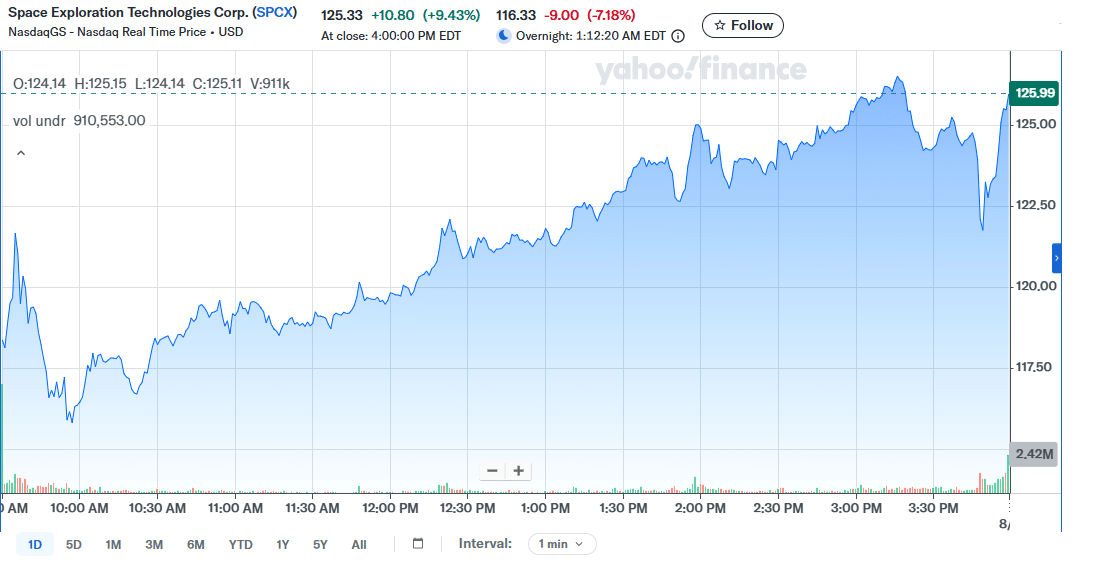
The IPO has made SpaceX’s earnings newly sensitive to Bitcoin’s price, though the holding is a rounding error against its ~$1.8 trillion valuation; its stock rose 9.4% on August 4 before falling in overnight trading after the results.
SpaceX’s Bitcoin Treasury, Now in Public View
SpaceX first disclosed the scale of its Bitcoin position in the S-1 filing ahead of its June IPO, revealing 18,712 BTC held at a cost basis of $661 million, an average of roughly $35,300 per coin. That places SpaceX among the largest corporate Bitcoin holders globally, behind Michael Saylor’s Strategy and ahead of, or alongside, Elon Musk’s own Tesla. The coins are held with a third-party custodian, and SpaceX has said it intends to continue that arrangement.
The position has drawn commentary from Bitcoin advocates. Around the IPO, Saylor noted SpaceX’s low average cost basis and framed the debut as further corporate validation of bitcoin as a treasury asset. For a crypto audience, the more consequential fact is simply that a company of SpaceX’s stature now carries Bitcoin on a public balance sheet, and must report its ups and downs every quarter.
The $539 Million “Loss” and Why That Framing Misleads
Under the FASB’s fair-value accounting standard (ASU 2023-08), which took effect for fiscal years beginning after December 15, 2024, companies must mark digital assets to market each period and run both gains and losses through their financial statements. That is why SpaceX’s Bitcoin line moved with the coin’s price: fair value fell from $1.637 billion at the end of 2025, to $1.293 billion at March 31, to $1.098 billion at June 30. The first-half decline was about $539 million; the second-quarter portion of that was roughly $195 million.
But two facts reframe the “loss.” First, it is entirely unrealized, SpaceX sold nothing; the markdown reflects Bitcoin’s lower price, and would reverse if the price recovers. Second, SpaceX remains ahead on the position: at a $661 million cost basis and a $1.098 billion quarter-end value, the holding is roughly $437 million in unrealized profit, up about 66% from what SpaceX paid. Describing that as a “loss” without context inverts the actual economics. It is worth noting, too, that the fair-value change sits outside SpaceX’s Adjusted EBITDA, the non-GAAP profit measure that came in at $3.5 billion for the quarter, so it dented the reported net loss of $541 million but not the operating profitability metric management emphasizes.
A Newly Crypto-Sensitive Income Statement
The real shift the IPO brings is transparency. While SpaceX was private, its Bitcoin gains and losses were invisible to the public; now they are a recurring, reported feature of its earnings. In effect, SpaceX’s income statement has become a live window into crypto volatility, every quarter, the market will see exactly how Bitcoin’s swings feed into the company’s bottom line.
Yet SpaceX is a very different kind of bitcoin proxy from Strategy. For Strategy, Bitcoin is the entire thesis, and its stock trades as a leveraged bet on the coin. For SpaceX, the roughly $1.1 billion position is a rounding error against a valuation reported to exceed $1.8 trillion; small enough that the stock will never trade on it, but large enough, some analysts argue, to help normalize Bitcoin as a corporate treasury asset. How SpaceX weathers this fair-value volatility over its first few quarters could influence whether other IPO-bound technology and AI firms follow suit.
A Gap Between Disclosed and On-Chain Holdings
One wrinkle for on-chain analysts: the 18,712 BTC SpaceX disclosed is more than double the roughly 8,285 BTC that blockchain-intelligence firm Arkham had been able to attribute to SpaceX wallets as recently as May 2026. Some coverage has read that gap as evidence of aggressive accumulation around the IPO. But SpaceX’s own filing reported the full 18,712 BTC as of December 31, 2025, well before the June listing, which suggests the more likely explanation is that a large share of the company’s stack simply was not publicly traceable on-chain, rather than a burst of new buying. Either way, the disclosure closed a long-standing gap between what analysts estimated and what SpaceX actually holds.
The Stock and Its Tokenized Shadows
SpaceX’s shares had a volatile session around the report. SPCX closed August 4 at $125.33, up 9.43%, then fell 7.27% to $116.22 in overnight trading after the results a pullback that came despite the revenue beat, and that observers tied to the company’s enormous spending, including $18.4 billion of capital expenditure in the quarter, most of it on AI infrastructure.
For crypto markets, SPCX matters beyond its own ticker: it is the underlying asset for the tokenized SpaceX stocks that trade on-chain, such as SPCXB and xStocks’ SPCXx, which track the share price and moved alongside it around the earnings. As The Crypto Times has covered, those tokenized products have become a flagship of the real-world-asset trend, meaning SpaceX now touches crypto from two directions at once: as a Bitcoin holder, and as the reference asset for a growing tokenized-equity market.
The Bigger Picture
SpaceX’s first earnings make it perhaps the most prominent example yet of a company that holds Bitcoin without being a Bitcoin company. Its treasury is passive, profitable, and small relative to its size, the opposite of the leveraged accumulation model, yet its newly public status means the crypto market now gets a quarterly read on how a trillion-dollar issuer accounts for its coins.
The $539 million paper decline will generate headlines, but the more durable story is what it demonstrates: that fair-value accounting cuts both ways, and that Bitcoin has quietly reached the balance sheets of one of America’s largest private-turned-public companies.
Also Read: SpaceX Tokenized bStock SPCXB Price Jumps 7% to $116 in Volume-Driven Rally