Avalanche said on Monday that its network is now the infrastructure powering the document vault built into the United Arab Emirates’ national digital identity platform, a claim that would place blockchain rails under one of the most heavily used government identity systems in the Gulf region.
The announcement named the country’s federal telecommunications regulator and a Dubai-based advisory firm as the parties behind the integration, though neither has confirmed the arrangement publicly and neither the scope of the deployment nor its production status was disclosed.
The statement was posted on Avalanche’s official account on X at 11:08 UTC on 14 September 2026, and remains the sole primary source for the claim. The post said TDRA is working with Deca4 to integrate Avalanche technology as the infrastructure supporting the UAE PASS Digital Vault, describing the vault as a feature that lets residents access and share verified official documents while blockchain records confirm authenticity and detect tampering. TDRA and Deca4 had not published matching statements on their websites at the time of writing.
What UAE PASS Is And How Large It Has Become
UAE PASS is the country’s national digital identity and signature platform, first launched at the Gulf Information Technology Exhibition (GITEX) in 2018 as a joint initiative of Digital Dubai, TDRA, and Abu Dhabi’s Department of Government Enablement. The platform lets citizens, residents, and visitors authenticate themselves on a smartphone, sign documents electronically, and reach thousands of federal and local services through a single sign-on.
TDRA’s own digital government page currently lists more than 11 million registered users, over 15,000 services, 363 service providers, and 1,028 digital channels running through UAE PASS. Economy Middle East reported in July 2026 that registered users had crossed the 12 million threshold, which matches the figure cited in the Avalanche announcement. Gulf News reported in September 2025 that the platform had recorded more than 2.6 billion digital transactions and 600 million logins.
The Digital Vault sits inside this platform. It lets users request, store, and share certified copies of official documents such as licences, certificates, and permits. The Central Bank of the United Arab Emirates (CBUAE) began treating vault documents as equivalent to physical originals for licensed financial institutions in 2019, and the UAE Prime Minister’s Office issued a 2021 mandate directing federal and local entities to accept them as authentic, as recorded by the Organisation for Economic Co-operation and Development’s Observatory of Public Sector Innovation.
The Vault Was Already Described As Blockchain-Powered
The official UAE government portal has for some time described the Digital Vault as powered by blockchain technology, and TDRA’s UAE PASS service page uses the same phrasing. That language predates the current announcement and does not identify any particular network.
A February 2026 Binance Research report on the UAE blockchain ecosystem associated the identity layer of UAE PASS with Hyperledger Fabric and the Digital Vault and trusted-records layer with Quorum, two permissioned enterprise stacks. The Avalanche post does not specify whether its network replaces those components, sits alongside them, or serves only as an anchoring layer that records document hashes for verification.
What Avalanche Disclosed, And What It Did Not
The announcement is specific on the product surface and vague on the engineering. It does not indicate whether the deployment covers a pilot phase or the live production vault, whether it runs on a permissioned Avalanche Layer 1 chain, a subnet, or the public Contract Chain (C-Chain), whether user documents themselves are placed on-chain or only cryptographic hashes are anchored, or how key custody, validator responsibilities, and data residency inside the UAE are handled. No timeline, contract value, or technical documentation was attached to the post.
Those distinctions matter because UAE PASS is production national infrastructure subject to the CBUAE’s rulebook on digital identification and verification for licensed financial institutions. A blockchain layer used to prove that a certificate has not been altered is a materially narrower claim than a national identity system running on a public chain.
Who Deca4 Is
Deca4 is a Dubai-headquartered advisory and implementation firm focused on blockchain, artificial intelligence (AI), and government digitisation. Its public materials reference a technical study tied to 11 million UAE PASS users, work on digital-asset wills, and land-registry tokenisation.
Founder and Chief Executive Officer (CEO) Mohamed Mahfoudh has represented the firm in earlier partnership releases. Deca4 had not issued a matching statement on the Avalanche integration on its site at the time of writing.
Avalanche’s Growing Regional Presence
Avalanche has been steadily building its footprint in the Emirates. The Avalanche Foundation incorporated a Distributed Ledger Technology (DLT) foundation in Abu Dhabi Global Market (ADGM) in December 2025 to run its Middle East and North Africa (MENA) programmes, enterprise pipeline, and government engagement under ADGM’s DLT foundation regime. That entity gives the network a regulated legal counterparty in the same jurisdiction as UAE PASS, though the incorporation on its own does not amount to proof of a live vault integration.
The network’s UAE work also sits inside a wider pattern of consumer and payment activity. On 1 September 2026, Ethena launched a USDe payments app on Avalanche with Visa, extending stablecoin utility across card rails on the same network. That product is separate from UAE PASS.
Regional Context: Governments That Have Named Their Chains
If TDRA confirms the arrangement, the UAE would join a still-small group of governments that have publicly identified the blockchain network running under their national identity systems. Bhutan integrated its National Digital Identity (NDI) platform with the Ethereum blockchain in October 2025, with the full migration of citizen credentials scheduled for the first quarter of 2026. That system covers roughly 800,000 residents, a fraction of the UAE PASS base.
Most other live national digital identity systems, including those operated by Estonia, Singapore, South Korea, and India, continue to rely on centralised or federated architectures rather than public blockchains, even where cryptographic proofs are used at the credential layer.
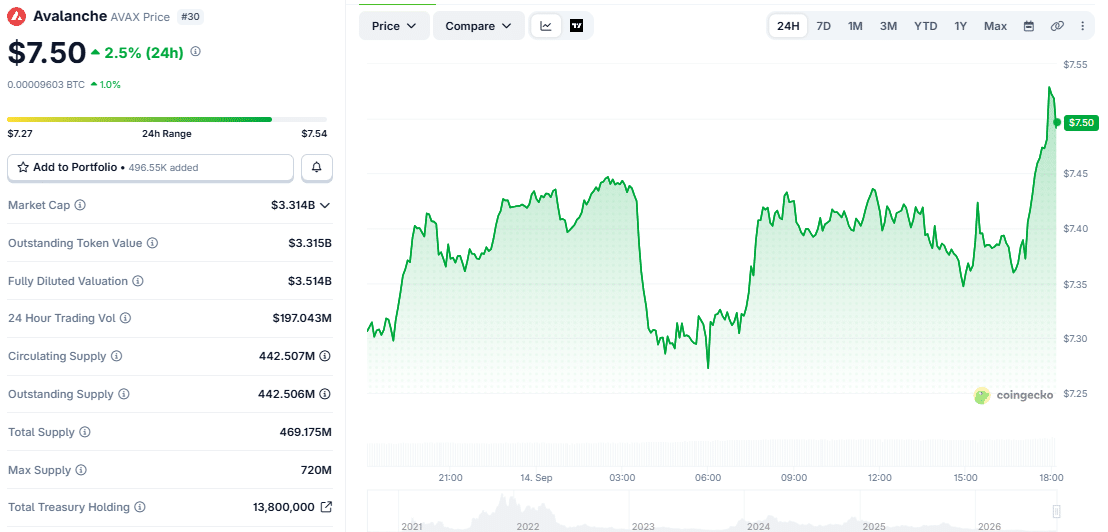
AVAX traded around $7.47 to $7.50 during European hours on 14 September 2026, up about 2% to 2.6% from the 13 September close near $7.29, with an intraday range near $7.26 to $7.49. The move was modest against the scale of the headline. Price action alone is not evidence that the integration has gone live in production.
What Would Amount To Full Confirmation
An authoritative record of the deployment would require TDRA, the UAE Prime Minister’s Office, or another federal entity to state that Avalanche is running in production on the Digital Vault, to identify the components of the vault that use it, to describe how personal data is kept off-chain, to specify the legal framework covering validators and incident response, and to explain whether users can independently verify a document hash.
Until that statement appears, the accurate description of this week’s development is that Avalanche has announced a TDRA-Deca4 integration into the UAE PASS Digital Vault, and that the vault has been officially described as blockchain-powered since well before the current announcement.
Also Read: FCA Explores New Rules for Tokenized Gold in UK Markets