Crypto markets entered September under pressure from two familiar forces: higher interest rates and regulatory uncertainty.
On September 16, the Federal Reserve raised its target range for the federal funds rate by 25 basis points to 3.75%–4%, in a unanimous 12–0 vote, its first hike since 2023. The central bank said inflation remained elevated and that the decision was intended to support a return toward its 2% target.
That should normally create a difficult environment for digital assets. Higher interest rates increase the appeal of cash and short-term government debt, and they raise the discount rate used to value riskier assets, including cryptocurrencies, technology stocks and venture-backed companies.
Crypto was also absorbing a political setback: on September 15, the CLARITY Act failed a key procedural (cloture) vote in the Senate, falling short of the 60 votes needed to advance. Yet the market did not collapse. Bitcoin recovered toward $81,000 on September 19, while the wider market also moved higher. CoinGecko data cited by CryptoTimes placed Bitcoin near $81,100, with 24-hour trading volume of about $42 billion.
The price reaction matters, but it is not the whole story. The more significant development is taking place below the surface: tokenized real-world assets (RWAs), stablecoins, and blockchain-based financial products continue to expand even when macroeconomic conditions become less supportive.
RWA.xyz reported about $38.50 billion in distributed real-world asset value on September 19 at 14:30 UTC, the value tracked on public blockchains, excluding stablecoins, alongside roughly 4.49 million holders and $368.13 billion in represented asset value, a broader measure that includes assets held in more restricted or “walled-garden” environments.
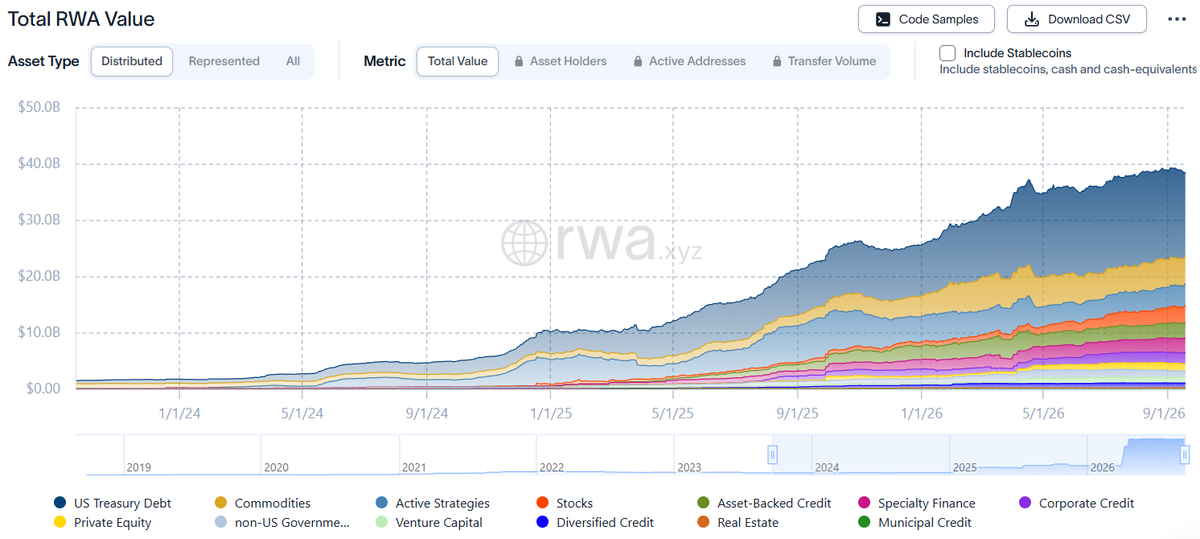
These numbers should not be read as proof that every part of tokenization is thriving equally. They do show that blockchain-based financial infrastructure is attracting capital and users beyond the traditional cycle of cryptocurrency speculation.
The main question is therefore changing. It is no longer simply whether crypto can rise when interest rates fall. It is whether tokenization has become useful enough to keep developing even when monetary policy and politics create headwinds.
The Fed’s rate hike did not break the market
Interest rates still matter enormously to crypto. When rates rise, investors can earn a higher return from relatively low-risk assets such as Treasury bills and money-market funds, which can reduce the capital flowing into speculative assets. Higher rates also make it more expensive to borrow, trade with leverage, or finance new blockchain projects.
The September decision was therefore a clear test. The Federal Reserve did not signal that the fight against inflation was over; it said inflation remained elevated and lifted the policy rate to 3.75%–4%.
Yet Bitcoin’s response was relatively resilient. It traded close to $76,000–$78,000 immediately after the decision, according to a CryptoTimes report, before recovering toward $81,000 by September 19, according to data from CoinGecko (as of September 19 at 14:30 UTC).
This does not mean rates have stopped affecting crypto. Bitcoin remains volatile, smaller tokens can still fall sharply when liquidity tightens, and the market has not permanently decoupled from traditional finance. The more reasonable interpretation is that parts of the market are becoming less dependent on a single source of demand. In earlier cycles, the market was dominated by retail speculation, leverage, and expectations of monetary easing.
Today, the ecosystem also includes stablecoin payments, tokenized Treasury funds, digital versions of equities and bonds, institutional custody, blockchain settlement, and programmable financial contracts.
That creates different kinds of demand.
A trader may buy Bitcoin because of expectations about liquidity or inflation. A fund manager may use a tokenized Treasury product because it offers regulated exposure to short-term government debt on blockchain rails. A fintech company may use stablecoins to move dollars across borders. These activities are connected to crypto, but they are not identical, and they do not all rise and fall together.
Regulatory setbacks that didn’t stop the momentum
The CLARITY Act’s failure to clear its procedural hurdle was a real disappointment for the industry. The bill aimed to create clearer federal rules for digital-asset markets, define the roles of the SEC and CFTC, and provide more certainty for banks and exchanges. Its setback leaves that legislative ambiguity in place, and market-structure legislation now looks unlikely to pass in 2026.
Yet the regulatory picture is far from frozen. In the same period, the SEC granted conditional relief allowing eligible platforms to trade tokenized versions of National Market System stocks for five years under specific conditions, including ensuring token holders receive the same rights as traditional shareholders, using public smart contracts, and coordinating trading halts. The agency also requested public comment on potential permanent changes.
Other developments continue in parallel. The GENIUS Act, signed in 2025, already established a federal framework for payment stablecoins. House committees have advanced separate crypto tax and Strategic Bitcoin Reserve bills. The SEC and CFTC have issued joint interpretive guidance on how existing laws apply to different categories of crypto assets. And in Europe, the MiCA regime is fully operational, giving the EU a comprehensive passporting framework.
The message from markets has been consistent: comprehensive legislation is desirable, but practical progress through agency action, existing laws, and institutional experimentation is already unlocking activity.
Tokenization is moving toward infrastructure
Tokenization is the process of creating a digital representation of an asset or financial claim on a blockchain or other distributed ledger. The token may represent a Treasury fund, a corporate bond, a private-credit position, an equity exposure, a commodity or a claim on cash. The blockchain records ownership or transfer instructions, while legal rights and asset custody may still depend on traditional entities such as banks, brokers, fund administrators and custodians.
The technology does not eliminate the need for those institutions. In many cases, it connects them to a new settlement system.
The SEC’s January 2026 statement described a tokenized security as a security represented by a crypto asset, with ownership recorded in whole or in part through a crypto network. The agency also made clear that the format does not determine whether securities laws apply.
That clarification matters because it moves the debate away from a simple question, “Is this asset on a blockchain?” toward more important ones:
- What rights does the token holder receive?
- Who is the legal issuer?
- Where is the underlying asset held?
- Does the token provide direct ownership or only synthetic exposure?
- Can the token be redeemed?
- Which investors are permitted to buy it?
- Which laws govern trading, custody, and settlement?
In other words, tokenization is not a way to avoid financial regulation. It is a way to represent and transfer financial assets using blockchain infrastructure.
That distinction may be one reason the sector has remained durable. Institutions are not necessarily entering because they want exposure to every digital token. They are entering because blockchain networks may improve settlement speed, reduce reconciliation costs, support fractional ownership and make financial assets available around the clock.
Tokenized Treasuries are leading the expansion
The strongest part of the tokenization market remains short-term government debt and cash-equivalent products. As of September 19 at 14:30 UTC, RWA.xyz’s government-securities section listed products such as Circle’s USYC at about $2.5 billion, BlackRock’s BUIDL at roughly $2.3 billion, Ondo’s USDY at about $2.2 billion, and Franklin Templeton’s BENJI-related products among the larger tracked instruments.
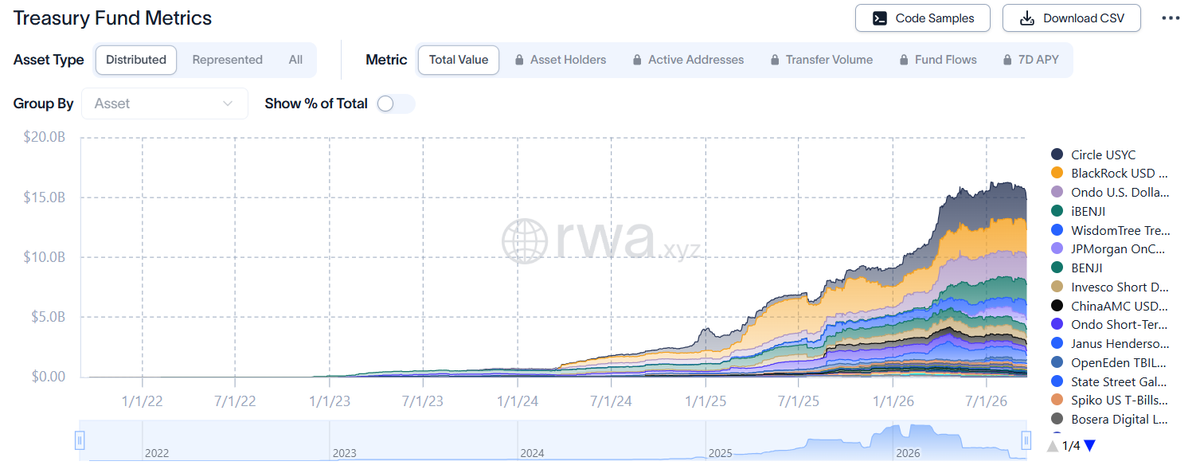
These products are attractive for a simple reason: they combine a familiar underlying asset with blockchain-based access. A tokenized Treasury product can offer exposure to short-duration government securities, a digital record of ownership, potentially faster transfers, use as collateral in blockchain-based markets, integration with decentralized applications, and automated distribution or settlement features.
The demand is also supported by the rate environment. Higher rates make Treasury bills more attractive because their yields are no longer negligible; tokenization then adds a new distribution and settlement layer to an asset investors already understand. This is an important difference from earlier crypto narratives. The buyer is not necessarily betting that an untested token will rise; the buyer may simply be seeking a familiar yield-bearing asset in a digital format.
These products are not risk-free, however. Their risks include issuer risk, custody risk, smart-contract risk, redemption restrictions, settlement delays, and differences between the token and the underlying fund, and some are available only to eligible investors or in specific jurisdictions. The market’s rapid growth should be read as evidence of product-market fit, not as proof that every tokenized fund is equally safe or liquid.
Stablecoins are becoming the settlement layer
Stablecoins are another major reason tokenization is progressing. As of September 19 at 14:30 UTC, RWA.xyz showed approximately $304.55 billion in stablecoin value, with USDT at about $193.6 billion, USDC at roughly $73 billion, and several other large dollar-linked assets.
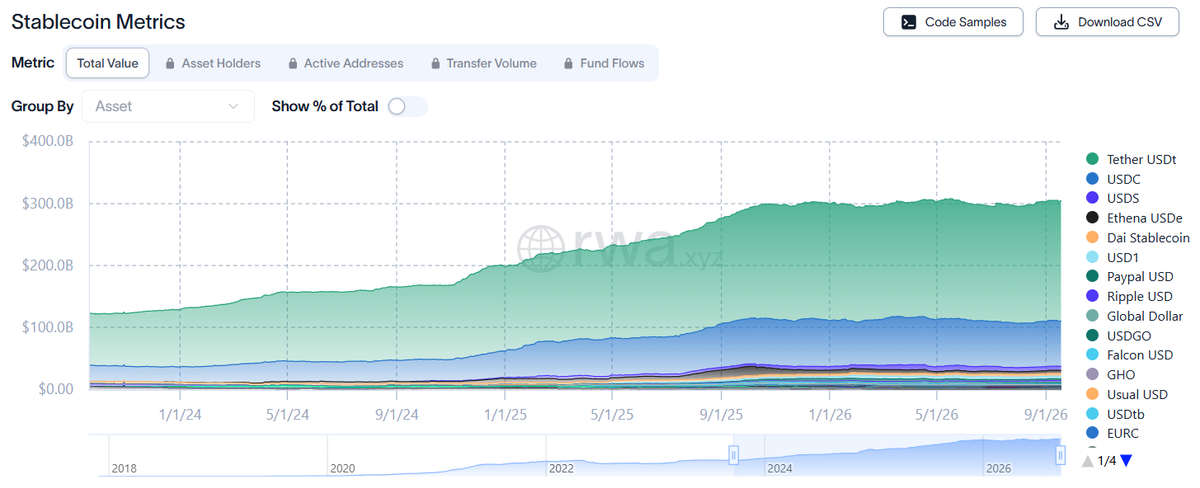
Stablecoins are not simply another crypto sector; they function as the settlement layer for much of the digital-asset economy. Users employ them to move dollar exposure between exchanges, settle trades on decentralized platforms, transfer value across borders, provide collateral for lending and derivatives, pay for digital services, and hold a dollar-linked asset outside traditional banking hours.
The scale of stablecoins gives tokenized assets a ready-made monetary rail. A tokenized bond or Treasury fund becomes more useful when users can buy and sell it with a liquid digital dollar; conversely, stablecoins become more useful when they can interact with yield-bearing assets and regulated investment products.
That creates a reinforcing cycle: stablecoins provide digital liquidity, tokenized assets provide investment and collateral opportunities, applications connect the two, and more users create demand for infrastructure, custody and compliance services. That cycle helps explain why tokenization can continue even when speculative trading slows.
Stablecoins carry their own risks. Supply is concentrated among a small number of issuers, and users remain exposed to reserve management, redemption, regulatory and operational risks. A stablecoin’s stability depends on the quality of its backing, the reliability of redemption arrangements and confidence in its issuer.
Institutional participation is widening
Institutional involvement is becoming more visible across the market. Large asset managers, banks, custodians and fintech platforms are testing products linked to government debt, funds, equities, private credit and commodities; RWA.xyz’s asset list includes tokenized stocks, credit instruments, private-equity products, gold-backed tokens and real-estate-related products.
The institutional case is built around operational benefits: faster settlement, fewer reconciliation steps, shared records among authorized participants, automated compliance controls, fractional ownership, programmable transfers, extended trading hours and easier integration with digital collateral.
Traditional markets often rely on multiple databases. A single trade may pass through brokers, clearing systems, custodians, transfer agents and fund administrators, each maintaining its own records. A shared ledger cannot solve every problem, particularly legal and regulatory ones, but it can reduce the need for every participant to reconcile separate records manually.
The strongest institutional use cases are therefore likely where settlement is slow, assets are hard to divide, collateral moves inefficiently, or investors need access outside normal trading hours: private credit, fund shares, Treasury products, trade finance and certain forms of collateral management. The transition will not happen overnight; institutions must manage privacy, cyber risk, integration costs, investor protection and compliance, and decide whether a public blockchain, private network or hybrid model best suits each product.
Still, the direction is becoming clearer: institutions are treating blockchain less as a replacement for finance and more as a possible upgrade to financial-market plumbing.
Liquidity remains the biggest test
The market has made real progress in issuing assets. Its next challenge is proving those assets can trade efficiently.
A token can be issued in seconds, but that does not guarantee an active market. Many tokenized products have limited secondary trading, restricted investor access, or redemption rules that prevent continuous liquidity.
This is the liquidity gap: the difference between having a token and having a deep market for it. A tokenized Treasury fund may have a clear redemption mechanism and strong demand; a tokenized private-credit position may be harder to trade because the underlying loans are illiquid; a tokenized real-estate interest may still depend on legal documents, valuations, local regulations, and a limited pool of buyers.
The sector must therefore move beyond issuance statistics. The metrics that matter include daily and monthly trading volume, bid-ask spreads, the number of active buyers and sellers, redemption time, cross-platform transferability, collateral acceptance, the number of independent market makers, and the share of holders that actively transact.
Holder counts, in particular, need careful interpretation. One user may control several wallets, while one institutional holder may represent many underlying investors, so a high holder count does not necessarily mean high liquidity.
The market also faces fragmentation: a product issued on one network may not transfer easily to another, compliance rules may restrict movement, and bridges introduce technical and security risks. This is why the next phase of tokenization will likely focus less on launching new products and more on connecting existing ones.
The risks behind the tokenization boom
The tokenization thesis is powerful, but it is neither inevitable nor risk-free. The main risks define the conditions required for the sector to mature:
Legal ownership
A token may represent direct ownership, an indirect entitlement, or only synthetic exposure. Investors need to know which they are buying.
Custody
The underlying asset may sit with a bank, broker, fund administrator, or special-purpose vehicle; failure of that intermediary can create losses even if the blockchain operates normally.
Smart-contract risk
A coding error or exploit can affect transfers, redemptions, or ownership records. Audits reduce this risk but do not remove it.
Liquidity risk
A product may trade around the clock in theory yet lack buyers under stress. Continuous availability is not the same as continuous liquidity.
Regulatory risk
Rules differ by country, asset class, and investor category; a product available in one jurisdiction may be restricted in another.
Concentration
A large share of tokenized value remains tied to dollar instruments, government debt, and a small group of issuers, which creates systemic and operational risk.
What investors should watch next
The next stage of the market will be determined by usage rather than headlines. Five indicators are worth tracking.
First, whether tokenized RWA value keeps growing after adjusting for asset-price changes; rising prices can inflate market value without new capital entering.
Second, whether growth expands beyond government securities and stablecoins. Private credit, equities, commodities, and real estate will show whether tokenization is becoming a broad market structure rather than a Treasury distribution channel.
Third, secondary-market activity. More issuance is not enough if products sit idle after launch.
Fourth, the legal structure of each product. The same label, “tokenized stock” or “tokenized bond,” can describe very different rights.
Fifth, whether blockchains become connected to traditional settlement systems. The real advantage may come not from one chain dominating all assets, but from interoperability among regulated issuers, custodians, stablecoins, and trading venues.
Broader context
Crypto is not ignoring rates or regulation. Those forces still influence prices, liquidity, and confidence. But tokenization is making the industry less dependent on the old cycle in which everything rose or fell with speculative demand and expectations of monetary easing.
The Federal Reserve’s decision to raise rates to 3.75%–4% created a clear macroeconomic headwind, and the CLARITY Act’s stall left the regulatory framework unsettled, yet neither stopped the development of tokenized financial products. The reason is straightforward: tokenization is increasingly being used to provide access to familiar assets, move digital dollars, manage collateral, and improve settlement. That utility can survive periods when speculative appetite weakens.
The market still has to prove that tokenized assets can deliver deep liquidity, clear legal ownership, and reliable redemption. Until then, issuance growth should be treated as an important signal, not a final verdict. But the direction is difficult to dismiss.
Tokenization is gradually becoming a financial-infrastructure story, and infrastructure tends to develop for reasons that extend beyond the next rate decision or legislative vote.
Also Read: Clarity Act Is Effectively Dead for 2026 — So Who Actually Regulates Crypto Now