
Bitcoin’s September climb and Ethereum’s stronger monthly advance pulled most crypto-linked equities higher after a turbulent summer, though performance diverged sharply across proxies, exchanges, miners, and stablecoin issuers. Strategy Inc. (MSTR) delivered the standout gain near 30%, while Circle Internet Group (CRCL) closed the month in the red.
The broader group, Coinbase (COIN), Robinhood (HOOD), MARA Holdings (MARA), IREN Limited (IREN), Bitmine Immersion Technologies (BMNR), and American Bitcoin Corp (ABTC), mostly finished positive, reflecting renewed risk appetite once Bitcoin stabilized above key levels and institutional flows returned.
Investors continue to treat these equities as regulated proxies for digital-asset exposure. When Bitcoin and Ethereum rise, leveraged or high-beta names such as MSTR amplify the move; when trading volumes or stablecoin activity lag, pure-play revenue businesses can underperform even in a rising crypto market.
The crypto backdrop: Bitcoin and Ethereum stabilize and advance
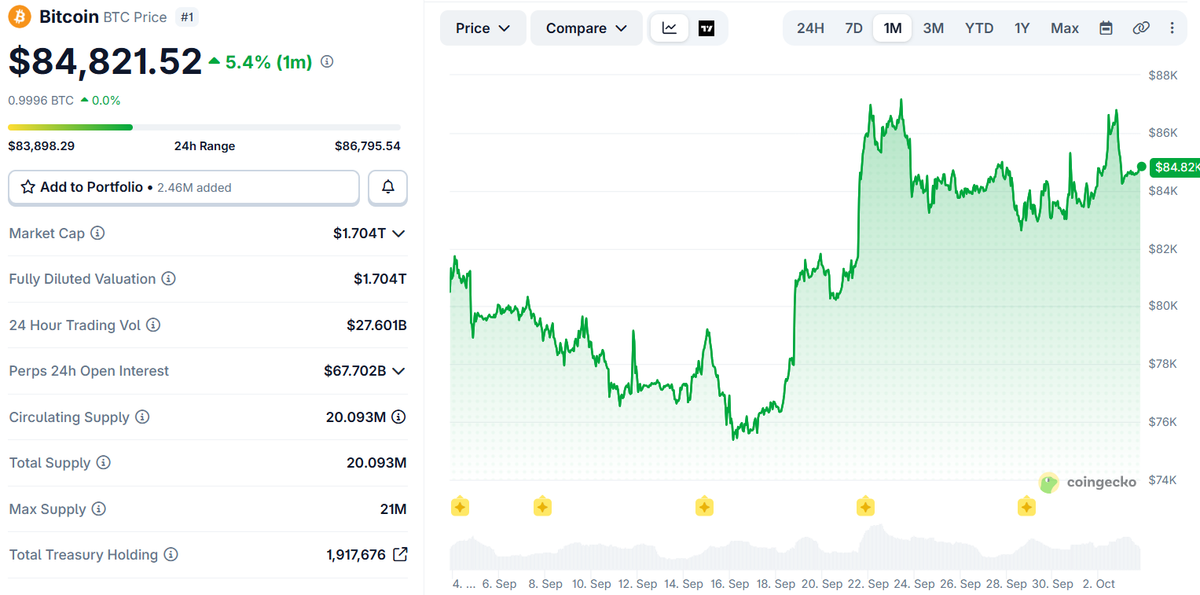
Bitcoin entered September after a turbulent summer. The month opened in the high-$70,000s and, around mid-month, slid to an intra-month low of roughly $74,900 on September 15, a move that coincided with the Federal Reserve’s September 16 rate decision and broader risk-off pressure. From that low, Bitcoin staged a decisive recovery, reclaiming $80,000 and then pushing to a monthly high of about $87,100 on September 21. Bitcoin traded near $84,822, up about 5.4% over the trailing month, with a market capitalization around $1.70 trillion, notably turning a historically weak “red September” green, according to data from CoinGecko (on October 3 at 16:00 UTC).
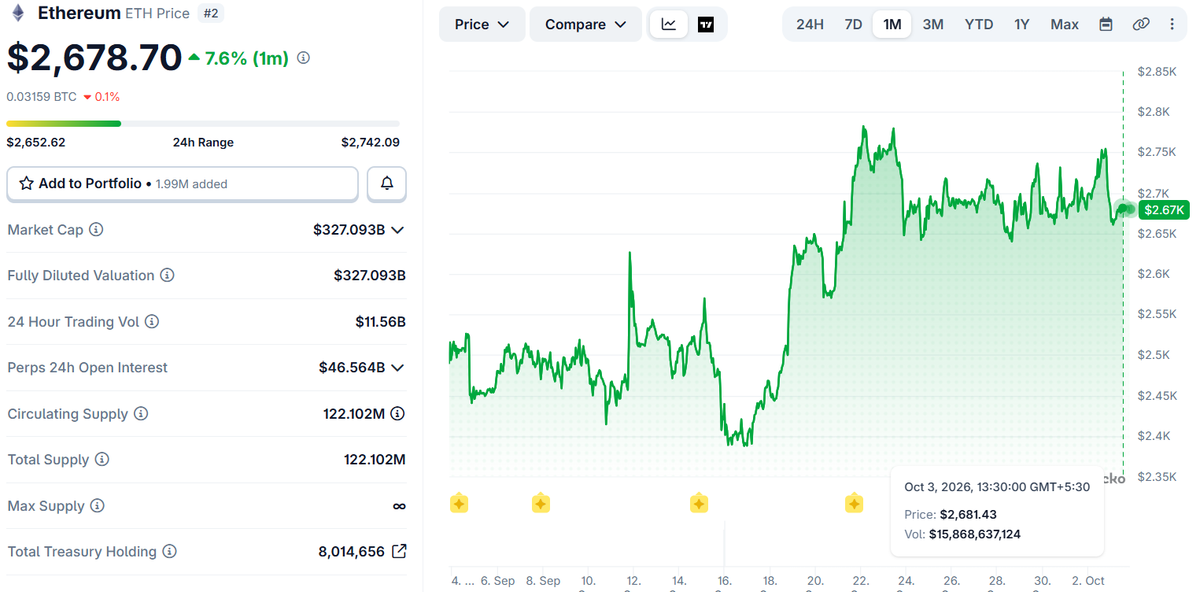
Ethereum outperformed Bitcoin on a percentage basis, rising approximately 7.6% over the same period and trading near $2,679 by early October. The ETH advance was supported by renewed ETF inflows, improving on-chain activity, and broader altcoin rotation once Bitcoin’s direction stabilized. Total crypto market capitalization recovered toward the high-$2 trillion range during the strongest sessions, according to data from CoinGecko (on October 3 at 16:00 UTC).
Key catalysts included strong spot Bitcoin ETF demand, net inflows of about $2.65 billion across September’s 21 trading days, including a near-record single day of roughly $999 million on September 21 (the same session as Bitcoin’s monthly high), short-covering that fueled the rapid move off the mid-$70,000s, and a more constructive reading of regulatory developments around tokenized securities.
Volatility remained elevated, Treasury yields rose, and oil prices spiked at points, but the net effect was a constructive close to the third quarter for the two largest digital assets. Crypto equities, which often move with higher beta, largely followed the recovery while showing wide company-specific dispersion.
Strategy Inc (MSTR): The Bitcoin proxy delivers the month’s biggest gain
No publicly traded company is more tightly linked to Bitcoin’s price action than Strategy Inc. Its large treasury holdings turn the equity into a leveraged vehicle for Bitcoin exposure. When Bitcoin advanced from the mid-month lows into the mid-$80,000s, MSTR amplified the move.
According to data from Yahoo Finance (on October 3 at 16:00 UTC), the stock rose approximately 29.9% over the trailing month, finishing near $160.01 on October 3, the strongest performance among the major crypto equities and well ahead of Bitcoin’s own ~5.4% gain. Early-period pressure gave way to a steep climb once Bitcoin reclaimed $80,000 and institutional demand returned, lifting MSTR above $170 at its late-September peak before it settled around $160. Volume expanded during the advance, consistent with both momentum buying and recognition of the company’s continued accumulation strategy.
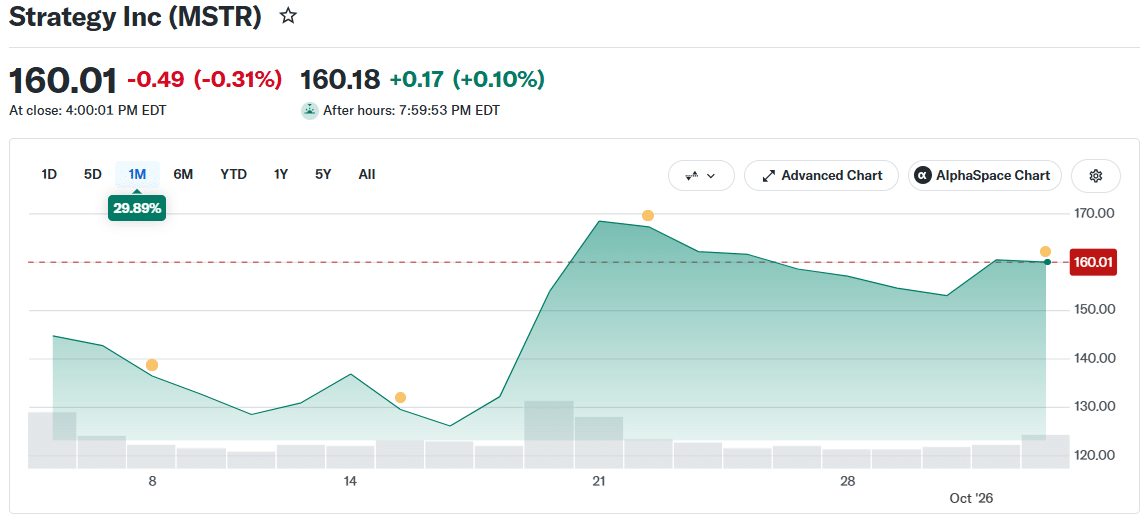
MSTR remains sensitive to Bitcoin’s direction, preferred-stock funding dynamics, and any shifts in its treasury approach. The month demonstrated the upside of that sensitivity after the losses seen earlier in the year. The stock’s outperformance relative to Bitcoin itself underscores the leverage embedded in the business model when the underlying asset is rising.
Coinbase (COIN): Trading activity stabilizes but gains remain modest
Coinbase’s revenue remains closely tied to trading volumes and institutional activity. Higher Bitcoin and Ethereum prices typically encourage greater retail and institutional participation, supporting fee income. Over the past month, the stock advanced roughly 4.6%, finishing near $183.00 after a mid-month recovery from lower levels, according to data from Yahoo Finance (on October 3 at 16:00 UTC).
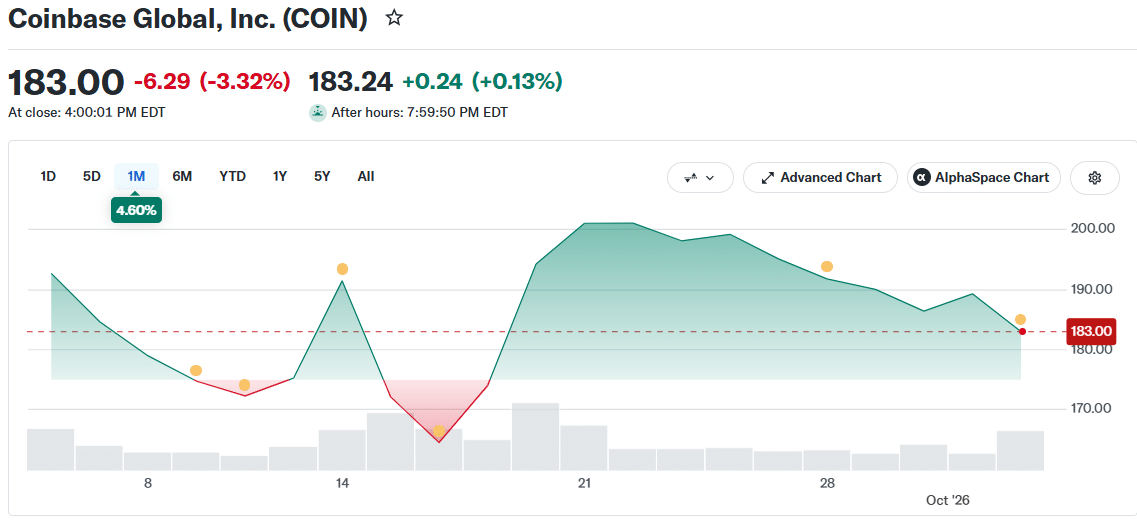
The chart shows an early dip, a sharp mid-month rebound that coincided with Bitcoin’s reclaim of $80,000 (COIN pushed above $200 at its late-September peak), and then a gradual pullback into early October as prices consolidated and a soft September U.S. jobs report weighed on risk sentiment. While COIN participated in the broader recovery, its percentage gain lagged the purest Bitcoin proxies, reflecting a more measured improvement in trading volumes relative to the outright price move in the underlying assets.
Product expansion, derivatives activity, and any progress on tokenized securities or broader “everything exchange” initiatives remain medium-term drivers. The month’s result suggests that volume recovery is underway but not yet explosive enough to produce outsized equity gains when Bitcoin’s move is orderly rather than parabolic.
Circle Internet Group (CRCL): Stablecoin headwinds persist
Circle, issuer of the USDC stablecoin, faced a different set of pressures. Stablecoin-linked valuations depend on circulating supply growth, reserve income, transaction volumes, and competitive positioning rather than direct beta to Bitcoin’s price. Over the past month, CRCL was the clear underperformer, declining approximately 8.3% and closing near $81.25, according to data from Yahoo Finance (on October 3 at 16:00 UTC).
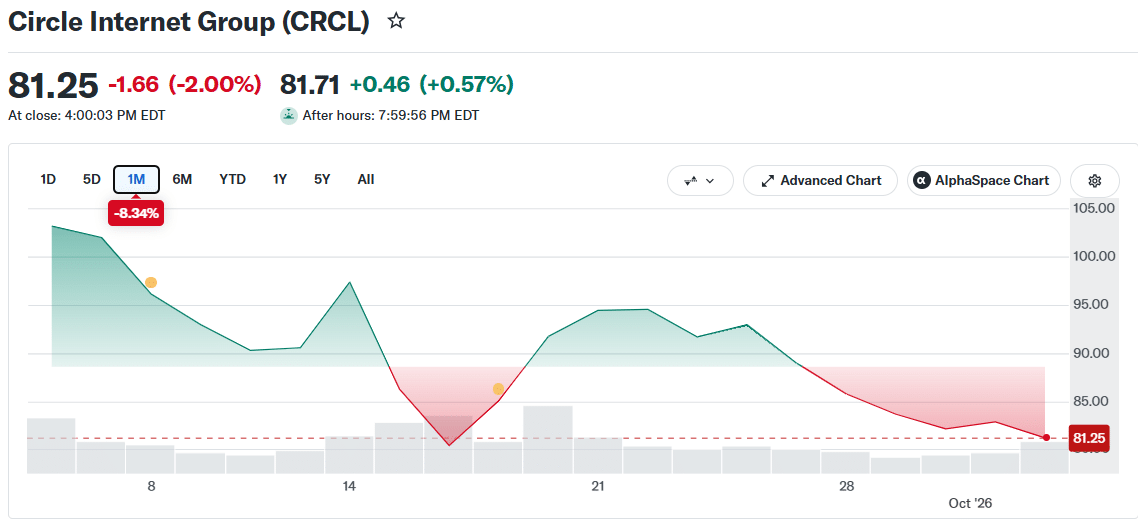
The chart reveals a steady erosion from early-period highs above $100, a mid-month attempt at stabilization, and then renewed weakness into the close. Slower-than-expected growth in USDC circulation, softer DeFi activity, and intensifying competition among dollar-pegged stablecoins, including yield-bearing alternatives and the prospect of bank-issued tokens under the new GENIUS Act framework, can weigh on the multiple even when crypto prices are rising.
Circle’s performance highlights that not every crypto-adjacent business benefits equally from a Bitcoin rebound; revenue quality and growth trajectory remain the primary valuation drivers for the stock.
Bitmine Immersion Technologies (BMNR): The Ethereum proxy delivers strong gains
Unlike pure Bitcoin miners, Bitmine Immersion Technologies has repositioned itself as the world’s largest corporate Ethereum treasury. The company holds more than 6 million ETH, and the second-largest crypto treasury of any public company behind only Strategy’s Bitcoin, and stakes the bulk of it through its MAVAN validator network to earn yield. (Its “Immersion” name reflects its origins in immersion-cooled Bitcoin mining; Ethereum itself is not mined but staked under proof-of-stake). That structure makes the equity behave like a leveraged ETH proxy, led by chairman Tom Lee’s stated goal of maximizing ETH-per-share.
Over the past month, as Ethereum rose approximately 7.6%, BMNR amplified that move and climbed roughly 13.9%, finishing near $26.27, according to data from Yahoo Finance (on October 3 at 16:00 UTC). The chart shows a clear mid-month surge that tracked ETH’s recovery off its lows, followed by consolidation that still left the stock with a solid double-digit advance.
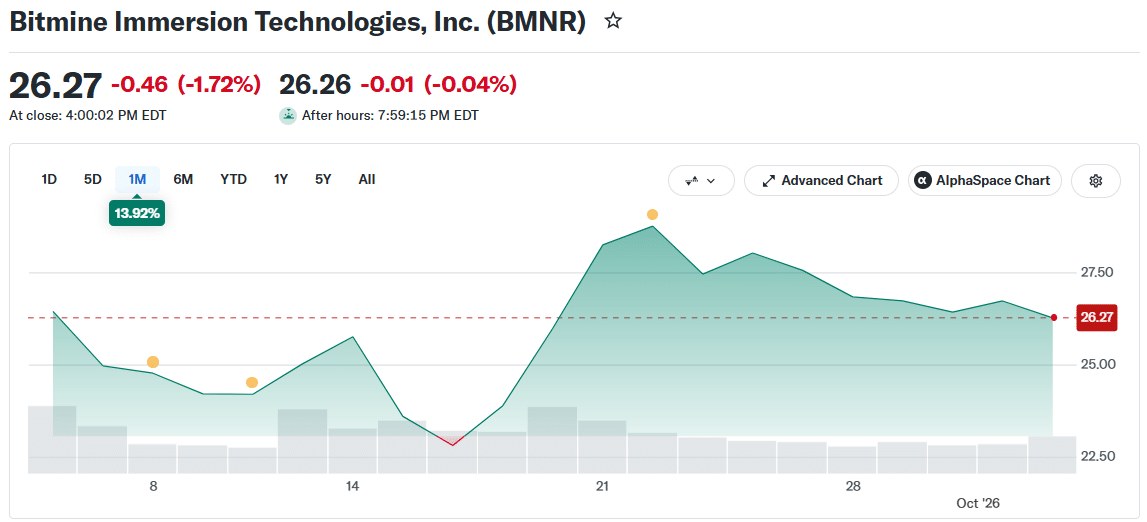
Because BMNR’s value is tied largely to its Ethereum holdings and staking operations, its share price is more sensitive to Ethereum’s direction, staking yields, network activity, and the market’s willingness to pay a premium over net asset value than to Bitcoin’s price alone. The month illustrated this relationship clearly: when ETH strengthened, BMNR delivered one of the stronger performances in the broader crypto-equity group, trailing only Strategy (MSTR) and Bitcoin-treasury peer Nakamoto Inc. (NAKA) on a percentage basis.
Mining and infrastructure: MARA and IREN advance, ABTC recovers
Bitcoin miners and related infrastructure companies operate capital-intensive businesses whose profitability is highly sensitive to Bitcoin price, energy costs, and hashrate efficiency. When Bitcoin rises while costs remain relatively stable, margins expand and equity valuations typically re-rate higher.
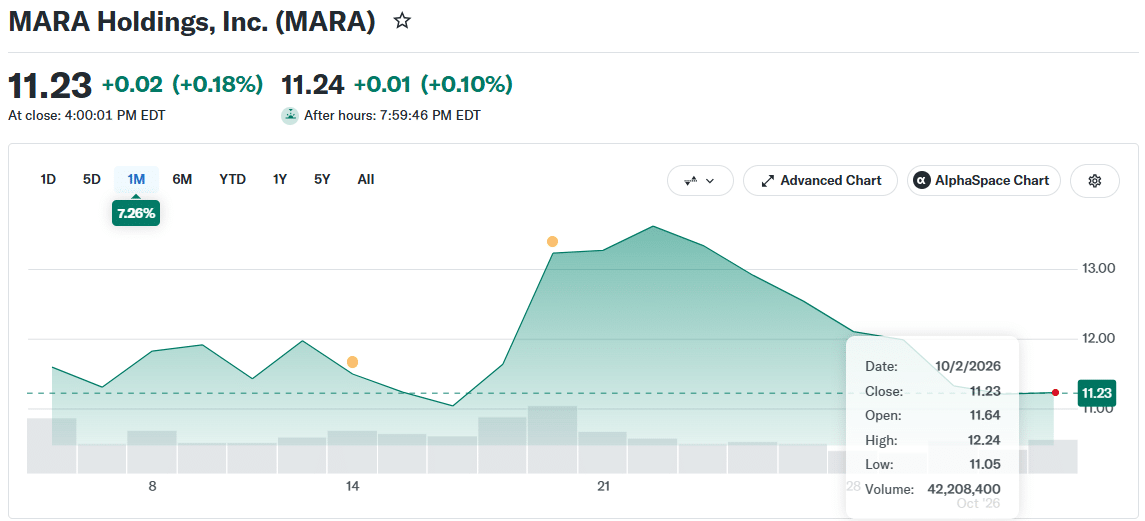
MARA Holdings (MARA) advanced roughly 7.3% to finish near $11.23, according to data from Yahoo Finance (on October 3 at 16:00 UTC). As one of the larger publicly traded miners, MARA benefited from the Bitcoin recovery and its substantial holdings of mined Bitcoin. The chart displays a clear mid-month surge followed by consolidation, consistent with the broader sector pattern. Liquidity and scale provided a degree of resilience relative to smaller peers.
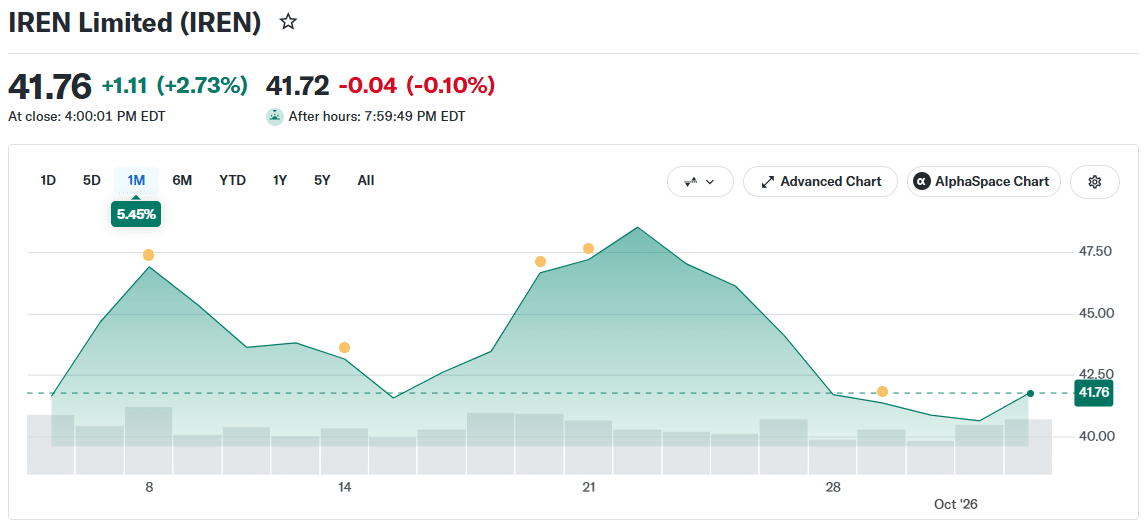
IREN Limited (IREN) gained approximately 5.5%, ending near $41.76, according to data from Yahoo Finance (on October 3 at 16:00 UTC). IREN continues to diversify into high-performance computing and AI-related infrastructure alongside its mining operations. The dual exposure offered some insulation, and the stock participated in the recovery without the extreme volatility seen in pure-mining names earlier in the year. The chart shows an early-period peak, a mid-month re-acceleration, and a controlled pullback into the close.
American Bitcoin Corp (ABTC) posted an approximate 8.1% gain, finishing near $8.51, according to data from Yahoo Finance (on October 3 at 16:00 UTC). Smaller mining-related names often exhibit elevated volatility, and ABTC remains especially jumpy following its 1-for-15 reverse stock split earlier in the year.
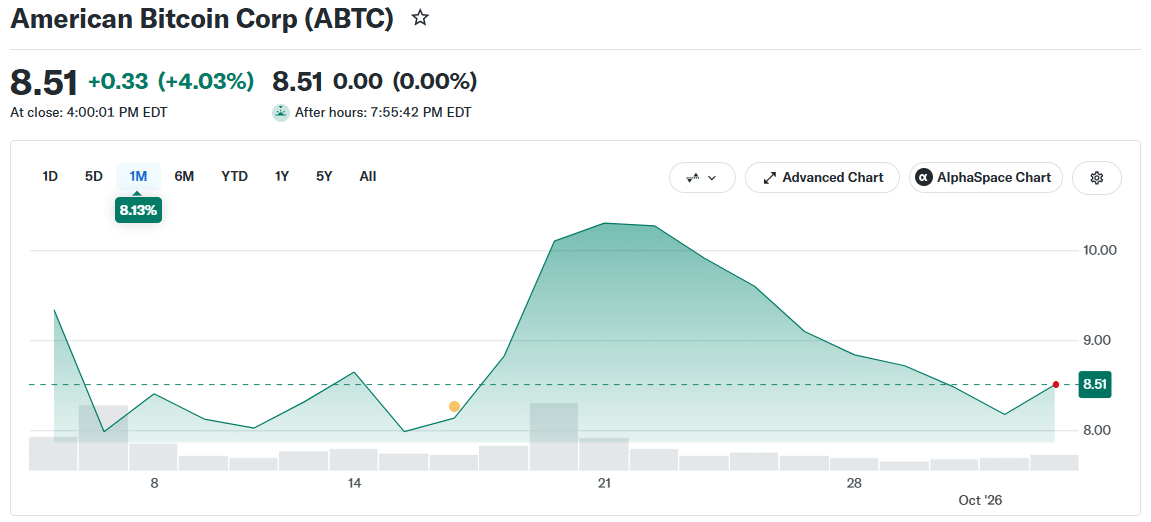
Its chart reflects a mid-month spike higher followed by a gradual decline that still left the stock positive for the period. The recovery from earlier weakness, and any corporate actions or listing-related developments, remain factors for investors to monitor.
Collectively, the mining and infrastructure cohort demonstrated that higher Bitcoin prices translate into equity gains, though the magnitude varies with scale, cost structure, and any non-mining revenue streams.
Robinhood (HOOD): Retail trading platform participates in the rebound
Robinhood benefits from retail engagement with both traditional and crypto assets. Higher crypto prices and renewed risk appetite typically support trading volumes and account activity. Over the past month, HOOD rose approximately 5.4%, closing near $112.74, according to data from Yahoo Finance (on October 3 at 16:00 UTC).
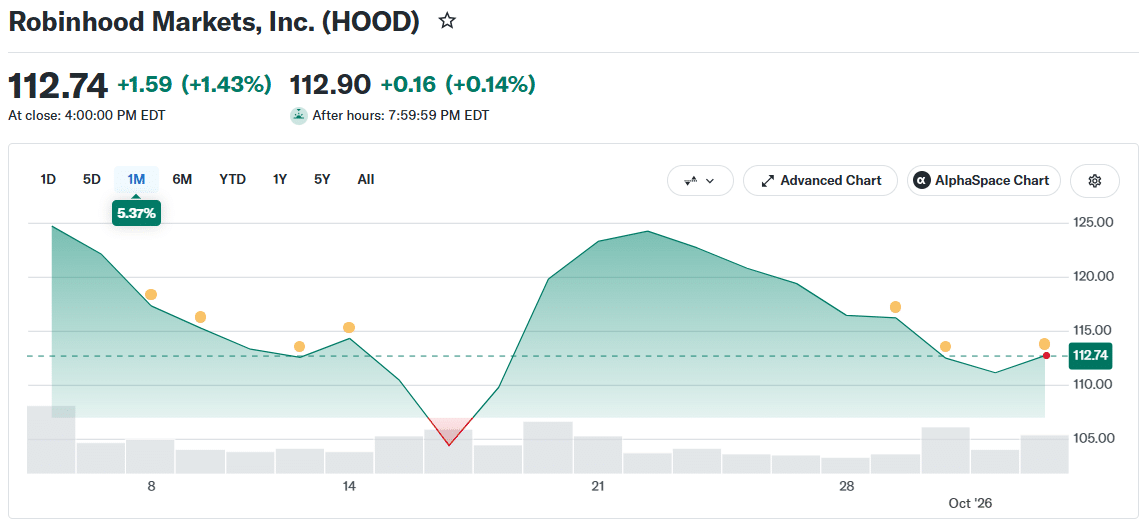
The chart pattern mirrors several peers: early-period softness, a mid-month recovery that tracked Bitcoin’s move higher (HOOD pushed above $125 at its peak), and consolidation into the close. HOOD’s crypto offering and broader platform strategy, including its expansion into derivatives and prediction markets, position it as a hybrid beneficiary of both equity-market and digital-asset sentiment. The gain was solid but not the most aggressive in the group, consistent with a measured rather than euphoric recovery in retail participation.
Other movers in the cohort
Beyond the core names, several related stocks participated in the rebound. According to data from Yahoo Finance (on October 3 at 16:00 UTC), Bitcoin-treasury company Nakamoto Inc. (NAKA) was among the strongest, up about 25.8% to $9.66, second only to MSTR. Among miners, CleanSpark (CLSK) rose about 12.4% to $12.74, Riot Platforms (RIOT) gained about 5.9% to $19.73, and Bitdeer Technologies (BTDR) added about 2.6% to $11.02.
The breadth reinforced the month’s theme: with Bitcoin and Ethereum both higher, nearly the entire crypto-equity complex moved up, with Circle the conspicuous exception.
Performance summary
The results underscore the continued tight linkage between crypto prices and related equities, while also highlighting important differences in business models. Figures are one-month (trailing ~30-day) returns and closing prices as of the October 3, 2026 close.
| Stock Ticker | Approximate September Performance | Closing Level (approx.) | Primary Driver |
|---|---|---|---|
| Strategy (MSTR) | +29.9% | $160 | Direct Bitcoin treasury leverage |
| Nakamoto Inc. (NAKA)+25.8% | +25.8% | $9.66 | Direct Bitcoin treasury strategy |
| Bitmine (BMNR) | +13.9% | $26.27 | Ethereum treasury leverage & staking yield |
| American Bitcoin (ABTC) | +8.1% | $8.51 | Mining recovery |
| MARA Holdings (MARA) | +7.3% | $11.23 | Scale mining + BTC holdings |
| IREN (IREN) | +5.5% | $41.76 | Mining + HPC diversification |
| Robinhood (HOOD) | +5.4% | $112.74 | Retail trading activity |
| Coinbase (COIN) | +4.6% | $183 | Trading volume recovery |
| Circle (CRCL) | –8.3% | $81.25 | Stablecoin growth concerns |
MSTR’s outperformance relative to Bitcoin itself illustrates the leverage inherent in its strategy, and the Bitcoin- and Ethereum-treasury proxies (NAKA, BMNR) likewise amplified their underlying assets. Mining names generally tracked or modestly exceeded Bitcoin’s percentage move. Exchange and brokerage platforms participated but with more muted gains. Circle’s decline stands out as the primary exception, driven by company-specific rather than macro-crypto factors.
What does this mean for the fourth quarter?
The rebound followed a difficult summer. The ability of Bitcoin to hold the low-to-mid $80,000s and of Ethereum to push higher supported a broad recovery in crypto equities. For these stocks to extend gains into the fourth quarter, several conditions appear important.
Bitcoin would benefit from sustained ETF inflows and a decisive move above the recent highs near $87,400. Ethereum’s relative strength could continue if network activity and institutional products keep expanding. Trading-volume recovery at Coinbase and Robinhood will be watched closely as a real-time indicator of retail and institutional engagement. Mining profitability remains sensitive to both Bitcoin price and energy costs; any sustained move higher in the underlying asset should support further equity re-rating for efficient operators.
Conversely, a renewed risk-off environment, whether from higher yields, geopolitical shocks, or regulatory setbacks, would likely pressure the higher-beta names first. Circle’s underperformance serves as a reminder that stablecoin and infrastructure businesses are not pure Bitcoin proxies; their valuations depend on growth metrics that can diverge from price action in the major cryptocurrencies.
Overall, the past month demonstrated that the tight correlation between digital-asset prices and related equities remains intact. When Bitcoin and Ethereum advance with improving flows, most crypto stocks participate, and the purest proxies can significantly outperform. The divergence within the group, particularly Circle’s lag, also shows that company-specific fundamentals continue to matter.
As the fourth quarter begins, the sector enters a more constructive technical and flow environment than it faced over the summer. Whether that environment produces sustained gains will depend on the durability of institutional demand, the path of monetary policy, and the ability of individual companies to convert higher crypto prices into improved operating results.
Also Read: Bitcoin Holders Who Bought Near the Top Are Selling Right Now