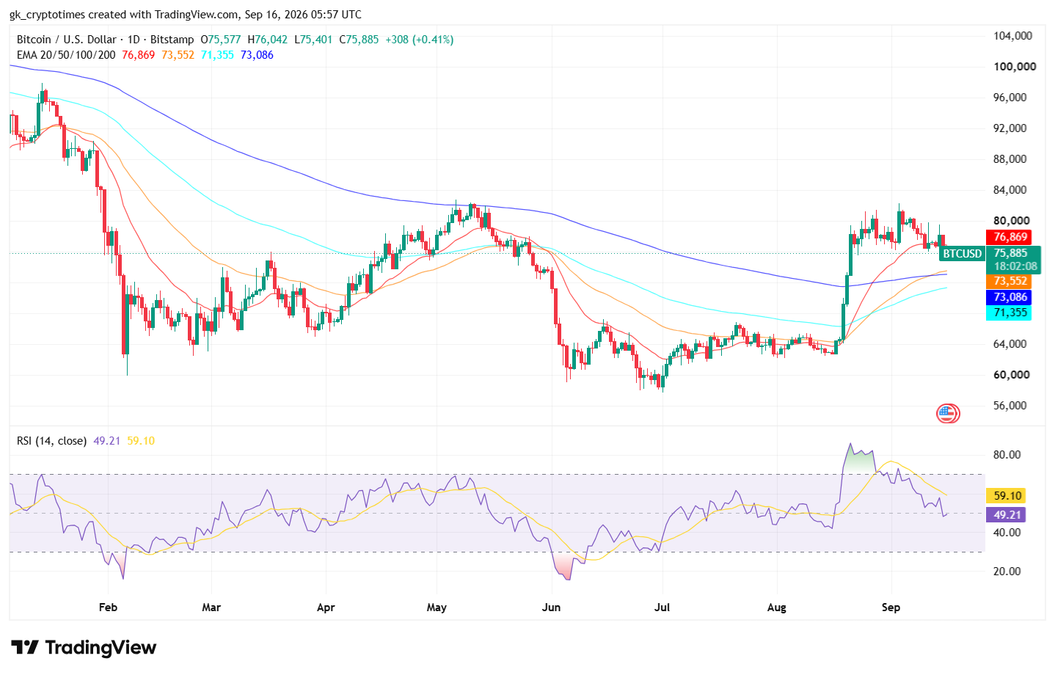
Bitcoin traded near $75,700 early Wednesday as investors waited for a Federal Reserve rate decision later in the day, a day after the Senate failed to advance the Digital Asset Market Clarity Act and after a session that pulled the largest cryptocurrency well below recent highs.
Aggregated market data from CoinGecko showed a September 16 reading of $75,656 (as of 5:55 AM UTC), down roughly 4% from weekly high. The largest cryptocurrency sits at a market capitalization of $1.52 trillion with elevated 24 hours trading volume of $39 billion.
The Crypto Fear and Greed Index stood at 51 (Neutral), after 69 (Greed) a day earlier, 66 last week and 31 last month. The daily gauge weights volatility and momentum most heavily, with smaller shares for social media, Bitcoin dominance and search trends.
Price, Sentiment and a Failed Market-Structure Vote
Bitcoin opened near $78,200 on Tuesday, traded as high as about $78,250, then fell through $76,000 and briefly under $75,000 before buyers returned. Prices clustered in a $75,400–$76,100 band into Wednesday’s early hours—as shown in the TradingView’s year-to-date (YTD) chart.
The same afternoon, the Senate rejected a motion to invoke cloture on the motion to proceed to H.R. 3633, the CLARITY Act. The Senate Daily Press recorded the tally at 49–50. Cloture requires 60 votes. The House-passed bill would assign the Commodity Futures Trading Commission primary oversight of digital commodities and set conditions under which certain tokens could trade outside full Securities and Exchange Commission registration.
The procedural failure leaves U.S. digital-asset market structure unchanged for now. That outcome adds a second source of event risk alongside monetary policy: investors had treated a path to floor debate as a potential catalyst for clearer rules on exchanges, custody and secondary-market trading.
Longer-term Treasury yields stayed elevated. The Treasury’s daily yield curve showed the 10-year note at 4.97 % on September 14, the latest full official print before Wednesday’s FOMC release. Higher yields raise the opportunity cost of holding non-yielding assets such as Bitcoin. Spot Bitcoin exchange-traded funds also recorded recent net outflows in issuer flow tables.
Fed Calendar, Inflation Data and What Comes Next
The Federal Open Market Committee ends a two-day meeting today. The Federal Reserve calendar lists the policy statement at 2:00 p.m. Eastern Time on September 16 and a press conference with Chair Kevin Warsh at 2:30 p.m. September is one of four meetings that include a Summary of Economic Projections and a dot plot of officials’ rate paths.
The current target range for the federal funds rate is 3.50% to 3.75%, last reaffirmed at the July 28–29 meeting. A 25-basis-point increase would lift the range to 3.75% to 4.00%.
Last week’s inflation report remains the public backdrop. The Bureau of Labor Statistics said the Consumer Price Index rose 0.4 % in August after seasonal adjustment and 3.4% over 12 months. The index excluding food and energy rose 0.3 % on the month and 2.4% over the year. Gasoline accounted for more than one-third of the monthly all-items increase.
CME FedWatch, which uses 30-day federal funds futures, has recently implied a high probability of a quarter-point move. Because that binary outcome is largely priced, the statement’s inflation language, the balance of risks and the updated dots are likely to matter more than the decision itself.
Bitcoin has often shown large five-minute swings around FOMC releases, with no consistent direction. Liquidity typically thins before 2:00 p.m. Eastern, then expands as algorithms parse the text. Minutes of this meeting are due October 7. The CLARITY Act remains on the Senate calendar after the failed cloture vote; any later motion to reconsider would be a separate legislative step.
As of 05:55 UTC on September 16, both the rate announcement and any further congressional action were still ahead. Prices, yields and sentiment can change quickly once the statement and press conference are public.
Also read: Former CFTC Chair Says SEC & CFTC Will Write Crypto Rules After CLARITY Act Fails