Key Highlights
- Senate Republicans rejected a late Democratic counterproposal hours before the initial vote on comprehensive crypto market structure legislation.
- The CLARITY Act needs 60 votes to invoke cloture and advance to formal Senate floor debate.
- Republicans said their latest text included 126 substantive changes requested by Democrats, including revisions on ethics and software developer protections.
Hours before the Senate’s initial procedural vote on comprehensive cryptocurrency market structure legislation, Senate Republicans rejected a late counteroffer from Democrats, leaving the measure’s path forward uncertain.
The Senate needs 60 votes to invoke cloture on the motion to proceed to H.R. 3633, allowing the chamber to begin formal floor consideration. Negotiations have lasted more than a year in the Senate and follow more than five years of congressional efforts to pass such legislation. The cloture vote was scheduled for 2:15 p.m.
Republican text and Democratic response
Senate Republicans released updated legislative text on Sunday evening. They stated the draft includes major concessions on ethics provisions, software developer protections, and the agriculture title. It also adds a “circuit breaker” mechanism intended to address concerns that stablecoin yield could prompt deposit withdrawals from community banks. Republicans said the text incorporates 126 substantive changes requested by Democrats.
Late Monday, Senate Democrats transmitted a counteroffer responding to the Republican draft. The counteroffer does not seek additional changes to the stablecoin yield provisions, which sources have described as a Republican-only issue.
On ethics, Democrats requested further restrictions on large crypto holdings, holdings by dependent children, and paid crypto promotions. Regarding the Blockchain Regulatory Certainty Act, they sought changes to narrow the provision’s scope and to state affirmatively that it does not modify criminal law. Agriculture title revisions proposed by Democrats include tighter rules on exchanges and conflicts of interest, along with protections for Tribal gaming laws.
Republican reaction
According to a Crypto In America report, Senate Banking Committee spokesperson Jeff Naft said in a statement: “In response to a significant step in their direction, Democrats have chosen to move the goalposts again. Republicans made 126 substantive changes at Democrats’ request, including major changes to address their ethics concerns. Yet we are hearing the same unreasonable asks and the same refusal to take yes for an answer. The final text is public.”
Republicans had described the Sunday evening text as their “last, best and final” offer. White House Crypto Council Executive Director Patrick Witt told Crypto In America on Monday that further changes would be limited. “If there are any changes, we’re talking about punctuation at this point or technical changes,” Witt said. “I view that as definitely a best and final offer.”
Democratic positions and internal dynamics
As earlier reported by The Crypto Times, several Senate Democrats, including Mark Warner of Virginia, Ruben Gallego of Arizona, and Raphael Warnock of Georgia, have stated that the ethics language previously signed off on by President Trump still requires work.
Sen. Elizabeth Warren (D-Mass.) has argued that the ethics language gives the administration too much control over enforcement and leaves loopholes that could allow President Donald Trump to continue profiting from existing crypto interests.
Sen. Catherine Cortez Masto (D-Nev.) has been involved in negotiations over the Blockchain Regulatory Certainty Act. She is reported to be seeking the additional changes to that provision, following earlier concessions that included the removal of explicit criminal protections.
Senator Kirsten Gillibrand of New York has privately urged Democratic colleagues to vote to proceed to the bill so that negotiations can continue on the floor, according to Politico.
Banking industry and White House responses
Eight banking trade groups, including the American Bankers Association and the Independent Community Bankers of America, criticized the new text on Monday. They stated that the deposit-flight circuit breaker “is not a safeguard at all” because it would activate only after substantial deposit movement had already occurred.
The circuit breaker would permit the Treasury secretary to intervene upon evidence of widespread transfers of deposits from community banks to stablecoins. The groups reiterated calls for tighter language on stablecoin rewards to close what they describe as remaining loopholes permitting interest-like payments.
The Council of Economic Advisers released an interactive tool that allows users to examine the deposit-flight argument. The tool builds on earlier CEA analysis that found no meaningful relationship between stablecoin growth and community bank deposit flight.
Witt said Republicans had already addressed banking concerns through measures including the circuit breaker and questioned the continued objections.
Senate vote considerations
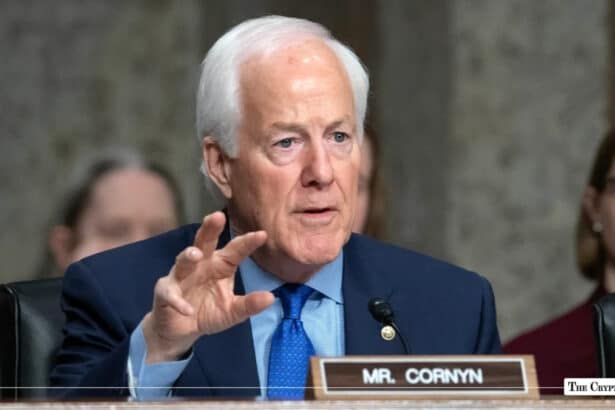
Some Republican senators remain undecided. Senator John Curtis of Utah said he would vote to proceed to the bill but remains opposed to final passage because of banking industry concerns. Senators John Cornyn of Texas and Susan Collins of Maine said they were still evaluating their positions.
Senator Mitch McConnell of Kentucky returned to the Senate on Monday night after a three-month absence. In a post on X, McConnell stated he would do his best to be present for tough votes when needed by the Republican conference.
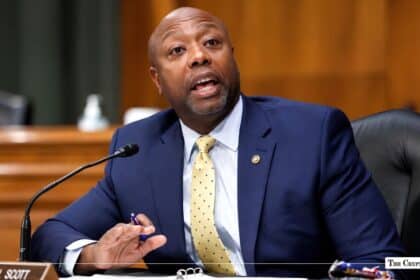
Earlier, Sen. Tim Scott’s office also pushed back after Democrats rejected the Republicans’ latest offer on the CLARITY Act.
Also Read: Cornyn Signals He May Side With Banks as CLARITY Faces 60-Vote Test