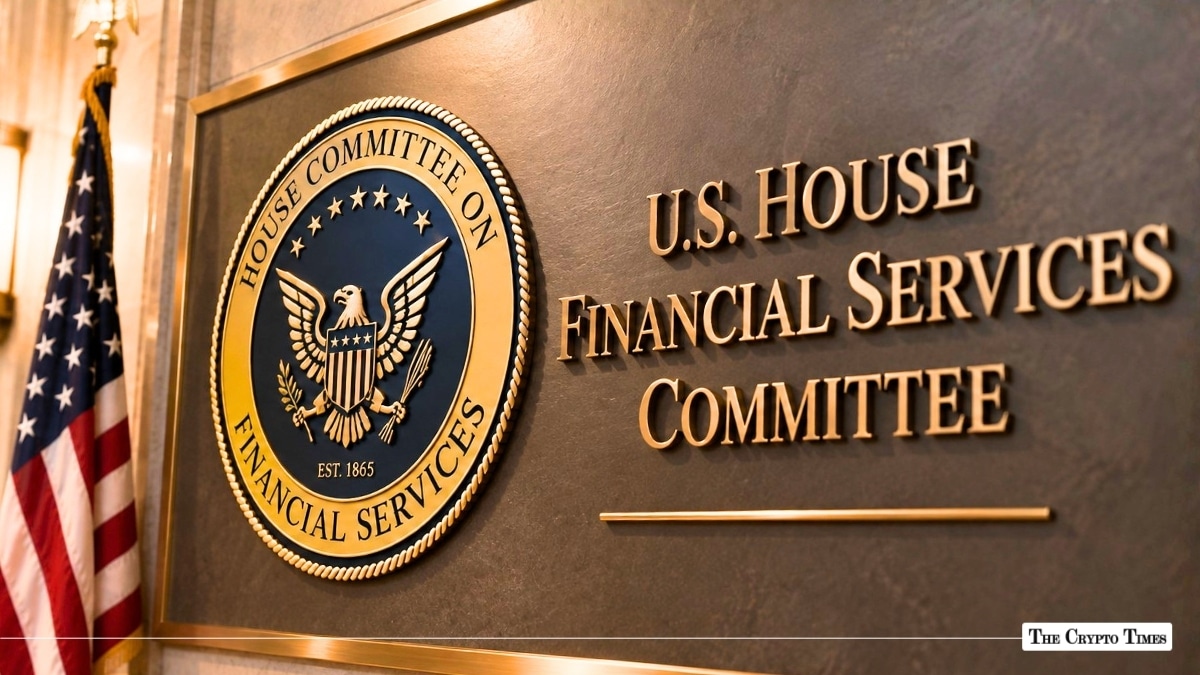
The House Financial Services Committee is set to hold a full-committee markup of H.R. 8957, the American Reserve Modernization Act of 2026, on Wednesday at 10:00 a.m. Eastern Time in Room 2128 of the Rayburn House Office Building.
The markup is listed with other measures on the committee calendar and is not a vote of the full House. The session will produce the first committee vote on a bill designed to write a Strategic Bitcoin Reserve into federal statute, months after President Donald Trump established one by executive order.
A markup is the session where members debate, offer amendments, and vote on whether to send a bill to the full House. According to the committee calendar, the September 16 markup is the first full-committee action on ARMA since Rep. Nick Begich (R-Alaska) introduced the measure on May 21, 2026, with Rep. Jared Golden (D-Maine) as co-lead sponsor. The Crypto Times covered the bill at introduction and again when the full legislative text became public, detailing custody, reporting, and holding-period rules. Primary records are on Congress.gov (H.R. 8957), GovInfo (introduced text), and the committee markup notice.
Cosponsor math heading into Wednesday
Congress.gov lists Begich as sponsor and 23 cosponsors, 21 of them original from May 21. Twenty-two are Republicans, and Golden is the only Democrat. Golden does not sit on the Financial Services Committee. That leaves the committee’s Democratic roster without a listed cosponsor heading into the vote, while six Republican cosponsors are members of the panel.
What the bill would require
According to the bill text published on GovInfo, the American Reserve Modernization Act would move the Strategic Bitcoin Reserve from an executive-branch program into statute.
Trump established the reserve through Executive Order 14233 on March 6, 2025, directing the Treasury Department to retain forfeited Bitcoin as a long-term reserve asset. Codifying the policy means a future administration could not unwind the framework with a new executive order alone.
Under the introduced text, the Treasury would have 180 days after enactment to establish secure storage for the reserve. Federal agencies would have 60 days to provide a full accounting of Bitcoin and other digital assets in their possession, then transfer qualifying holdings once the facility is operational. Qualifying Bitcoin, mainly coins obtained through criminal or civil forfeiture, penalties, and settlements, would be moved into the reserve.
Bitcoin placed in the reserve generally could not be sold, swapped, auctioned, encumbered, or otherwise disposed of for at least 20 years. After that window, later drafts have contemplated limited sales, including a cap of 10 percent of reserve assets in any two years subject to congressional review. The exact post-20-year language could still change if the Steil substitute is adopted.
The Treasury would also publish recurring proof-of-reserve reports covering balances, transactions, and control of private keys, with independent verification. The introduced text called for quarterly public cryptographic attestations, and reporting frequency is one item that could shift in the substitute. Reporting on the posted substitute has described an annual public proof-of-reserve report rather than a quarterly cadence; that language is not final until the committee adopts a text.
The measure directs the Treasury and Commerce departments to study budget-neutral ways to add Bitcoin to the reserve without new taxes, new borrowing, or deficit spending. Paths listed in the introduced text include the conversion of non-Bitcoin stockpile assets, Federal Reserve surplus remittances, and gold-certificate revaluations.
The bill is not a mandate to buy Bitcoin on the open market with appropriated funds. It also does not, in the introduced text, require a fixed purchase target such as 1 million bitcoin. A separate Digital Asset Stockpile would hold federal non-Bitcoin tokens under rules distinct from the 20-year Bitcoin lockup.
Steil substitute could rewrite key clauses
Rep. Bryan Steil, who chairs the Financial Services Subcommittee on Digital Assets, Financial Technology, and Artificial Intelligence, has posted an amendment like a substitute, designated ANS_HR8957, on the committee’s markup notice.
An amendment like a substitute replaces the entire text of the original bill and, if adopted, becomes the base text that members further amend and vote on. Holding-period, audit, acquisition, and reporting-frequency language are the provisions most likely to move through such a substitute.
Where ARMA fits in the broader crypto push
The reserve vote lands alongside Congress’s wider work on federal digital-asset rules. Treasury Secretary Scott Bessent told the Senate Finance Committee on June 3 that the department was proceeding on the reserve at “deliberate speed” and urged lawmakers to advance the Digital Asset Market Clarity (CLARITY) Act, a separate market-structure measure, as The Crypto Times previously reported.
What happens after the committee vote
Committee approval on Wednesday would report ARMA favorably to the House floor. The bill would still need a full House vote, Senate action, and the president’s signature before becoming law.
House members are expected to leave Washington after September 17 until after the November election, making a floor vote this month unlikely even if the committee reports the measure out.
Also Read: White House Puts Stablecoin Yield Ban’s Lending Gain at 0.02% Ahead of CLARITY Vote