Bitcoin mining operators listed on public markets slipped below cash breakeven as a group in the second quarter of 2026. The weighted average pre-tax cash cost to produce one Bitcoin reached about $75,500, while Bitcoin closed the quarter at $58,400. The gap left many firms mining at a loss on a cash basis and prompted some to pay substantial sums to walk away from equipment orders.
The findings come from CoinShares’ latest quarterly mining review, which also recorded a record-low monthly average hash price of $27.7 per petahash per second per day in June.
According to the report, Bitcoin’s network hashrate sat roughly 50% below its longer-term trend after the first six-month decline since China’s 2021 mining ban. Those conditions compressed revenue even as energy and operating expenses remained elevated for much of the listed cohort.
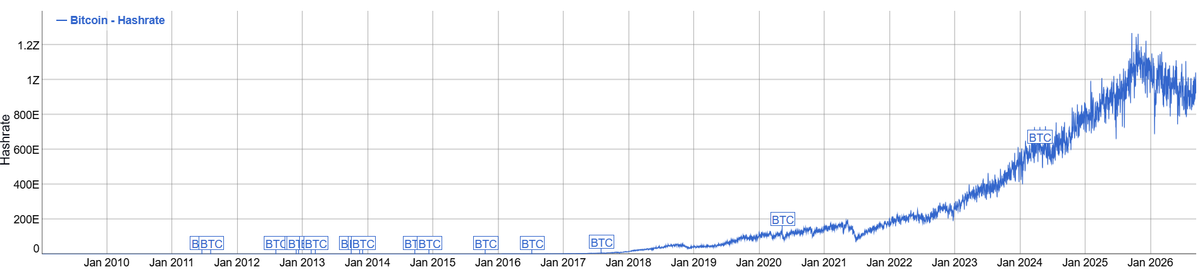
Bitcoin’s network hashrate—as noted in BitInfoCharts data—rose sharply through 2024 and 2025 before topping above 1.2 zettahashes per second in 2026. The metric has since pulled back from that peak but remains near 1 zettahash per second, still close to record levels even as listed miners report cash losses.
Listed miners slip below aggregate breakeven
CoinShares calculated that the listed mining sector as a whole generated less cash from operations than it spent to keep machines running. Individual company costs varied widely. Some operators with lower power contracts or more efficient fleets remained closer to profitability, while others reported production costs well above $100,000 per coin.
The report noted that at least 35 exahashes of capacity are scheduled to leave the public cohort as several firms complete exits or conversions of sites toward high-performance computing.
The pressure is visible in the numbers. Bitcoin’s quarter-end price represented less than half its October 2025 peak of $126,080—as noted in CoinGekco data. As of publishing (1:40 PM UTC), BTC was trading near $76,700 with a market capitalization of $1.54 trillion.
Combined with the hash-price slump, that left miners facing the tightest cash margins since the 2024 halving. Several companies have already shut down or begun winding down remaining self-mining operations, redirecting capital and power toward data-center leases.
Operators pay to cancel next-generation hardware
One of the clearest illustrations of the retreat is Core Scientific’s decision to terminate a large equipment contract. In its Form 10-Q filed with the U.S. Securities and Exchange Commission, the company disclosed that it entered a termination and settlement agreement with Block Inc. and Proto Global LLC. The deal canceled remaining delivery obligations for next-generation mining hardware representing roughly 15 exahashes and produced a $41.9 million loss recorded in the second quarter.
Core Scientific had previously paid deposits totaling tens of millions of dollars under the 2024 purchase agreement. Management tied the cancellation to its broader shift away from self-mining toward high-density colocation for artificial-intelligence customers. Colocation revenue already accounted for the majority of the firm’s second-quarter sales, while self-mining income fell sharply.
The CoinShares report framed the Core Scientific payment as part of a wider pattern: miners are “paying to stop mining.” Other listed names have sold bitcoin reserves, curtailed expansion, or announced complete exits from the activity. Existing energized sites are increasingly viewed as scarce assets because of growing restrictions on new data-center interconnections across multiple U.S. states.
Whether the current squeeze leads to a lasting reduction in network hashrate or simply accelerates the conversion of mining facilities into AI infrastructure remains an open question.
For now, the cash-cost figures and contract-cancellation charges show that a meaningful portion of the public mining sector is operating below water and is willing to absorb one-time losses to leave the business.
Also read: Bitcoin Miner Indicator Triggers Buy Signal After 58.6% Median Returns