
Bloomberg Intelligence senior commodity strategist Mike McGlone outlined several factors pointing to potential weakness in Bitcoin in a September 13, 2026 post, describing the asset as a volatile, speculative instrument now tightly linked to equity markets.
Bitcoin traded near $76,805 on that date according to CoinGecko’s historical data. The analysis centers on Bitcoin’s role as a high-beta proxy for stocks at a time when the S&P 500 sits well above long-term averages and 30-day federal funds futures price additional tightening.
At the time of publishing (6:10 AM UTC, September 15), Bitcoin was trading at $77,640—up over 23% in the last month, as per live market data from CoinGecko.
Bitcoin’s Equity Correlation and Volatility Profile
McGlone noted that Bitcoin’s returns have roughly matched those of the S&P 500 over the past five years while exhibiting nearly three times the volatility. He called the combination unattractive under standard risk-management rules.
The first cryptocurrency, launched in 2009 during the Great Recession, has frequently led risk-asset rallies and, in his view, may now be signaling a reversal. High correlation with the S&P 500 becomes especially relevant when overall market beta declines, he wrote, because Bitcoin now also serves as the reference asset for millions of other cryptocurrencies.
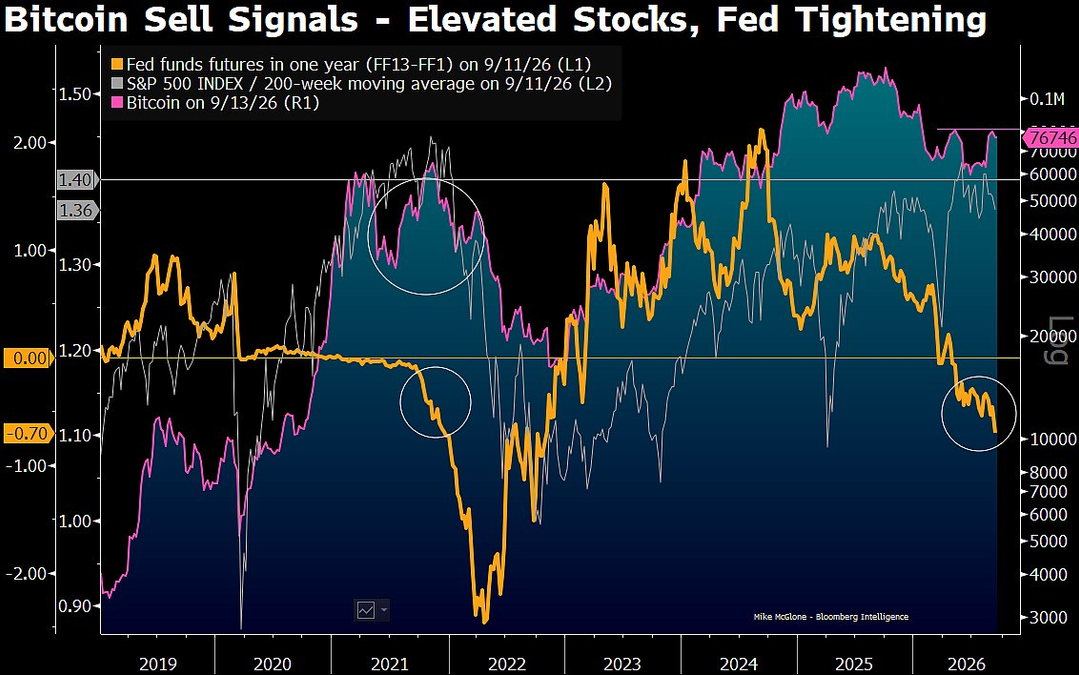
The S&P 500 closed at 7,619.98 on September 14, 2026, per S&P Dow Jones Indices data published through FRED. McGlone’s accompanying graphic showed the index trading well above its 200-week moving average, a stretch he identified as one of three concrete sell signals. That valuation backdrop, combined with Bitcoin’s elevated volatility, reduces its appeal as a diversifier, according to the strategist.
Technical Levels and Policy Pricing as Downside Catalysts
A recent rebound in Bitcoin stalled near $80,000 resistance, according to McGlone. The price action on the chart he published placed Bitcoin around $76,746 on September 13.
Simultaneously, one-year federal funds futures (the FF13-FF1 spread) were pricing approximately 70 basis points of additional rate increases. The Federal Open Market Committee has held the federal funds target range at 3.50–3.75% through mid-2026, per official statements. Futures markets imply a higher path over the coming twelve months.
McGlone grouped these elements—resistance at $80,000, priced tightening, and the S&P 500’s distance from its 200-week average—as the primary reasons Bitcoin could decline. He described the cryptocurrency as fitting a “stock-puppet” category because of its equity correlation, particularly in periods when risk appetite fades. A persistent 20% drawdown in the S&P 500, he added, has historically been sufficient to push Bitcoin toward its longer-term pivot near $10,000.
Historical Pivot and Conditions for Divergence
Bitcoin’s $10,000 level has served as an enduring reference point in McGlone’s work. He argued that a sustained equity correction of that magnitude would likely pull the cryptocurrency lower unless Bitcoin begins to display independent strength that diverges from stocks. The strategist has maintained a cautious stance on the asset for an extended period, emphasizing that its original recession-era narrative has given way to equity-market beta. He made a similar $10,000 reversion case in September 2025, writing on X that “normal reversion in Bitcoin might be toward $10,000” after the asset’s post-recession launch and the subsequent proliferation of other cryptocurrencies.
Contrasting Views from Coinbase and Bitwise
Not every market participant shares McGlone’s $10,000 reversion case. Coinbase CEO Brian Armstrong said in a September 10 Bloomberg Television interview that he believes Bitcoin has already seen the bottom of the current cycle and should trend higher over the next one to two years as the next halving approaches. He has kept a personal longer-term target of BTC price hitting $400,000 by 2030 and stated on X in June that he remains “as bullish as ever on Bitcoin, and still long.” Armstrong frames the asset as digital gold whose four-year cycle, not equity correlation alone, still governs the path.
Similarly, Bitwise CIO Matt Hougan, another renowned analyst, recently predicted that Bitcoin could grow to 25% of the gold market by 2035. In a podcast with VirtualBacon, Hougan walks through Bitwise’s store-of-value model: gold + Bitcoin growing from roughly $30 trillion toward ~$90 trillion by 2035 if gold’s post-2004 ~13% CAGR continues, with Bitcoin taking a 25% share in the base case (~$1.3 million per BTC). He calls that share assumption conservative rather than aggressive.
The timing of these recent views from both the industry leaders sit against McGlone’s emphasis on stock-market beta, priced Fed tightening, and mean reversion toward $10,000. Though McGlone’s assessment does not constitute a forecast of imminent collapse; it identifies conditions under which a larger decline becomes more probable.
Bitcoin would need to hold above recent resistance and decouple from equities to invalidate the setup he described. Until that occurs, the combination of stretched stock valuations, priced monetary tightening, and Bitcoin’s own volatility profile remains the core of the sell-signal case presented by Bloomberg Intelligence.
Also read: Bitcoin Miner Indicator Triggers Buy Signal After 58.6% Median Returns