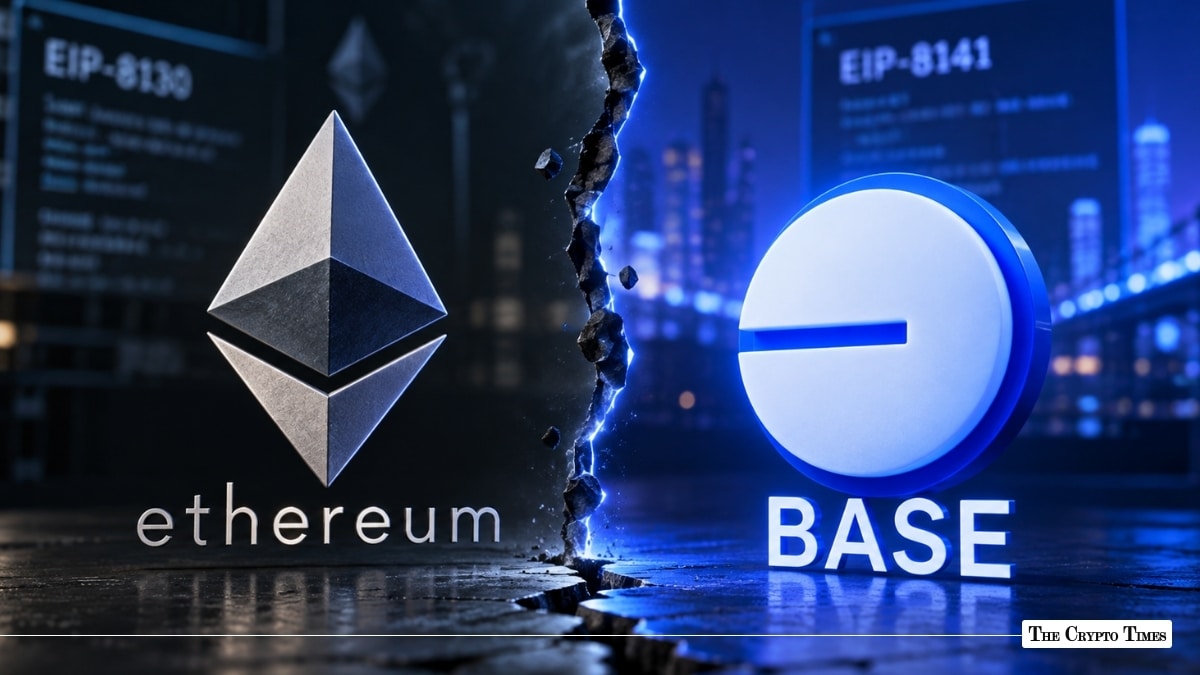
Ethereum and Base developers have called off efforts to produce one shared account abstraction design, Ethlabs researcher Derek Chiang said, and both proposals remain drafts. The split follows differences over how account abstraction should balance scalability, security, and other network priorities.
The collaboration centered on EIP-8130, led by Base, and EIP-8141, Ethereum’s Frame Transactions proposal. Both aim to improve crypto wallets with features such as gasless transactions and passkey-based authentication.
Ethlabs researcher Derek Chiang said on X that the collaboration broke down last week after the two sides failed to agree on a design that met both networks’ goals. Ethereum is focused on censorship resistance, privacy and security, while Base and other Layer 2 networks are more focused on scalability, customization and compliance.
Different priorities
Chiang said Ethereum Layer 1 wants account abstraction to support a highly decentralized network. It also aims to strengthen resistance to censorship and value capture while improving privacy, security and long-term quantum resistance.
Base needs account abstraction that can operate at large scale. It also wants clearer rules around which accounts and transactions can be supported on its network.
“Ethereum wanted to be the best version of Ethereum, and Base wanted to be the best version of Base,” Chiang said.
He added that interoperability was ultimately secondary to each network’s core goals. The teams explored several technical solutions, but each would have required one side to compromise on important objectives.
Two account abstraction designs
EIP-8141, also known as Frame Transactions, is being developed for Ethereum and is scheduled for inclusion in the Hegotá upgrade, targeted for 2027. The proposal would make account abstraction a native part of Ethereum.
It uses programmable frames for transaction validation, gas payment, and execution. The design also supports post-quantum security, native key rotation, and batch transactions. It can also allow users to pay transaction fees through alternative methods without relying on centralized relayers.
The proposal aims to make accounts more flexible by allowing developers to define how transactions are validated and how gas is paid.
EIP-8130, led by Base, takes a different approach. It introduces a new transaction type and an onchain keystore. The proposal supports features such as custom authentication, transaction batching, and gas sponsorship. Base has been testing it on its Vibenet devnet.
The keystore allows accounts to manage their approved authenticators. Transactions also specify which authenticator should be used, allowing networks to check transactions without running arbitrary wallet code.
Both proposals seek to move beyond Ethereum’s traditional externally owned accounts and give users more flexible ways to interact with blockchain applications.
Wallets face new challenge
The split could create more work for wallet developers and applications that support multiple EVM networks.
Chiang said the decision puts the “burden” on wallets to handle the resulting fragmentation. If both standards move forward, wallets may need to support different native transaction formats across Ethereum and Base.
However, Chiang does not necessarily view the split as a negative outcome.
“If reducing fragmentation comes at the cost of homogenizing chains to the point that they fail to solve problems for the users they care about, that would not be a price worth paying,” he said.
He added that wallets and applications could eventually hide these technical differences by supporting the native transaction formats of different chains.
Ethereum’s broader EVM challenge
The disagreement highlights a broader challenge for the Ethereum ecosystem as Layer 2 networks develop their own technical requirements.
Chiang said the EVM has historically helped Ethereum and its Layer 2 networks maintain a common user experience. But as different chains target different use cases, maintaining a single standard could become harder.
He suggested two possible paths. The ecosystem could create a broader coordination system that gives Layer 2 networks more influence over shared EVM standards. Alternatively, developers could accept some fragmentation and build wallets and applications that hide the technical differences from users.
“Ethereum is the art of staying together while remaining different,” Chiang said.
Ethereum and Base are now expected to continue developing their respective account abstraction designs. Wallet and application developers will play a key role in keeping the user experience smooth across both networks.
Also Read: Ethereum Q2 Revenue Jumps 112% as Active Addresses Fall 30%